How the U.S. gave away a breakthrough battery technology to China : NPR

The former UniEnergy Technologies office in Mukilteo, Wash. Taxpayers spent $15 million on research to build a breakthrough battery. Then the U.S. government gave it to China.

Jovelle Tamayo for NPR


hide caption

toggle caption

Jovelle Tamayo for NPR


The former UniEnergy Technologies office in Mukilteo, Wash. Taxpayers spent $15 million on research to build a breakthrough battery. Then the U.S. government gave it to China.

Jovelle Tamayo for NPR

When a group of engineers and researchers gathered in a warehouse in Mukilteo, Wash., 10 years ago, they knew they were onto something big. They scrounged up tables and chairs, cleared out space in the parking lot for experiments and got to work.

They were building a battery — a vanadium redox flow battery — based on a design created by two dozen U.S. scientists at a government lab. The batteries were about the size of a refrigerator, held enough energy to power a house, and could be used for decades. The engineers pictured people plunking them down next to their air conditioners, attaching solar panels to them, and everyone living happily ever after off the grid.

“It was beyond promise,” said Chris Howard, one of the engineers who worked there for a U.S. company called UniEnergy. “We were seeing it functioning as designed, as expected.”

Chris Howard was an engineer at UniEnergy Technologies.

Jovelle Tamayo for NPR


hide caption

toggle caption

Jovelle Tamayo for NPR


Chris Howard was an engineer at UniEnergy Technologies.

Jovelle Tamayo for NPR

But that’s not what happened. Instead of the batteries becoming the next great American success story, the warehouse is now shuttered and empty. All the employees who worked there were laid off. And more than 5,200 miles away, a Chinese company is hard at work making the batteries in Dalian, China.

The Chinese company didn’t steal this technology. It was given to them — by the U.S. Department of Energy. First in 2017, as part of a sublicense, and later, in 2021, as part of a license transfer. An investigation by NPR and the Northwest News Network found the federal agency allowed the technology and jobs to move overseas, violating its own licensing rules while failing to intervene on behalf of U.S. workers in multiple instances.

Now, China has forged ahead, investing millions into the cutting-edge green technology that was supposed to help keep the U.S. and its economy out front.

UniEnergy Technologies and Avista’s solar energy storage system is displayed at an event in 2015.

Office of Gov. Jay Inslee


hide caption

toggle caption

Office of Gov. Jay Inslee


UniEnergy Technologies and Avista’s solar energy storage system is displayed at an event in 2015.

Office of Gov. Jay Inslee

Department of Energy officials declined NPR’s request for an interview to explain how the technology that cost U.S. taxpayers millions of dollars ended up in China. After NPR sent department officials written questions outlining the timeline of events, the federal agency terminated the license with the Chinese company, Dalian Rongke Power Co. Ltd.

“DOE takes America’s manufacturing obligations within its contracts extremely seriously,” the department said in a written statement. “If DOE determines that a contractor who owns a DOE-funded patent or downstream licensee is in violation of its U.S. manufacturing obligations, DOE will explore all legal remedies.”

Several U.S. companies have tried to get a license to make the batteries

The department is now conducting an internal review of the licensing of vanadium battery technology and whether this license — and others — have violated U.S. manufacturing requirements, the statement said.

Forever Energy, a Bellevue, Wash., based company, is one of several U.S. companies that have been trying to get a license from the Department of Energy to make the batteries. Joanne Skievaski, Forever Energy’s chief financial officer, has been trying to get hold of a license for more than a year and called the department’s decision to allow foreign manufacturing “mind boggling.”

Joanne Skievaski is the chief financial officer of Forever Energy in Bellevue, Wash. The company has been trying to get a license from the Department of Energy to make the batteries for over a year.

Jovelle Tamayo for NPR


hide caption

toggle caption

Jovelle Tamayo for NPR
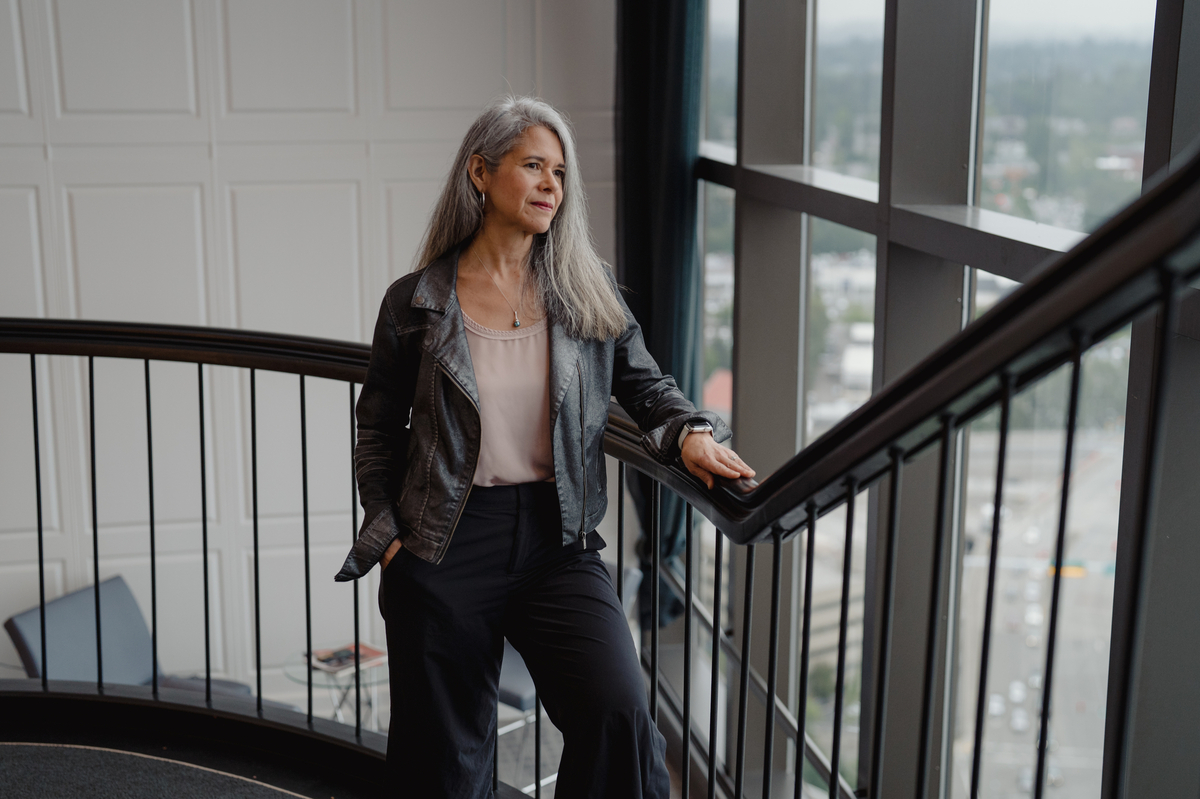

Joanne Skievaski is the chief financial officer of Forever Energy in Bellevue, Wash. The company has been trying to get a license from the Department of Energy to make the batteries for over a year.

Jovelle Tamayo for NPR

“This is technology made from taxpayer dollars,” Skievaski said. “It was invented in a national lab. (Now) it’s deployed in China, and it’s held in China. To say it’s frustrating is an understatement.”

The idea for this vanadium redox battery began in the basement of a government lab, three hours southeast of Seattle, called Pacific Northwest National Laboratory. It was 2006, and more than two dozen scientists began to suspect that a special mix of acid and electrolyte could hold unusual amounts of energy without degrading. They turned out to be right.

It took six years and more than 15 million taxpayer dollars for the scientists to uncover what they believed was the perfect vanadium battery recipe. Others had made similar batteries with vanadium, but this mix was twice as powerful and did not appear to degrade the way cellphone batteries or even car batteries do. The researchers found the batteries capable of charging and recharging for as long as 30 years.

An employee looks at a vanadium flow battery in Pacific Northwest National Laboratory’s Battery Reliability Laboratory in 2021.

Andrea Starr/Pacific Northwest National Laboratory


hide caption

toggle caption

Andrea Starr/Pacific Northwest National Laboratory
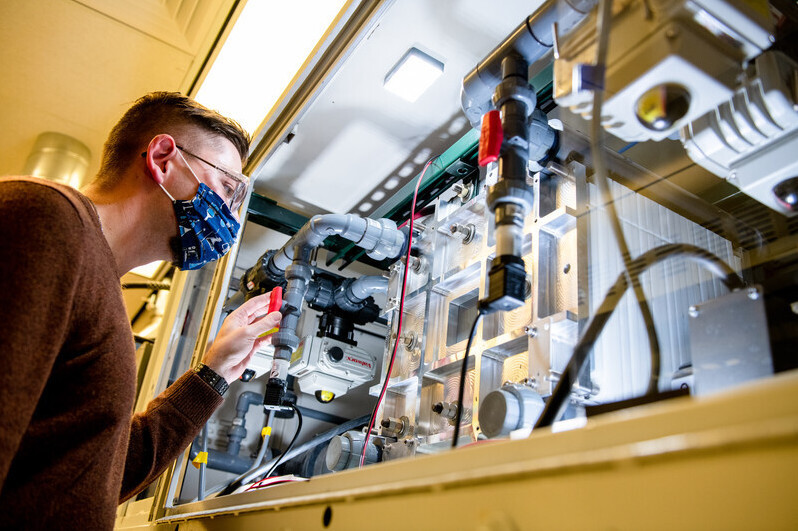

An employee looks at a vanadium flow battery in Pacific Northwest National Laboratory’s Battery Reliability Laboratory in 2021.

Andrea Starr/Pacific Northwest National Laboratory

Gary Yang, the lead scientist on the project, said he was excited to see if he could make the batteries outside the lab. The lab encourages scientists to do just that, in an effort to bring critical new technology into the marketplace. The lab and the U.S. government still hold the patents, because U.S. taxpayers paid for the research.

In 2012, Yang applied to the Department of Energy for a license to manufacture and sell the batteries.

The agency issued the license, and Yang launched UniEnergy Technologies. He hired engineers and researchers. But he soon ran into trouble. He said he couldn’t persuade any U.S. investors to come aboard.

“I talked to almost all major investment banks; none of them (wanted to) invest in batteries,” Yang said in an interview, adding that the banks wanted a return on their investments faster than the batteries would turn a profit.

Imre Gyuk (left), director of energy storage research in the Office of Electricity of the Department of Energy, Washington Gov. Jay Inslee and Gary Yang of UniEnergy Technologies stand together in 2015.

Office of Gov. Jay Inslee


hide caption

toggle caption

Office of Gov. Jay Inslee


Imre Gyuk (left), director of energy storage research in the Office of Electricity of the Department of Energy, Washington Gov. Jay Inslee and Gary Yang of UniEnergy Technologies stand together in 2015.

Office of Gov. Jay Inslee

He said a fellow scientist connected him with a Chinese businessman named Yanhui Liu and a company called Dalian Rongke Power Co. Ltd., along with its parent company, and he jumped at the chance to have them invest and even help manufacture the batteries.

At first, UniEnergy Technologies did the bulk of the battery assembly in the warehouse. But over the course of the next few years, more and more of the manufacturing and assembling began to shift to Rongke Power, Chris Howard said. In 2017, Yang formalized the relationship and granted Dalian Rongke Power Co. Ltd. an official sublicense, allowing the company to make the batteries in China.

Any company can choose to manufacture in China. But in this case, the rules are pretty clear. Yang’s original license requires him to sell a certain number of batteries in the U.S., and it says those batteries must be “substantially manufactured” here.

In an interview, Yang acknowledged that he did not do that. UniEnergy Technologies sold a few batteries in the U.S., but not enough to meet its requirements. The ones it did sell, including in one instance to the U.S. Navy, were made in China. But Yang said in all those years, neither the lab nor the department questioned him or raised any issues.

Chris Howard is now the director of operations at Forever Energy in Bellevue, Wash.

Jovelle Tamayo for NPR


hide caption

toggle caption

Jovelle Tamayo for NPR


Chris Howard is now the director of operations at Forever Energy in Bellevue, Wash.

Jovelle Tamayo for NPR

Then in 2019, Howard said, UniEnergy Technologies officials gathered all the engineers in a meeting room. He said supervisors told them they would have to work in China at Rongke Power Co. for four months at a time.

“It was unclear, certainly to myself and other engineers, what the plan was,” said Howard, who now works for Forever Energy.

Yang acknowledges that he wanted his U.S. engineers to work in China. But he says it was because he thought Rongke Power could help teach them critical skills.

Yang was born in China but is a U.S. citizen and got his Ph.D. at the University of Connecticut. He said he wanted to manufacture the entire battery in the U.S., but that the U.S. does not have the supply chain he required. He said China is more advanced when it comes to manufacturing and engineering utility-scale batteries.

“In this field — manufacturing, engineering — China is ahead of the U.S.,” Yang said. “Many wouldn’t believe [it].”

He said he didn’t send the battery and his engineers abroad to help China. He said the engineers in that country were helping his UniEnergy Technologies employees and helping him get his batteries built.

But news reports at the time show the moves were helping China. The Chinese government launched several large demonstration projects and announced millions of dollars in funding for large-scale vanadium batteries.

As battery work took off in China, Yang was facing more financial trouble in the U.S. So he made a decision that would again keep the technology from staying in the U.S.

The EU has strict rules about where companies manufacture products

In 2021, Yang transferred the battery license to a European company based in the Netherlands. The company, Vanadis Power, told NPR it initially planned to continue making the batteries in China and then would set up a factory in Germany, eventually hoping to manufacture in the U.S., said Roelof Platenkamp, the company’s founding partner.

Vanadis Power needed to manufacture batteries in Europe because the European Union has strict rules about where companies manufacture products, Platenkamp said.

“I have to be a European company, certainly a non-Chinese company, in Europe,” Platenkamp said in an interview with NPR.

Gary Yang launched UniEnergy Technologies after the Department of Energy issued him a license to manufacture and sell the vanadium batteries.

Jovelle Tamayo for NPR


hide caption

toggle caption

Jovelle Tamayo for NPR


Gary Yang launched UniEnergy Technologies after the Department of Energy issued him a license to manufacture and sell the vanadium batteries.

Jovelle Tamayo for NPR

But the U.S. has these types of rules, too. Any transfer of a U.S. government license requires U.S. government approval so that manufacturing doesn’t move overseas. The U.S. has lost significant jobs in recent years in areas where it first forged ahead, such as solar panels, drones and telecom equipment. Still, when UniEnergy requested approval, it apparently had no trouble getting it.

On July 7, 2021, a top official at UniEnergy Technologies emailed a government manager at the lab where the battery was created. The UniEnergy official said they were making a deal with Vanadis, according to emails reviewed by NPR, and were going to transfer the license to Vanadis.

“We’re working to finalize a deal with Vanadis Power and believe they have the right blend of technical expertise,” the email from UniEnergy Technologies said. “Our transaction with Vanadis is ready to go pending your approval …”

The government manager responded that he needed confirmation before transferring the license and emailed a second employee at UniEnergy. The second employee responded an hour and a half later, and the license was transferred to Vanadis Power.

Whether the manager or anyone else at the lab or Department of Energy thought to check during that hour and a half or thereafter whether Vanadis Power was an American company, or whether it intended to manufacture in the U.S., is unclear. Vanadis’ own website said it planned to make the batteries in China.

In response, department officials said they review each transfer for compliance and said that new rules put in place last summer by the Biden administration will close loopholes and keep more manufacturing here.

But agency officials acknowledged that its reviews often rely on “good faith disclosures” by the companies, which means if companies such as UniEnergy Technologies don’t say anything, the U.S. government may never know.

Joanne Skievaski said she and others from the company repeatedly warned Department of Energy officials that the UniEnergy license was not in compliance.

Jovelle Tamayo for NPR


hide caption

toggle caption

Jovelle Tamayo for NPR


Joanne Skievaski said she and others from the company repeatedly warned Department of Energy officials that the UniEnergy license was not in compliance.

Jovelle Tamayo for NPR

That’s a problem that has plagued the department for years, according to government investigators.

In 2018, the Government Accountability Office found that the Department of Energy lacked resources to properly monitor its licenses, relied on antiquated computer systems, and didn’t have consistent policies across its labs.

In this case, it was an American company, Forever Energy, that raised concerns about the license with UniEnergy more than a year ago. Joanne Skievaski said she and others from the company repeatedly warned department officials that the UniEnergy license was not in compliance. In emails NPR has reviewed, department officials told them it was.

“How is it that the national lab did not require U.S. manufacturing?” Skievaski asked. “Not only is it a violation of the license, it’s a violation to our country.”

Now that the Department of Energy has revoked the license, Skievaski said she hopes Forever Energy will be able to acquire it or obtain a similar license. The company plans to open a factory in Louisiana next year and begin manufacturing. She bristles at the idea that U.S. engineers aren’t up to the challenge.

“That’s hogwash,” she said. “We are ready to go with this technology.”

Still, she says it will be difficult for any American company at this point to catch up. Industry trade reports currently list Dalian Rongke Power Co. Ltd. as the top manufacturer of vanadium redox flow batteries worldwide. Skievaski also worries about whether China will stop making the batteries once an American company is granted the right to start making them.

That may be unlikely. Chinese news reports say the country is about to bring online one of the largest battery farms the world has ever seen. The reports say the entire farm is made up of vanadium redox flow batteries.

This story is a partnership with NPR’s Station Investigations Team, which supports local investigative journalism, and the Northwest News Network, a collaboration of public radio stations that broadcast in Oregon and Washington state.

Holocaust museums use new technology to capture survivors’ stories : NPR

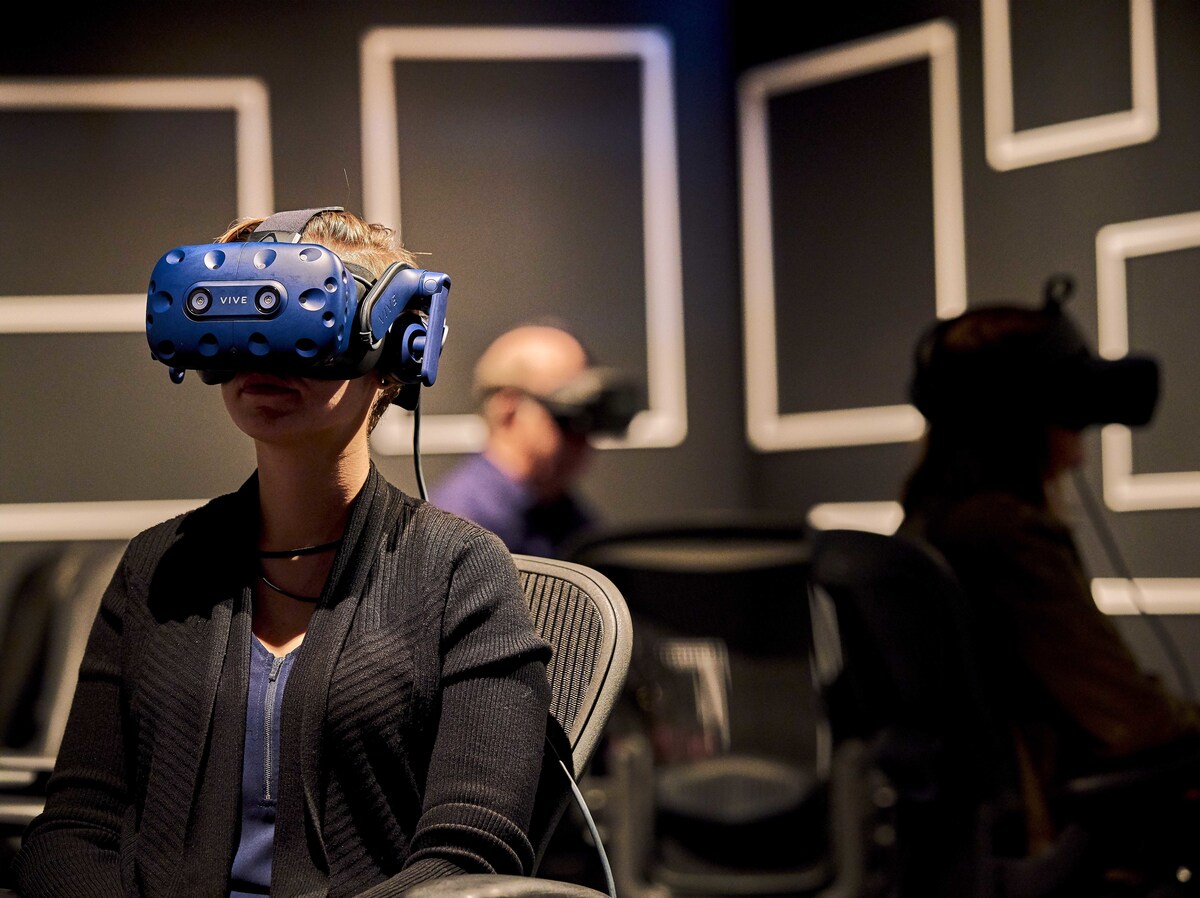
A young visitor experiences “A Promise Kept” at the Illinois Holocaust Museum.

Scott Edwards/Illinois Holocaust Museum


hide caption

toggle caption

Scott Edwards/Illinois Holocaust Museum


A young visitor experiences “A Promise Kept” at the Illinois Holocaust Museum.

Scott Edwards/Illinois Holocaust Museum

Most Holocaust survivors are in their 80s or 90s. With every year, fewer remain to tell us their stories. So museums and archives are using advanced technologies to preserve their testimonies and introduce them to new generations.

For example, at the Illinois Holocaust Museum and Education Center in Skokie, you can slip on a virtual reality headset and enter the world of survivor George Brent, at the moment the terrified teenager stepped off a boxcar at Auschwitz-Birkenau in 1944.

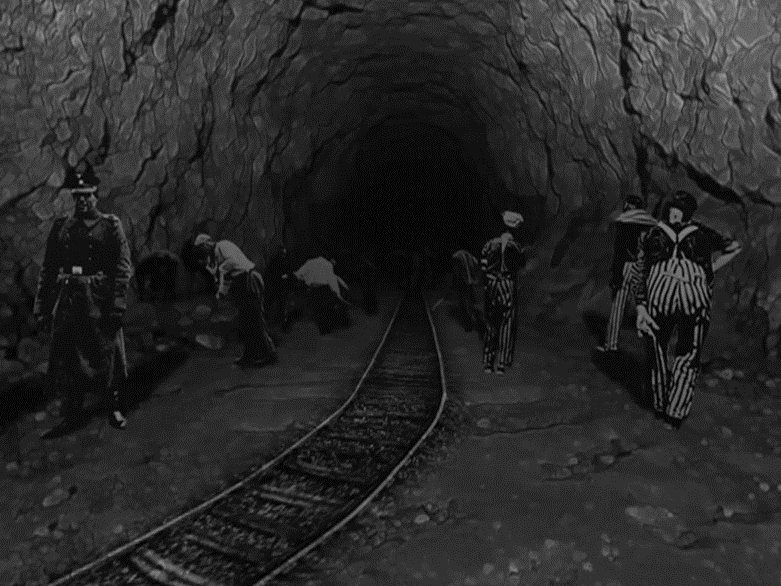
“There was a great deal of shouting –’Raus, raus, schnell, schnell! Leave everything behind!'” he says in the 12-minute film. It’s part of the exhibit “The Journey Back: A VR Experience,” which takes viewers from that first heartbreaking separation from his family to the grueling slave labor Brent was later forced to perform in the mines of the Ebensee concentration camp in Austria.

Brent, now 93 years old, is gentle and good-natured as he recalls making his part of “The Journey Back” on a Zoom call with NPR. He was too fragile to make a trip to Europe, he says, so the VR film based on his testimony used green screens to put him in some of the places he describes, such as the men’s concentration camp barracks and the loading docks at Auschwitz-Birkenau.

Standing in front of a green screen, survivor George Brent recounts his experience at Auschwitz-Birkenau in the VR film “Don’t Forget Me.”

Illinois Holocaust Museum


hide caption

toggle caption

Illinois Holocaust Museum


Standing in front of a green screen, survivor George Brent recounts his experience at Auschwitz-Birkenau in the VR film “Don’t Forget Me.”

Illinois Holocaust Museum

As you turn around, wearing the headset, you’ll also find yourself transported inside of charcoal drawings that communicate the darkness and dread of his experience in Nazi-run camps and quarries.

A still image from “Don’t Forget Me,” illustrating the mining tunnels at the Ebensee concentration camp in Austria, where George Brent and other inmates were forced to perform slave labor.

Illinois Holocaust Museum


hide caption

toggle caption

Illinois Holocaust Museum


A still image from “Don’t Forget Me,” illustrating the mining tunnels at the Ebensee concentration camp in Austria, where George Brent and other inmates were forced to perform slave labor.

Illinois Holocaust Museum

“It gives me the chills when I think about it, that this technology became available just in time to capture these stories,” says Susan Abrams, CEO of the Illinois Holocaust Museum. For years, she says, numerous survivors would tell their stories to visitors in person. The museum began making “The Journey Back” in 2017 and spent more than seven figures recreating Brent’s testimony as a virtual reality experience. The story of another survivor, Fritzie Fritzshall, is told as well, in a separate movie. (A former president of the museum, Fritzshall died at age 91 soon after her VR testimony was completed).

But employing new technology to capture survivors’ stories is nothing new, says UCLA professor Todd Presner, who studies the Holocaust and digital culture.

He describes the work of David Boder, an American psychology professor who used then- cutting edge technology to record testimonies starting in 1946.

“He brought this wire recorder to displaced persons camps throughout Europe, interviewing survivors in multiple languages and really, the first one to record their voices,” he says. (Those interviews have been archived online by the Illinois Institute of Technology as Voices of the Holocaust).

The interviews were especially powerful, Presner adds, at a time when newsreels were largely silent, and images of survivors were seen, not heard. Likewise, he says, “The Journey Back: A VR Experience” makes the Holocaust feel immediate, especially for people who’ve never had the opportunity to visit places like the Auschwitz-Birkenau memorial and museum in Poland.

But virtual reality is not the only technology transforming how we see—and increasingly, interact with — survivors’ testimonies. USC Shoah Foundation, founded by director Steven Spielberg in 1994, is one of the largest digital collections of survivor testimonies in the world. Right now, its interim executive director Kori Street is standing in its quiet lobby, facing a life-sized screen of an elderly man in a pink upholstered chair.

“Pinchas, can you tell us your story?” they ask.


USC Shoah Foundation
YouTube

The man, Pinchas Gutter, looks a little like the actor Anthony Hopkins. Gutter, who survived six concentration camps, is still living, in Toronto Canada. Onscreen, Gutter blinks and appears to compose himself. “I was born in 1932, in Łódź,” he begins. The artificial intelligence that enables Gutter to answer dozens of questions took a solid week of filming and seemingly endless inquiries from various interlocutors, including children.

Young people, Street says, tend to be braver in asking hard questions to a digitally-rendered survivor rather than an in-person senior citizen, whose feelings they often want to protect. And interactive experiences like this one are more compelling to many visitors than just passively watching the Foundation’s massive archival collection of testimonies. “There’s no reason why we can’t take these 2D testimonies, of which we have 55,000, and retrofit them to work with AI,” Street says.

As to where the technology may take things next, Street acknowledges all those wildly popular exhibits featuring the work of wildly popular artists. “There’s a lot of debate about a lot of these immersive experiences. The Van Gogh one, most recently the Frida Kahlo one. People either love [them] or they don’t but museums — to get people in, they need to keep on this.”

The idea of “Auschwitz: The Immersive Experience” might seem tasteless at best and Westworld at worst. But as a way into Holocaust history, an immersive experience could be presented with thoughtfulness, authenticity and care, says Sarah Lumbard. She’s the director of museum experience and digital media at the United States Holocaust Memorial Museum.

“In VR, we’ve looked at– how do you explain the experience of the Warsaw ghetto,” she says. “How might we explain that, really transporting you to the ghetto? And specifically, looking at how do you see … and bring to life one group’s effort to preserve evidence that was later found after the war? This is something you do to create a whole new world, a world that doesn’t exist, which is why gamers use it.”

“There are really excellent applications of game theory to learning about the Holocaust without it devolving into something that is dangerous, that is dark tourism,” says Kori Street.

At a time when hate crimes have risen sharply and members of Congress have trivialized survivors’ experiences, Holocaust museum directors say their stories are more important than ever. And new technologies and new tools—used correctly- can bring that history home.

CES and the future of tech : NPR

NPR’s Michel Martin speaks with tech journalist John Hendel about attending the Buyer Electronics Exhibit this year and what the long term of tech seems to be like.


MICHEL MARTIN, HOST:

The Purchaser Electronics Demonstrate, superior recognised as CES, wrapped up on Friday in Las Vegas. The yearly trade clearly show is 1 of the biggest tech functions of the calendar year, a time for corporations and inventors to show their most recent and biggest thoughts. And whilst the pandemic and politics place a damper on this year’s accumulating – attendance was way down, and lots of of the significant names stayed absent for worry of blowback – we nonetheless assumed it would be a good time to hear about the exhibit and what it tells us about the upcoming of tech. So we referred to as John Hendel, a tech reporter at Politico who attended CES in authentic existence, as they say. John Hendel, welcome. Thank you for joining us.

JOHN HENDEL: Thank you. Excellent to be listed here.

MARTIN: So first, what was it like to attend CES in person? As I stated, a whole lot of significant companies resolved to show up at just about this 12 months. A great deal of individuals did, much too. So – but what was it like and how did that impact the really feel of the conference?

HENDEL: That was the truly type of surprising thing in my intellect mainly because I assume I in the beginning envisioned just form of pure tumbleweeds and, you know, no a person definitely there even. You know, that was the initial kind of anxiety that, like, no one would come when you saw every big business from T-Cell to Facebook to Amazon, you know, form of pulling back from this. But there have been however hundreds of people just all about the trade present. I signify, I think about 40,000 attendees however arrived to this.

MARTIN: Effectively, 1 of the details that you created in your article about it in composing about it with your colleague – simply because a whole lot of the major names stayed away, some of the smaller vendors obtained a chance to shine – appropriate? – a minor little bit. So can you just tell us about one or two of the greatest developments that stood out to you from this 7 days?

HENDEL: You know, a person even larger concentrate we observed this yr usually was on health and fitness and wellness pretty significantly front and heart at the trade show. And you had overall health treatment providers like Abbott talking when you actually hadn’t had wellness treatment corporations at CES ahead of. You know, Abbott was on stage conversing about their techniques to take a look at and, you know, how they’ve been capable to help all through the COVID-19 pandemic with speedy tests and how that technologies could be made use of in other form of tests. And you noticed a good deal of other suppliers. There was one I remember on the trade demonstrate ground that talked about, you know, an AI private coach that you could have. And there were being diverse wearables that would be tracking wellness info. Those people new sectors like health, wellness, transportation, all of that was incredibly substantially form of at the forefront in a various form of way.

MARTIN: You outlined that the determination by Amazon, Google, Microsoft, TikTok and other folks to sit out CES in particular person, we already talked about the fact that it variety of opened the doorway for other tech organizations to flex their muscle, but you also claimed that the absence of these large tech firms who, you know, have drawn a lot of Washington’s ire in new months and yrs, you mentioned it established a extra harmonious tone. Do you consider this convention tells us anything likely ahead about the relationship amongst Washington and tech businesses, particularly major tech, or was this just sort of a 1-off provided just the one of a kind conditions?

HENDEL: You clearly saw, even among the like some of the healthcare companies in this article, you know, they were being creating a position that even although you will find a ton of shopper data applied in some of their wellbeing, tech expert services, they are various from some of the social media products and services that would be making use of data. That is some thing that really appeared hanging and will be instructive when Congress does compose any legislation that may offer with this, irrespective of whether they are on facts privateness or other pieces of the variety of tech coverage arena. And again, you experienced senators who did arrive in individual, and they mentioned it is really extremely critical to be conversing to these organizations. You know, I saw the chair of the Senate Commerce Committee Maria Cantwell and Senator Jackie Rosen and Senator Blackburn. I observed them going for walks together – amid the exhibitors and truly seeking deep into that. So I imagine for them, you know, they say which is useful. And so, yeah, I am curious what is future and exactly where we are going to see that go.

MARTIN: That was John Hendel, a tech reporter at Politico, telling us what he observed at the Shopper Electronics Display, CES, that just wrapped up on Friday. John Hendel, many thanks so substantially for conversing to us.

HENDEL: Thank you.

Copyright © 2022 NPR. All legal rights reserved. Visit our internet site conditions of use and permissions web pages at www.npr.org for further data.

NPR transcripts are developed on a hurry deadline by Verb8tm, Inc., an NPR contractor, and manufactured working with a proprietary transcription system designed with NPR. This text may perhaps not be in its closing sort and may well be up to date or revised in the foreseeable future. Accuracy and availability may perhaps change. The authoritative report of NPR’s programming is the audio report.

People are talking about Web3. Is it the Internet of the future or just a buzzword? : NPR

Web3, short for web 3.0, is a vision of the future of the Internet in which people operate on decentralized, quasi-anonymous platforms, rather than depend on tech giants like Google, Facebook and Twitter.

Ani_Ka/Getty Images


hide caption

toggle caption

Ani_Ka/Getty Images


Web3, short for web 3.0, is a vision of the future of the Internet in which people operate on decentralized, quasi-anonymous platforms, rather than depend on tech giants like Google, Facebook and Twitter.

Ani_Ka/Getty Images

There’s a buzzword that tech, crypto and venture-capital types have become infatuated with lately. Conversations are now peppered with it, and you’re not serious about the future until you add it to your Twitter bio: Web3.

It’s an umbrella term for disparate ideas all pointing in the direction of eliminating the big middlemen on the internet. In this new era, navigating the web no longer means logging onto the likes of Facebook, Google or Twitter.

Think of it this way: The nascent days of the Internet in the 1990s were Web 1.0. The web was seen as a way to democratize access to information, but there weren’t great ways of navigating it beyond going to your friend’s GeoCities page. It was pretty disorganized and overwhelming.

Then came Web 2.0 starting in the mid-2000s. Platforms like Google, Amazon, Facebook and Twitter emerged to bring order to the Internet by making it easy to connect and transact online. Critics say over time those companies amassed too much power.

Web3 is about grabbing some of the power back.

“There’s a small group of companies that own all this stuff, and then there’s us who use it, and despite the fact that we contribute to the success of these platforms, we don’t have anything to show for it,” said Mat Dryhurst, a Berlin-based artist and researcher who teaches classes at New York University on the future of the internet.

And so, the answer, according to Dryhurst and other Web3 fans, is an iteration of the internet where new social networks, search engines and marketplaces crop up that have no company overlords.

Instead, they are decentralized, built upon a system known as the blockchain, which already undergirds Bitcoin and other cryptocurrencies. Imagine it as a kind of bookkeeping where many computers at once host data that’s searchable by anyone. It’s operated by users collectively, rather than a corporation. People are given “tokens” for participating. The tokens can be used to vote on decisions, and even accrue real value.

In a Web3 world, people control their own data and bounce around from social media to email to shopping using a single personalized account, creating a public record on the blockchain of all of that activity.

“To the average person, it does sounds like voodoo,” said Olga Mack, entrepreneur and blockchain lecturer at University of California, Berkeley. “But when you press a button to switch on lights, do you understand how the electricity is made? You don’t have to know how electricity works to understand the benefits. Same is true of the blockchain.”

Right now, the idea of the entire Internet reinventing may sound like some far-away digital utopia. But Web3 is driving new conversations — and generating lots of new money, particularly from crypto investors.

‘At first baffling,’ but Web3 is growing more mainstream and tech companies are taking note

The Web3 movement has been helped along by the rise of NFTs, or non-fungible tokens, which are digital collectibles and other online files that can be bought and sold with cryptocurrency. Then there are the publicity stunts. Recently, a group of crypto enthusiasts banded together to attempt to purchase a copy of the U.S. Constitution with digital currency. They organized under the name ConstitutionDAO. (A DAO stands for a decentralized autonomous organization, the name for an online collective of crypto supporters who assemble together collectively in a group governed by blockchains and tokens. It’s very Web3.)

Dryhurst admits that trying to explain Web3 can be exasperating, since it’s a loosely-defined term that takes on a slightly different shape depending on who is defining it but, he said, that’s the case with all new frontiers of technology.

“Every new advent of the web is at first baffling,” he said.

To technologists and cryptographers, Web3 has remained a theoretical grand vision for years. But in recent months, the push for a blockchain-powered future has come to dominate tech conferences and social media chatter in certain circles. It’s even forced major tech companies to assemble teams dedicated to Web3.

And that’s brought a certain irony to the evolution of Web3: Enthusiasts hope Web3 will mean that sharing photos, communicating with friends and buying things online will no longer by synonymous with Big Tech companies but be done through a multitude of small competing services on the blockchain — where, for instance, every time you post a message, you earn a token for your contribution, giving you both ownership stake in the platform and one day a way to cash in.

In theory, this also means avoiding fees, rules and the strictures of tech companies. Nonetheless, major tech platforms are also jumping on the idea.

“It means that all the value that’s created can be shared amongst more people, rather than just the owners, investors and employees,” said Esther Crawford, a senior project manager at Twitter.

Crawford said Twitter is studying ways to incorporate Web3 concepts into the social network, like one day being able to log into the social network and tweet from an account associated with a cryptocurrency, not a Twitter account. She sees the future differently: not a crypto version of Twitter replacing Twitter. But rather Twitter introducing Web3 features on top of standard Twitter.

“For a long time, Web3 has been very theoretical,” she said. “But now there is a surge of momentum to build.”

Will Web3 be the new norm?

Experts say, in the best case scenario for Web3 enthusiasts, the technology will operate alongside Web 2.0, not fully supplant it.

In other words, blockchain-based social networks, transactions and businesses can and will grow and thrive in the coming years. Yet knocking out Facebook, Twitter or Google completely is not likely on the horizon, according to technology scholars.

“I’m not in a position to say who will win,” Dryhurst said. “But Web2 companies will be folding Web3 ideas into their services to stay relevant.”

He thinks many people would want to be able to take their data and history of interactions online wherever they go on the Internet, rather than remain on singular web platforms–what some call the “walled gardens” of big tech companies.

“This is a fundamentally difference experience than what we’re used to today,” Dryhurst said.

But he admits that boundless freedom can lead to troubling outcomes for some.

“The Faustian bargain is that the same reasons that it’s exciting that there’s nothing impeding people to build whatever community they want, I can’t stop someone from building something that’s hellacious,” he said.

Decentralized social networks have proved appealing to white supremacists and other far-right groups, but Sam Williams, founder of Arweave, a blockchain-based project for storing data online, said he trusts most small communities to determine what speech is permitted online.

On balance, he said, collective voting on the rules of engagement will be better than what users experience on major social media platforms today.

“If we stay in the current paradigm, we will move further and further into a realm where a small handful of companies run by a small number of people run our experiences in cyberspace,” he said. “And in that world, the problems of Big Tech are exacerbated.”

Another issue, of course, is government oversight. Blockchain-based tokens are now in a regulatory netherworld, but that could soon change as the Biden administration begins the process of setting new rules for the industry.

How does Web3 fit with that other vision of the Internet’s future — the metaverse?

Facebook recently rebranded itself Meta, and said its priority would be to build the “metaverse,” a digital future where everyone is living and interacting and working together in virtual reality.

Among the company’s stated principles is “robust interoperability,” meaning that users could take their accounts or avatars from site to site or service to service seamlessly, rather than have to log in to accounts controlled by separate companies every time they visit new sites.

That’s also one of the ideals of Web3.

But true believers say there is no place for Facebook in a Web3 world, no matter how hard the social network tries to be part of the next generation of the Internet.

“Facebook will always be incentivized to enrich Facebook,” Williams said. “And that’s not how cyberspace should be governed.”

What’s the chance Web3 is just an over-hyped fantasy?

It doesn’t take long to find skeptics of Web3.

James Grimmelmann, a Cornell University professor who studies law and technology, has become vocal about his doubts.

“Web3 is vaporware,” said Grimmelmann, referring to a product that’s announced but never delivered.

“It’s a promised future internet that fixes all the things people don’t like about the current internet, even when it’s contradictory.”

He said if part of the impetus is to resist giving up personal data to Big Tech companies, then the blockchain is not the solution, since that will make even more data public.

“It doesn’t make any sense,” he said. “The vision says the problem with the internet is too many centralized intermediaries. Instead of having lots of different applications and sites, we’ll put it all on blockchains, which puts it all in one place.”

To Grimmelmann, Web3 represents technologists reaching for the idealistic ethos of the dawn of the internet — everyone can freely use the information superhighway! — that long ago was overtaken by tech companies.

The Internet’s evolution always has been a tug between fragmentation and centralization, he said. When it swings too far in one direction, a backlash tries to pull it in the opposite direction.

“Blockchains are interesting and solve some difficult problems in new ways,” he said. “They’re probably going to end up in the toolkit that the next internet is built out of, but that doesn’t mean the internet is going to be built around them.”

But many people who found wealth during the pandemic by investing in cryptocurrencies are looking around for something to plunge cash into beyond NFTs of “bored apes” who are members of a cartoon “yacht club.”

Right now, he said, Web3, albeit mostly theoretical, is the thing.

“There are a lot of people who have money to invest,” he said. “And they need some vision to throw money at.”

20 Years Later, 2 More 9/11 Victims Are Identified : NPR

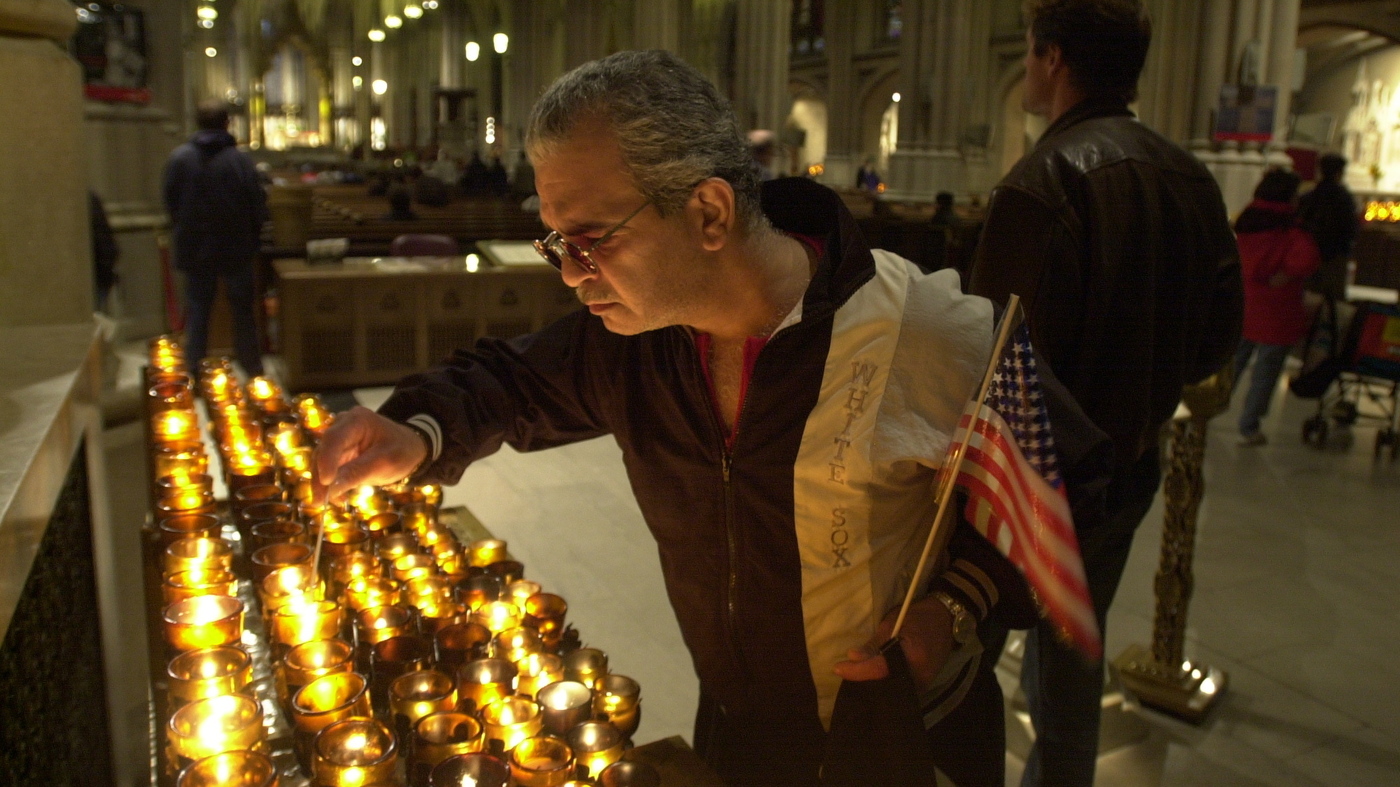
A male in New York Town lights a candle on Sept. 14, 2001, for the victims of the Sept. 11 terrorist assaults.

Robert F. Bukaty/AP


disguise caption

toggle caption

Robert F. Bukaty/AP


A man in New York City lights a candle on Sept. 14, 2001, for the victims of the Sept. 11 terrorist assaults.

Robert F. Bukaty/AP

Two much more victims of the 9/11 terrorist assaults at the Entire world Trade Centre have been identified in New York Metropolis — just days before the nation marks the 20th anniversary of the tragedy.

Dorothy Morgan of Hempstead, N.Y., is the 1,646th sufferer to be identified by means of ongoing DNA investigation of unknown continues to be recovered from the Earth Trade Heart web site, the place 2,753 life had been shed. The second human being — and the 1,647th victim — is a man whose identify is being withheld at his family’s ask for.

Morgan and the gentleman were being discovered by New York City’s Place of work of Chief Clinical Examiner applying new forensic technological know-how and advancements in DNA science.

“Twenty a long time ago, we made a promise to the families of Earth Trade Centre victims to do what ever it can take for as extensive as it takes to determine their liked types, and with these two new identifications, we carry on to satisfy that sacred obligation,” reported Dr. Barbara A. Sampson, chief healthcare examiner of the town of New York.

Morgan’s identity was verified as a result of DNA testing of remains recovered in 2001, the Office environment of Main Medical Examiner said. The unnamed man’s id was verified by way of stays found in 2001, 2002 and 2006.

It really is the initially time in two decades a victim’s remains have been discovered. There are nevertheless more than 1,100 victims, at least 40{4224f0a76978c4d6828175c7edfc499fc862aa95a2f708cd5006c57745b2aaca} of those who died on 9/11, that continue being unidentified.

According to The New York Situations, forensic experts are tests and retesting much more than 22,000 entire body elements that were being recovered from the Globe Trade Center website. A lot of the testing is carried out utilizing bone fragments the measurement of a Tic Tac.

The longtime effort to identify victims of the Earth Trade Center attacks is viewed as the premier and most sophisticated forensic investigation in U.S. heritage, according to New York City’s Place of work of Main Medical Examiner.

Sampson explained, “No issue how a great deal time passes because September 11, 2001, we will never ever fail to remember, and we pledge to use all the tools at our disposal to make guaranteed all all those who had been lost can be reunited with their households.”