


I have an admission: I once created “doorway pages” on a large scale.
In my defense, this was years before Google existed. And, it was not considered spam in those days.
Doorway pages might seem like a nebulous concept for some marketers to grasp. Since Google announced that creating such pages was considered illicit practice, there has been some confusion.
However, such mixups are just as wrong as cloaking in SEO. So read on, and I will explain what doorway pages are, how to watch for them, and what to do about them.

What are doorway pages?
Google defines doorways as:
“…sites or pages created to rank for specific, similar search queries. They lead users to intermediate pages that are not as useful as the final destination.”
They also cite the following examples as doorways:
• Having multiple websites with slight variations to the URL and home page to maximize their reach for any specific query
• Having multiple domain names or pages targeted at specific regions or cities that funnel users to one page
• Pages generated to funnel visitors into the actual usable or relevant portion of your site(s)
• Substantially similar pages that are closer to search results than a clearly defined, browseable hierarchy
The early days of doorway pages
Doorway pages seemed like a mystical, magical thing back in the earliest days of search engines.
This is partly because, in the advent of the commercialized/public internet, everyone thought that website visitors would only enter your site via the homepage.
Essentially, visitors would only arrive and enter through the “front door.” This idea led people to obsess over the design of homepages, while the rest of the website was often nearly an afterthought.
Thus, as search engines absorbed and reflected webpages, it suddenly felt like reaching some high stage of Buddhist-monk-level enlightenment to realize that a website could now have many “front doors” through which visitors would enter.
I did not know what doorway pages were when I thought I invented them circa 1996/1997. Search engines grew first out of curated directories of links, but once pages began being spidered, things changed fast. I had been tasked with increasing traffic to one of Verizon’s biggest websites at the time.
I recognized that the site’s homepage could not be particularly optimized for ~8,000 business categories and ~19,000 cities. I realized that individual pages should be spawned, each optimized to rank for business categories, cities, or combos of both.
I named my pages “portals” because the whole process seemed almost magical. I was following nearly mystical ritual-like designs in optimizing the pages and experimenting. I imagined I was virtually teleporting people who had a search need for “restaurants in springfield” or “doctors in bellevue” into our website where I would match them up with precisely what they wanted.
Despite the lack of any guide or formula that talked about such doorways at scale, many others came up with similar solutions, seeking to expand content to match up with growing varieties of user queries in search engines.
My “portal pages” skunkworks project was a clear success, although it would be some years further before leadership in the company recognized the value and allowed me to deploy the concept beyond my pilot research project.
Get the daily newsletter search marketers rely on.
The rise of doorway pages in search results
When doorway pages were first added to the list of spam practices, there was some degree of hubbub about them, with heavy emphasis expressed by Googlers reinforcing that the use of doorways was contravened.
Not as much has been said about the topic in the years since. Google appeared to be increasingly circumspect about the imposition of penalties related to the practice and other quality rules.
The lack of attention brought to doorway pages seemed to cause some marketers to believe that they are not a big deal.
The typical rationalization is: “Amazon does it, and Google SERPs are full of Amazon, so…”
Often, these folks employ doorway pages on their own websites.
There has been a spike in lawsuits involving doorway pages in the last six years. I first wrote about this in 2017, “Initial Interest Confusion rears its ugly head once more in trademark infringement case,” where I mentioned an older lawsuit where watch company Multi Time Machine sued Amazon for hosting a search results page for “mtm special ops watches” (and other similar keyword searches that could be related to the watch company’s marks).
Amazon hosted the “MTM special ops watches” page, but only showed search results for other competing products.
Multi Time Machine contended that this could confuse consumers expecting MTM products, which was therefore an infringement.
That suit was eventually dismissed as the court determined that no “reasonably prudent consumer” would be confused about the Amazon page that presented products that would be considerably underpriced for MTM watches.
In yet another case (“Bodum USA, Inc. v. Williams-Sonoma, Inc.”), French press coffee maker manufacturer Bodum sued their former retail partner Williams-Sonoma under similar circumstances.
Williams-Sonoma had sold Bodum products for a time but eventually discontinued selling them, opting instead to manufacture their own branded French press coffee makers.
However, the Bodum search results page on the Williams-Sonoma.com website continued to be maintained, only it now presented Williams-Sonoma products and not Bodum’s.
Thus, the circumstances, including accusations that the products themselves were confusingly similar, were arguably much more confusing than in the Multi Time Machine/Amazon case.
The Bodum v. Williams-Sonoma case settled out of court, with Williams-Sonoma adding a disclaimer to their web results, “We do not sell Bodum branded products.”
I subsequently spoke with the CEO of another company that formerly sold their products through Williams-Sonoma. In a similar sequence, the latter also dropped them, began featuring their own, competing products, and maintained a search results page that used (and ranked for) the dropped company’s brand name.
In Google’s recent overhaul of its Webmaster Guidelines, including renaming them to Google Search Essentials, Google could have easily avoided this category if they were no longer a concern.
Instead, the newly updated Spam Policies section page promotes Doorways to the second-listed contravened practice, right after Cloaking. Google also added another example of Doorways as well.
Google’s take on doorway pages: A brief history
Doorway pages were against the rules very early in Google’s 20-plus-year history. I could find reference to doorway pages in Google’s rules as far back as June 2006 (although I think there may have been a rule in place a little before that):

In a session at the first SMX Advanced conference in 2007, Google’s former head of web spam Matt Cutts was asked for more descriptive guidelines.
Just a few days later, Vanessa Fox announced on Google’s Webmaster Central Blog that they had expanded on the guidelines, providing more examples, among other things.
The expanded text stated:
“Doorway pages are pages specifically made for search engines. Doorway pages contain many links – often several hundred – that are of little to no use to the visitor, and do not contain valuable content. HTML sitemaps are a valuable resource for your visitors, but ensure that these pages of links are easy for your visitors to navigate. If you have a number of links to include, consider organizing them into categories or into multiple pages. But in doing so, ensure that they are intended for visitors to navigate the sections of your site, and not simply for search engines.”
By 2013, Google’s Webmaster Tools content guidelines section had modified this description, stating:
“Doorway pages are typically large sets of poor-quality pages where each page is optimized for a specific keyword or phrase. In many cases, doorway pages are written to rank for a particular phrase and then funnel users to a single destination. Whether deployed across many domains or established within one domain, doorway pages tend to frustrate users.”
In 2015, Google saw fit to post an article on the Google Search Central Blog, further highlighting what Google disliked about doorway pages and announcing a specific “ranking adjustment” (read: a core update that would penalize doorway pages).
“Over time, we’ve seen sites try to maximize their “search footprint” without adding clear, unique value. These doorway campaigns manifest themselves as pages on a site, as a number of domains, or a combination thereof. To improve the quality of search results for our users, we’ll soon launch a ranking adjustment to better address these types of pages. Sites with large and well-established doorway campaigns might see a broad impact from this change.”
At their best, doorway pages could be an effort to provide navigation between search engines’ results pages and the most granular content within a website. If one had a limited crawl budget, such pages could provide collecting pages for many granular-level, individual website pages.
But, at their worst, doorway pages could inflate a site’s indexed pages by thousands and millions of pages, lending little value between the various ones and seeking to enable the site to appear for many more searches than the site merited.
Jennifer Slegg’s analysis of the doorway pages ranking adjustment announcement at the time was that it was most likely focused on improving the quality of local search queries and mobile search results.
Indeed, local business directory websites had tried to index their webpages for all category and location combinations. (This was what my early doorway pages were, before the anti-doorway rules got instituted, as I worked for Verizon’s Superpages – one of the largest of the early online yellow pages.)
That said, there is cause to think that local directory sites somewhat get special treatment from Google (as I will describe shortly in the “Types of doorway pages” section below).
Barry Schwartz outright called the “adjustment” a “doorway page penalty algorithm.”
The automated penalty likely made many realize that doorway pages were considered a serious violation of Google’s guidelines.
Websites had been penalized for this in the past, but many believed that if their sites were not currently penalized, then what they were doing was okay in Google’s eyes.
This irrationally founded belief was proven untrue as the doorway page penalty rolled out.
Seven years later, a whole younger, fresh set of organic search marketers have forgotten that doorway pages are a serious violation, just as some did in the past.
This can happen as an oversight in some instances. Other times, SEO marketers can get progressively bolder and more ambitious about expanding indexable pages to the point where they have crossed a boundary. By then, Google detects doorway pages and dings them pretty sharply.
While having even one doorway page is considered against Google’s rules, in truth, doorway page infractions are determined by scale.
Having a few may not cause issues, but a large ratio of them versus meatier pages is far likelier to be detected, resulting in a negative outcome.
Types of doorway pages
Spammy city/region pages
This corresponds to Google’s example of “[h]aving multiple domain names or pages targeted at specific regions or cities that funnel users to one page.”
For instance, imagine a law firm in a small state like New Hampshire:
- Creating pages targeted to “[legal specialty] in [city name]” with all identical templates having just the city name replaced on each page.
- The pages all funneling users to a “Contact Us” page.
It would begin to look pretty spammy and repetitive if done for the roughly 234 towns in New Hampshire.
But, also imagine this sort of thing done with over 19,000 incorporated cities and towns in the United States.
There is cause to think that local businesses for large metro areas implementing this (i.e., targeting the roughly 88 cities of greater Los Angeles or the more than 200 cities of the Dallas-Fort Worth Metroplex) could incur a penalty, particularly if the business did not have a physical address in each targeted city, which would qualify it for having such pages.
Here is an example of a doorway page used by a current international business directory (name redacted).
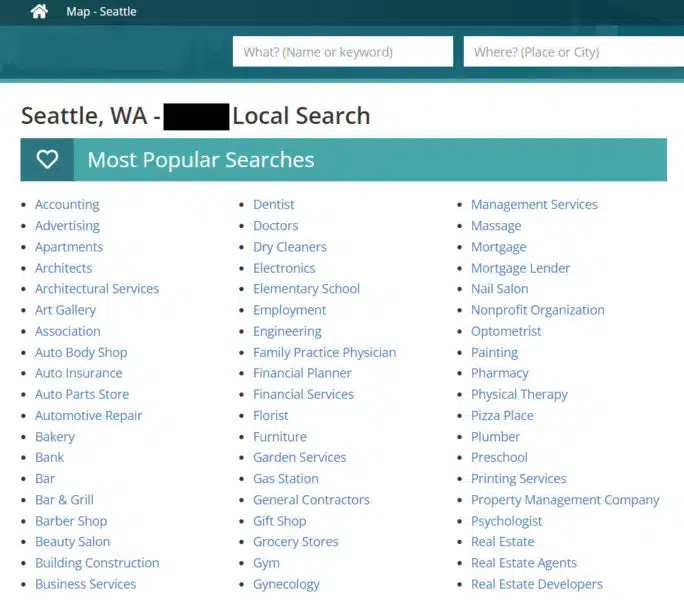
There are clearly some caveats to Google’s algorithmic rules around defining spammy city/region types of pages.
One can perform a search right now and see local business listings pages from major directory websites like Yelp and Yellow Pages appearing in the top search results for a huge number of business category keywords combined with local city names (e.g., “accountants in poughkeepsie, ny”).
Sites like neighborhoods.com and nextdoor.com are doing great. If the page shows high-quality, valuable information about each city a website targets, it likely won’t be considered a doorway page. This is a key criterion that many seem to miss when assessing whether doorway pages are policed by Google.
Now, if you display a page like “Attorneys in New York City”, but the page merely has links to listings for all the boroughs, that would qualify as a doorway page.
If a user seeks “attorneys in nyc” and clicks on a page that does not contain listings for “attorneys in nyc” but merely links to other pages, then that would be a very poor user experience.
But, if they clicked on the page and got listings of attorneys, that would not fit in the model of being a doorway page per se.
You can understand this by searching for “attorneys in nyc.” You will see on the first page of search results listings from Justia, FindLaw, Cornell University attorney listings, Yelp, the New York City Bar Association, Martindale-Hubbell, and Expertise.com.
Microsites
Google does not refer to “microsites” in their guidelines, but this is what the tactic used to be called.
Google’s current rule states, “Having multiple websites with slight variations to the URL and home page to maximize their reach for any specific query.”
The concept of microsites was employed more when SEOs noticed that Google seemed to give ranking preference to websites incorporating the keyword in the domain name.
Imagine if Target.com pursued this. They sell over 3,000 types of products based on their sitemaps file.
Creating a “subwebsite” for each type of product with links back to their main website to conduct a purchase would have been massively irritating. It would also be largely unnecessary because Google can fully show their existing category pages in search results.
This is an attractive idea for website operators who think this will be a shortcut to successes they failed to achieve by insufficiently optimizing their existing websites.
I have argued with CEOs before about this very thing, telling them that “to successfully employ a microsite, you must market it equivalently to your main website – promote it, advertise it, use social media with it, etc – don’t do it, because nobody markets microsites sufficiently when they create dozens, hundreds, or even thousands of them!”
You can create a special promotional website for a few things, but you better treat them pretty close to complete, standalone websites to achieve good rankings.
A unique, keyworded URL is insufficient in itself. This is not a shortcut to across-the-board high rankings.
Indexable internal search results pages
Google has stated for many years now that they do not want to index a website’s search results pages as this could be an infinite set of pages, considering all the many keywords that could be used to conduct a search on a website. Search-results-in-search-results is an irritating user experience.
This is perhaps the most confusing aspect of Google’s guidelines because there are a few ways to define “search results” on websites.
Category pages or item listings pages on some websites use website/database search functionality to display these types of pages.
Google’s SEO Starter Guide states:
“Avoid: Letting your internal search result pages be crawled by Google. Users dislike clicking a search engine result only to land on another search result page on your site.”
However, there are differences between allowing one’s category pages to be indexed (of a limited number and very specific) vs. having many variations indexed for category-type keywords that display substantially identical pages.
This can happen with ecommerce websites when marketers create category pages including every variation of product options. Ecatalog software often supplies “faceted” navigation options that produce such pages. Here’s an example:
- Micro SD Digital Cameras $100 to $250, 9 or less megapixels
- SD Digital Cameras $100 to $250, 9 or less megapixels
- Micro SD Digital Cameras $250 to $500, 9 or less megapixels
- SD Digital Cameras $250 to $500, 9 or less megapixels
- Micro SD Digital Cameras $500 to $700, 9 or less megapixels
- SD Digital Cameras $500 to $700, 9 or less megapixels
- Micro SD Digital Cameras $100 to $250, 10 to 11 megapixels
- SD Digital Cameras $100 to $250, 10 to 11 megapixels
- Micro SD Digital Cameras $250 to $500, 10 to 11 megapixels
- SD Digital Cameras $250 to $500, 10 to 11 megapixels
- Micro SD Digital Cameras $500 to $700, 10 to 11 megapixels
- SD Digital Cameras $500 to $700, 10 to 11 megapixels
Now, some websites have such a breadth of content that they might be able to produce such pages without running afoul of a doorway page assessment.
But many websites may display virtually identical content on such pages or display only a single product listing – which would have been served better by only having the product page itself indexed.
In yet more egregious cases, some websites have set up things such that when consumers conduct searches on their websites, it will automatically produce indexable search results pages for each of those queries.
This can result in loads of pages indexed with only the keyword name changing, while the contents of the pages are substantially or wholly similar to others on the website.
This is the case for those Williams-Sonoma pages where an indexed search result for “bodum coffee makers” might be the same content as for a “French press coffee makers” category page.
Even more concerning, blindly generating pages from users’ search results can create pages featuring keywords that are no longer relevant to the website. In other words, spam and, put in another way, potential trademark infringement.
In one lawsuit I worked on, an online retailer allowed thousands and thousands of pages generated by users’ search queries on the site to be indexed, including for major brand names that the website did not carry, such as Nike, Versace, Burberry, Gucci, Yves St. Laurent, Chanel, Eddie Bauer, and more.
An even greater number of pages were indexed from the website, focused on keyword phrases that would produce substantially similar to identical search results pages:
- “white jeans”
- “white jean”
- “size 17 jeans”
- “jeans size 17”
- “black jeans”
- “black rip jeans”
- “black rips jeans”
- “black ripped jeans”
- “black ripped jean”
- “ripped black jeans”
- “black jeans men”
- “black jeans mens”
Imagine these sorts of keyword phrases multiplied hundreds and thousands of times over, and you get the picture. Huge scale, duplicate content, and spammy.
Any website with substantial content and search functionality that uses the GET method can end up with indexed internal search results.
I had a client circa 2007/2008 whose business model was creating a sort of curated search results pages that got de-indexed by Google overnight when this rule was promoted.
Substantially duplicate content propagated via keyword variations
You can already see how this could work in the example above where pages were indexed for an online retailer under multiple, highly-similar keywords, and the pages would have identical content.
There may be some level of plausible deniability where SEO software paired up with Shopify or other online shopping software can result in more and more user-generated search queries getting indexed as pages.
But, some websites have sought to programmatically create alternate versions of content pages using synonyms, keyword research APIs, AI, or some human editors. The page’s content could be published on multiple pages, each titled and headlined with different keywords.
Many thin content websites have done this very thing in the past, and it likely does not work well in Google these days.
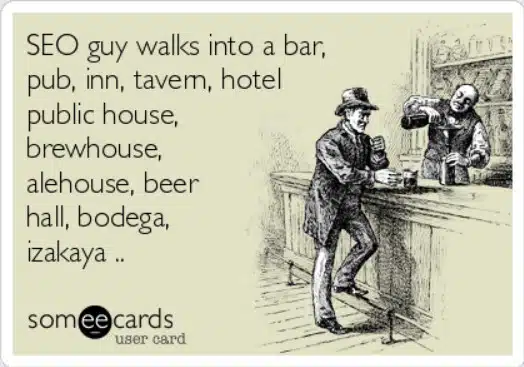
SEO’s stereotypical propensity for going overboard with keyword optimizations.
Do not do this with Doorway Pages, or your website could get dinged! Meme
postcard image courtesy of Someecards. Copyright © Someecards.
Unsure? How to avoid a doorway ‘ding’
You may wonder if you are at risk of having your website “dinged” by Google for having doorway pages. If you *know* you have doorway pages, eliminate them in favor of focusing on pushing the quality and promoting your other content pages.
If you are unsure if you have what Google would consider doorway pages or want ideas on how to fix them, read on for some recommendations.
There has long been the suggestion that Amazon gets away with doorway pages because they have loads of PageRank. Therefore, Google displays many of Amazon’s doorway pages where other websites would not.
With 135 million pages indexed and ranking for top product name queries across the board, Amazon is indeed in a unique position. Google can – and does – take the position that providing users with what they seek is the first and foremost priority.
So if the site is desired/expected in the search results, Google might allow infractions to pass to maintain the page in the search results where consumers can find it. That does not mean that Google likes doorway pages, however.
But, I do not think Amazon’s pages are particularly doorway pages.
Generally, if you click on an Amazon listing in Google’s search results for a product, you will find what you are looking for. Those can be category listings pages or specific product pages.
But, you see pictures, typically, of what you are looking for, and the results are pretty satisfactory. This is a key determinant.
Doorway pages are typically:
- A sort of interstitial between Google’s search results and the actual destination pages users are seeking.
- Duplicated across many similar keywords.
- Are even spammed at keyword combinations with the content of the pages bearing little relation to what the user is specifically seeking.
The takeaway is not that “Amazon gets away with Doorway Pages”. The takeaway is that “Amazon provides a very satisfactory experience for searchers by delivering on the promise of the keyword targeting of their pages.”
Here are some tips for reducing your risks of a doorway “ding”.
Simply remove doorways from the index
Google suggests using robots.txt, but I have another take.
A robust internal link hierarchy is valuable for SEO, as that can help ensure Google finds and indexes the site’s granular content.
For this reason, perhaps the quickest fix is to add a robots meta tag to those pages with a “noindex” directive, along with the “follow” directive to keep the links on the page getting crawled.
Keep internal search from generating pages
It is true that you can mine your internal website search data to discover keywords that your users may be using to find your type of content.
You should still use that as a guide for creating new content, modifying existing content, or introducing other pages related to the top-searched terms.
But do not let your internal searches automatically transform into pages of search results that search engines can index.
Doing so will put your site squarely on an increasing curve of cookie-cutter-templated pages that will generate levels of duplication, pages with low value, and open you up to possible spam-hacking exploits.
You should human-curate the pages added to your site, so stop the uncontrolled flow of pages created each time users type word combos into your search forms.
You should also consider tech modifications if your internal search URLs are indexable because it is natural for users to share page URLs with others. This can result in user-generated external links growing over time until you involuntarily have a large set of doorway pages.
You may need to set all those robot meta tags with noindex directives or disallow them in robots.txt.
Alternatively, you could switch the search functionality to only work with the POST method, revoking the ability for full URLs to be bookmarkable/indexable.
Redesign your category pages to be richer
Category and subcategory pages do not have to be mere navigational lists of links to deeper pages. You can display top items from the categories on the page along with navigational links deeper.
Informational text content could be included, as well as videos and preview snippets and links to related blog posts. Highlight the newest items, recently-updated content, top-sellers, or endorsement blurbs.
In short, you want to transform what have been essentially linking pages for search engines into pages that are simultaneously highly usable and useful for end users.
Make core content pages more relevant for alternate keywords
If you are using doorway pages to try to have content that appears for many related keyword phrases, you are using only one SEO method.
Instead of doorways, you can judiciously add one or two other keyword phrases onto the page itself if you add them in a natural way that reads well for users. Do not go overboard, or you will run afoul of Google for keyword stuffing.
Another option is to create external links pointing to the main page for any given topic, using alternate keyword phrases for the link text. Again, avoid going overboard with too many and do not resort to external link building to accrue the links.
You could write posts on your website’s blog or in articles to link the alternate keywords’ text back to the main page for the topic.
Do away with doorway pages
Doorway pages have now been a contravened practice for about two decades.
Google’s recent update to Search Essentials increased the prominence of doorway pages in the contravened spam policies section. They also added an example among those long present.
This indicates that doorway pages continue to be considered a bad practice and every bit as severe as the other black hat SEO practices that are risky, wrong, and unethical. Otherwise, Google would have used the opportunity of updating the section to revoke the doorway guidelines.
Despite some level of rationalization and confusion on the part of the search community, doorway pages will continue to remain a bad practice.
It could penalize your website (or a portion of it) such that the pages are buried far down in the search results or even de-indexed entirely so that they cannot be found for any search.
Alternative optimizations can provide perceived benefits associated with doorway pages and reduce or avoid the conditions that can cause them.
Stick with contemporary SEO best practices and avoid involvement with doorway pages. You’ll see your organic search rankings program grow and benefit without the risks of getting on Google’s bad side.
Managing doorway pages (by eliminating them) has further benefits as well. You’ll do away with potentially significant legal liability associated with the practice.
Opinions expressed in this article are those of the guest author and not necessarily Search Engine Land. Staff authors are listed here.

New on Search Engine Land
About The Author