How China’s Huawei technology is being used to censor news halfway across the world

When a staffer at the independent media website Iwacu in the central African state of Burundi tried to visit the outlet online in late October, they received an error message instead. “Hum. Nous ne parvenons pas à trouver ce site;” the site could not be found  – even though the local media regulator had promised to unblock it in February.

A report published in August found Burundian networks using technology from Chinese company Huawei to block Iwacu and other news sites. The report was funded and published by PrivacyCo, the parent company of privacy research and advice website Top10VPN.com. Co-authors Valentin Weber and Vasilis Ververis, PhD candidates at the University of Oxford and Humboldt University of Berlin respectively, told CPJ in a recent video call about their research tracking Huawei equipment known as middleboxes to internet networks in 72 countries, 18 of which were using the devices to block news or other websites. (Weber has since joined the German Council on Foreign Relations as a cyber research fellow.)

In Cuba, the report found the sole state-controlled internet service provider ETECSA using Huawei technology to block independent news website Cubanet, among others; authorities in Cuba have subjected Cubanet and its journalists to frequent restrictions. Readers can bypass blocks using virtual private networks (VPN), but many news outlets must shift their work to other sites or social media. In Egypt, a number of outlets have gone out of business after being blocked.   

Middlebox devices can examine the packets of data that facilitate browsing and communication using a process called deep packet inspection. DPI has benign, even essential functions, like making connections faster or caching content for future access, but it can also be used to manipulate or filter information, the authors said. In the wrong hands, a middlebox could divert visitors to a rogue website designed to steal passwords or install malware, for example.

Such intrusions are hard to detect, but the 18 countries in the report acknowledge blocking – notifying users via their browsers that the content they are trying to access is restricted – making censorship a starting point for researchers to assess whether countries are using middleboxes to undermine human rights, according to Weber and Ververis.  

Glenn Schloss and Rob Manfredo of Huawei’s U.S. corporate communications team acknowledged CPJ’s request for an interview when the report was initially published, but did not subsequently respond to emailed questions.  

The interview with Weber and Ververis has been edited for length and clarity.

You describe Huawei’s middleboxes performing “online behavior management” – where does that term come from?

Weber: It comes from Huawei marketing material relating to a specific middlebox, the ASG5000 series. We found it in a Chinese language source, so it’s our translation, but I think it matches the capabilities well – it can detect traffic and act on it, managing the behavior of [internet] users in various contexts and venues.

Why are you concerned about the security implications of middleboxes on national networks?

Weber: Important traffic is flowing through these devices but the policies [for the data Huawei receives from them] sometimes weren’t clear – what happens to the data, or whether it can be transferred further. For different continents or territories, we found a database location – in Mexico for Latin America for example – but you wouldn’t know what happens once the data is transferred there. 

Ververis: An analogy for a consumer would be a cleaning robot that sends data to the vendor about the dimensions of your house. Hopefully it’s in good faith, but I would not be surprised if that data was being sold or analyzed [for other purposes].

Should individuals on a network be concerned that a middlebox could access private information, or passwords, for example?

Ververis: Usually you should not be worried when you’re visiting websites, especially websites that use some kind of encryption or secure layer [like HTTPS, which prevents others from reading or intercepting information exchanged between a reader and the websites that they visit]. We all know that you shouldn’t connect to open WiFi, [but instead] use a VPN or Tor [on untrusted networks], and [log in to accounts with] two-factor authentication.

But it’s difficult to protect against a strong adversary. Let’s say you’re a journalist on a network that you don’t trust. The network can gain a lot of information from your connectivity, and middleboxes can [be used to facilitate a cyberattack].

How did you detect that these middleboxes were being used to block websites?

Ververis: We use open data from the Open Observatory of Network Interference, which collects network measurements from volunteers all over the world. When you’re sending and receiving a request from a web server you get back some metadata, and we were able to find the specific Huawei tag added to these responses. That might reveal the device, the model, sometimes the version. The middlebox we found had already been found in 2017 OONI research on Cuba.

It’s only possible to do this research if the data is provided openly, the way OONI does. Other entities like Cloudflare and Google, or the transparency reports from social media companies, don’t help researchers and journalists find out what’s going on.

You found 18 countries blocking content with middleboxes, up from seven in an earlier study you did in 2019. What does that suggest?

Ververis: We have more data from OONI now than before, but censorship has [also] been increasing. It’s actually quite surprising that [so many countries] use the same device, so there may be more to unpack there – whether it’s cheap, or easy to deploy, we don’t know.

Is Huawei providing maintenance on these devices or facilitating how they are used?

Ververis: In general, infrastructure [used by internet service providers] should be maintained by the vendor. You usually pay for a license to keep using it [for a specified period].

Weber: The devices report back to the vendor, sending error notices and other information, so the manufacturer might be incentivized to act on that, for example to provide software updates. We also expect that Huawei is likely to provide keyword lists or broad categories for blocking to the customers.

Your report found websites in the news and media category were among those most subject to blocking – what do you take that to mean?

Ververis: News and political advocacy were among the higher categories, though in some countries we have much more data than in others. There are [also] other [blocking] methodologies. In Cuba, they still use the Huawei middlebox, but they’re also deploying something else. Either it doesn’t have a tag or it’s the same equipment that’s been changed, or, most probably, other devices.

The research is not conclusive, but our goal was to raise awareness. If one vendor and one device can do so much damage, what happens with the other dozens or even hundreds that are also out there?

Weber: We uncovered the tip of the iceberg. If there has been some political censorship in a country, even if it’s just a few websites, we can expect there to be more. 

Would you argue Huawei is more likely to facilitate censorship because of its origins in China, one of the most censored countries in the world?

Weber: Like all other companies, Huawei is profit driven, which means they will sell anywhere they can make money. We’ve seen that Blue Coat Systems, a company based in the U.S., was selling to regimes that were questionable. There are very few international regulations that would inhibit any of these companies [from] selling wherever there is an opportunity.  

[Editor’s note: Researchers at the University of Toronto’s Citizen Lab have reported products sold by Blue Coat Systems being used to censor and surveil internet traffic around the world in the past,  including in Syria in 2011, despite a U.S. trade embargo. The company – which has since been acquired and restructured, according to Forbes – told the Wall Street Journal that the technology had been transferred without its knowledge.]       

What is a company’s responsibility if it supplies a middlebox to a customer that uses it to censor news under local law?

Weber: There are best practices to engage customers abroad and do risk assessments. I haven’t seen much evidence that Huawei does this.

If you’re a manufacturer selling to law enforcement or government entities, you have to assess their human rights record. It’s too easy to say, “We don’t know how it’s going to be used.” We were able to find questionable use of the technology, a multi-million or multi-billion-dollar company should be able to as well.    

Iron Rhino Launches – Service Industry SEO

Iron Rhino Logo

Logo

Service Industry-oriented SEO Program that delivers fast effective results.

KOMOKA, ONTARIO, CANADA, November 23, 2021 /EINPresswire.com/ — Iron Rhino is pleased to announce that it has launched a service industry-oriented SEO program. The service provides great results for any company looking to gain high authority backlinks to their website and increase online visibility for their business. This new launch comes as a result of growing demand from the company’s current clients in the service industry who are interested in increased rankings on Google, Yahoo, Bing, and other search engines, Home Decor Ideas.

For those that are curious about what the process involves, it begins with an analysis report which provides insight into how well your site currently ranks in comparison to competitors’ sites within your sector. After this initial report is completed, you will be given a list of actions that can be taken to improve rankings and drive more refined traffic to your website.

This service is designed to give a business with a focus on services an edge in the digital marketing world. The company’s search engine optimization, or SEO, services are focused on gaining high authority backlinks for your website. The turnaround time is fast and effective so you can have control over what content goes out from your site as well as what links are created.

Anyone interested in learning about the new SEO service or about what the process entails can find out more by visiting Iron Rhino’s website or by calling 1-888-982-9166.

About:
Iron Rhino is a fully integrated marketing agency, located in London Ontario. They specialize in Search Engine Optimization (SEO). And provide you with digital marketing services to make your business successful and stand out, especially in this ever-changing digital world.

Additional services offered include website design, business listing management, blog writing, video creation, social media management, review generation, LinkedIn lead generation, and more. These services will help any company that specializes in a service-oriented profession become more visible online and rank higher than competitors who do not offer these types of targeted digital marketing campaigns.

Iron Rhino is transparent and feels that it is important to develop trust between them and their clients. They take the time to sit down with you, listen to you, and educate you. Unlike other agencies, they don’t charge by the hour, but instead, provide you with a flat rate per month. What’s more? They’re confident that their rates are among the best in the industry!

Chris Lawrence
Iron Rhino
+1 888-982-9166
email us here

Visit : https://decoideashogar.com/

Rich Warren | The mysterious world of VPNs | Science-technology

In honor of Halloween, we delve into the magical and mysterious environment of virtual non-public networks.

A reader inquired whether or not he wants a VPN, the internet’s version of a ghost:

“I was asking yourself if you could delve into the inner workings of VPNs. I have Express VPN, which appears to be to get the job done well sufficient, but I’m not just absolutely sure what all it does and doesn’t do for me. I notice that it anonymizes my spot so that some other web-sites assume I’m in Chicago, but I do not know exactly how it guards me from tracking or other privacy invasions.”

A VPN is a sleight of hand that turns you much more or much less invisible on the web, or at minimum will make it appear to be that you are somewhere, or at times even someone, you’re not.

A VPN specially encrypts your communications and then, as the reader notes, routes them by means of just one or extra community servers other than the one equipped by your world wide web service service provider. Thus, a snoop or hacker first requirements to split the encryption and then figure out who you are and the place you are positioned.

With the rampant pc hacking and fraud these days, online people search for out defense. A VPN delivers some from the nefarious ghouls who test to intercept and/or steal your knowledge. This applies regardless of whether accessing your financial institution account, producing online purchases or sending e-mails. If you are employing your phone’’s mobile data relationship, its encryption normally supplies defense but won’t certainly conceal your site.

Regardless of all the publicity, a VPN does not necessarily profit numerous, if not most men and women. If you carry out world wide web transactions from residence with wired Ethernet or appropriately password-protected Wi-Fi connections, a VPN supplies modest further safety other than concealing your place. If you reside your daily life at Espresso Royale, Panera or other public Wi-Fi locales, a VPN offers an further layer of security.

Some consumers illicitly hire VPNs to trick written content providers, this sort of as Netflix, to perspective programming not offered in the U.S. or their hometown (these as sports) or home region. A VPN might place servers in international locations all over the globe, so Netflix thinks you are in Morocco fairly than Mahomet.

Despite the fact that some VPNs supply a no cost tier, people are constrained and usually fraught with constraints. Approximately all VPNs come with two damaging aspects:

  • They can be high priced. Most start out with a basic tier at about $5 a thirty day period, which provides up to $60 a year, and several cost two times or three occasions that substantially.
  • They also slow factors down. By bouncing your data through a distant server, email and net searching gradual considerably. I tried using a major VPN and unsubscribed immediately after a week simply because all world-wide-web action on my cellular phone attempted my tolerance.

One other consideration requires the integrity and spot of the VPN. At the very least a couple dozen VPNs are vying for your company, and they are capable to snoop on your knowledge if they want. This is in particular accurate of people primarily based in areas of the entire world with unfastened legal systems missing world-wide-web safeguards.

VPNs supply a layer of security for all those who may be lax about their pc security or work in regions of specific vulnerability, this kind of as motels and coffee outlets. I’ll have a column with security strategies this winter.

A reader pointed out that I mixed up “gigahertz” and “gigabits per second” in my last column. I wrote: “Anticipating long term web advancements, the Ethernet input is 2.5 gigahertz.” My slip-up. That must have been 2.5 gigabits per next.

Lastly, soon after getting in contact with my credit-card organization and the Superior Organization Bureau, I finally gained a recalcitrant partial refund for the applied router I returned to buyyour

ownmodem.com, also running as dontlease

yourmodem.com.

Working with this business was not nice, and I never propose accomplishing small business with them. If you do not feel me, go through their consumer assessments on the Far better Business enterprise Bureau site.

Abundant Warren, who lives in the Champaign spot, is a longtime reviewer of customer electronics. Email him at hifiguy@volo.internet.

‘Society of the future’: Youngsters explore the world of science and technology at festival | News

Kevin Nelson, an engineer with ZF Transmissions, was among the the lots of grownups in the science and technology fields who talked with youngsters at the Imagine STEAM Pageant on Saturday in Uptown Greenwood.

The numerous young persons who came out for the celebration could easily relate to Nelson, who manned a booth in which little ones could electric power a racecar on a monitor by pedaling a bicycle, or see how a transmission features by functioning it with a handheld crank.

“I like to give again to the neighborhood and really encourage the future era to go after STEM,” Nelson claimed. “I in fact received into engineering as a result of systems like this. To start with Robotics opened my eyes to engineering. Ever considering that, when I have the chance, I like to come out and open up the entire world of engineering to youngsters to aid really encourage them to perhaps pursue a vocation.”

iMAGINE’s mission is to generate meaningful encounters that endorse a tradition of lifelong mastering and vocation readiness with an emphasis on science, technological know-how, engineering, arts and mathematics (STEAM), in accordance to the imaginesteamsc.org internet site.

Hundreds of children labored their way through Uptown to the many booths, several of which supplied fingers-on discovering encounters.

Sarah Ware, 9, visited the Piedmont Tech Electronic Engineering Technologies booth, the place she pushed buttons to work robots. She said she loves science and know-how due to the fact “you can make fairly substantially everything you want. You just have to locate the ideal devices.”

Sarah, who wishes to be an engineer a person working day, ideas to go to the Because of West Robotics Club summer camp future 12 months.

“Sarah is really into STEM things,” her mom, Brittany Ware, stated. “In fact, she wishes to go to STEM at Westview (Elementary) when she’s in sixth quality. So, we resolved to come out and see what all of this was about.”

At the Lonza booth, youngsters mixed baking soda and vinegar for an acid/base reaction, then filled black gloves to make a “monster hand.”

“I think it is significant to clearly show young ones that science isn’t terrifying, and it’s pleasurable,” Lonza laboratory technician Kalee Aiken reported. “You can have so considerably pleasurable owning diverse experiments and applying science to understand how the planet operates. It’s just a fantastic way to get youngsters into the unique locations of science. I imagine this is a definitely excellent plan just to be equipped to demonstrate young ones how considerably enjoyable they can have, and, with any luck ,, encourage them to possibly go down that area later in existence.”

Natasha Littlejohn introduced her daughters, together with 5-calendar year-outdated Lauryn Cae Littlejohn, to the pageant. Lauryn Cae appreciated finding out to engage in a hand drum.

“I preferred to expose her to STEAM-variety actions and find out more about STEAM,” Natasha claimed. “They are really good in math and science.”

The competition also showcased stay animals, bees and bugs.

Mac Curry, founder of PAWS Animal Wildlife Sanctuary, experienced a well-liked booth.

“We have a variety of non-releasable, federally licensed educational animals,” Curry mentioned. “We go out into the neighborhood and do loads of diverse educational programs, and this was a very good venue for that.”

Rusty Deason claimed it was his family’s 1st time at the yearly STEAM Competition.

“We preferred to appear out and see the science and know-how,” he said. “It’s amazingly crucial. That’s the entire world we are living in. It’s exactly where we are headed.”

James Taylor said he arrived with his son mainly because of his fascination in engineering.

“This sort of falls in line with the type of things he likes,” Taylor stated. “He likes gadgets — like how MythBusters does science experiments. That’s form of what triggered him. He enjoys stuff like that, so executing this was suitable in line with that.”

Lakelands Grasp Gardener Jennifer Goldman assisted at the Town of Greenwood Mosquito Administration and Bee Metropolis United states of america booth.

“We like educating young children and serving to them, and educating them on mosquitoes to retain the inhabitants down,” she reported. “Kids are the potential.”

Susan Lybrand brought daughter Addison, 9, who peered intently into the beehive at the Lakelands Beekeepers Association booth.

“I assumed it would be a little something she was fascinated in,” Susan stated. “She likes a large amount of science and technological innovation-sort things.”

Addison reported she most appreciated generating the monster hand. This was her first time at the competition.

Tori McClinton introduced son Reeves, who was specially fascinated in a very small electrical property at the Greenwood CPW booth.

“It’s just a superior fingers-on working experience for youngsters,” Tori said. “There’s a lot of matters geared towards kids and studying. It’s incredibly important.”

Lily Sweetenburg, 14, stopped by the Eaton booth, which displayed LEGOs.

“I want to be a scientist and do engineering stuff,” Sweetenburg said. “I’ve always appreciated building with LEGOs. I also like making robots. I’d like to do robotic engineering.”

Adalina Harvill, 12, said her father located out about the pageant and prompt she show up at.

“He likes to take us to these things,” she stated. ‘I like mastering all the distinct factors and viewing all the different organizations that come out.”

Lauren Austin brought her loved ones to the pageant for the to start with time.

“They like science,” she said. “They are loving all the arms-on things. They are all about science now. They want to understand all they can.”

Lauren Malone, with Teijin Carbon Fibers, reported her company is seeking into the future by collaborating in the competition.

“This event is the fantastic illustration of supporting the modern society of the long term,” she claimed. “These kids are engaged in things to do below that truly get them to foster creative imagining and progressive tips. This promotes not only the notion of STEM, but assists us make a workforce for the potential. Engaging with these young ones and allowing them know about our business and the points we have ideal right here in Greenwood is a exclusive option, and we imagine these are excellent festivities for the kids.”

Speak to team writer Greg Deal at 864-943-5647 or adhere to on Twitter @IJDEAL.

Synthetic Media: How deepfakes could soon change our world – 60 Minutes

You may possibly in no way have heard the time period “artificial media”— a lot more normally known as “deepfakes”— but our armed forces, legislation enforcement and intelligence businesses unquestionably have. They are hyper-real looking video clip and audio recordings that use synthetic intelligence and “deep” finding out to generate “faux” articles or “deepfakes.” The U.S. govt has grown significantly involved about their opportunity to be made use of to distribute disinformation and commit crimes. That’s simply because the creators of deepfakes have the electric power to make men and women say or do anything, at least on our screens. Most Individuals have no strategy how considerably the technologies has occur in just the past 4 yrs or the danger, disruption and options that come with it.

Deepfake Tom Cruise: You know I do all my personal stunts, certainly. I also do my personal music.

deepfakesarticle.jpg
Deepfake Tom Cruise

Chris Ume/Metaphysic


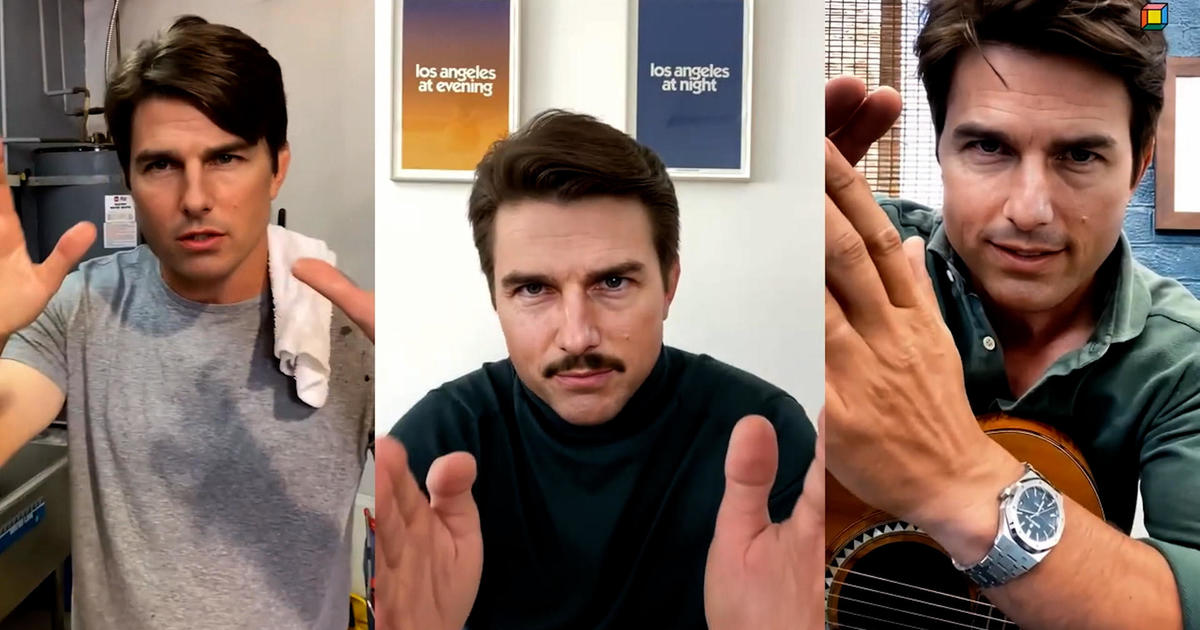
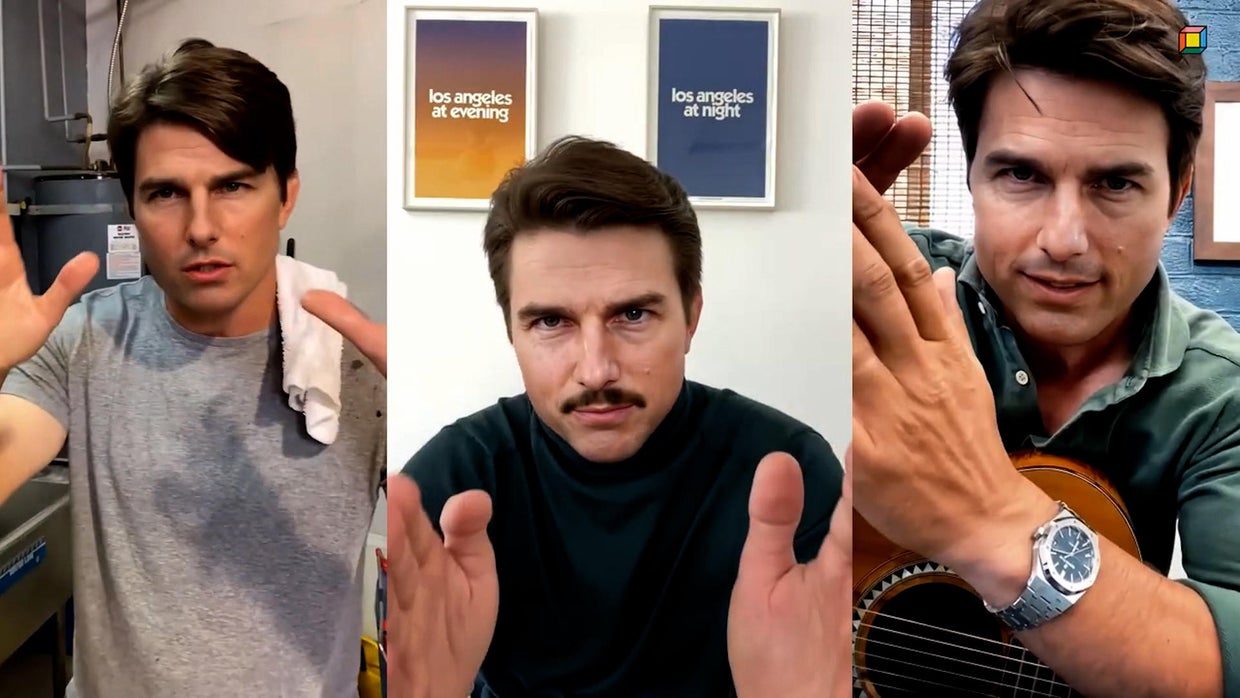
This is not Tom Cruise. It can be one particular of a series of hyper-practical deepfakes of the movie star that started showing up on the video clip-sharing application TikTok earlier this yr.

Deepfake Tom Cruise: Hey, what’s up TikTok? 

For days people today wondered if they ended up true, and if not, who experienced developed them.

Deepfake Tom Cruise: It is really important.  

Last but not least, a modest, 32-year-aged Belgian visual consequences artist named Chris Umé, stepped forward to claim credit rating. 

Chris Umé: We considered as extensive as we are making crystal clear this is a parody, we are not executing something to damage his picture. But immediately after a couple of films, we recognized like, this is blowing up we are having millions and tens of millions and tens of millions of views.

Umé states his operate is designed easier due to the fact he teamed up with a Tom Cruise impersonator whose voice, gestures and hair are approximately identical to the authentic McCoy. Umé only deepfakes Cruise’s confront and stitches that onto the actual video and sound of the impersonator.

deepfakesscreengrabs03.jpg
Chris Umé

Deepfake Tom Cruise: That’s where by the magic takes place. 

For technophiles, DeepTomCruise was a tipping level for deepfakes.

Deepfake Tom Cruise: Nevertheless obtained it.

Invoice Whitaker: How do you make this so seamless?

Chris Umé: It commences with education a deepfake design, of study course. I have all the facial area angles of Tom Cruise, all the expressions, all the feelings. It can take time to generate a really excellent deepfake design.

Monthly bill Whitaker: What do you mean “schooling the design?” How do you train your computer system?

Chris Umé: “Instruction” means it’s heading to analyze all the photos of Tom Cruise, all his expressions, in comparison to my impersonator. So the computer’s gonna train by itself: When my impersonator is smiling, I’m gonna recreate Tom Cruise smiling, and which is, which is how you “educate” it. 

deepfakesscreengrabs06.jpg
A youthful variation of deepfake Invoice Whitaker

Chris Ume/Metaphysic  


Making use of video clip from the CBS News archives, Chris Umé was equipped to teach his personal computer to master each individual facet of my experience, and wipe absent the decades. This is how I appeared 30 decades ago. He can even remove my mustache. The options are endless and a little frightening.

Chris Umé: I see a whole lot of problems in my do the job. But I you should not brain it, essentially, mainly because I never want to idiot people. I just want to present them what is probable.

Bill Whitaker: You you should not want to fool people today.

Chris Umé: No. I want to entertain persons, I want to raise recognition, and I want 

and I want to present exactly where it truly is all going. 

Nina Schick: It is with out a doubt a person of the most critical revolutions in the long term of human conversation and perception. I would say it really is analogous to the delivery of the world-wide-web.

Political scientist and engineering specialist Nina Schick wrote one particular of the very first books on deepfakes. She 1st arrived across them 4 yrs back when she was advising European politicians on Russia’s use of disinformation and social media to interfere in democratic elections.

Invoice Whitaker: What was your reaction when you to start with recognized this was achievable and was heading on?

Nina Schick: Effectively, specified that I was coming at it from the point of view of disinformation and manipulation in the context of elections, the actuality that AI can now be made use of to make pictures and online video that are bogus, that glance hyper real looking. I imagined, effectively, from a disinformation standpoint, this is a match-changer.

deepfakesscreengrabs09.jpg
Nina Schick

So considerably, there’s no proof deepfakes have “modified the activity” in a U.S. election, but before this 12 months the FBI set out a notification warning that “Russian [and] Chinese… actors are applying artificial profile visuals” — developing deepfake journalists and media personalities to spread anti-American propaganda on social media. 

The U.S. army, legislation enforcement and intelligence businesses have kept a cautious eye on deepfakes for a long time. At a 2019 listening to, Senator Ben Sasse of Nebraska requested if the U.S. is prepared for the onslaught of disinformation, fakery and fraud.

Ben Sasse: When you believe about the catastrophic potential to public believe in and to marketplaces that could appear from deepfake assaults, are we organized in a way that we could probably react speedy adequate?

Dan Coats: We plainly need to have to be additional agile. It poses a significant risk to the United States and something that the intelligence local community requires to be restructured to deal with. 

Given that then, technological know-how has continued shifting at an exponential rate although U.S. policy has not. Endeavours by the authorities and large tech to detect artificial media are competing with a community of “deepfake artists” who share their newest creations and methods on line. 

Like the internet, the very first place deepfake technological know-how took off was in pornography. The unhappy fact is the the greater part of deepfakes now consist of women’s faces, primarily famous people, superimposed onto pornographic movies.

Nina Schick: The 1st use scenario in pornography is just a harbinger of how deepfakes can be utilized maliciously in a lot of different contexts, which are now starting to crop up. 

Bill Whitaker: And they are finding greater all the time?

Nina Schick: Certainly. The extraordinary factor about deepfakes and artificial media is the tempo of acceleration when it comes to the know-how. And by 5 to seven several years, we are essentially on the lookout at a trajectory in which any solitary creator, so a YouTuber, a TikToker, will be capable to produce the exact level of visible results that is only accessible to the most perfectly-resourced Hollywood studio now.

deepfakesscreengrabs13.jpg
An illustration of a deepfake

Chris Ume/Metaphysic   


The technological know-how guiding deepfakes is synthetic intelligence, which mimics the way people master. In 2014, researchers for the initial time employed personal computers to make reasonable-hunting faces applying something called “generative adversarial networks,” or GANs.

Nina Schick: So you established up an adversarial video game the place you have two AIs combating just about every other to consider and create the best faux synthetic written content. And as these two networks beat every other, a person striving to make the greatest graphic, the other seeking to detect the place it could be much better, you essentially close up with an output that is progressively improving upon all the time. 

Schick claims the ability of generative adversarial networks is on total display at a web page known as “ThisPersonDoesNotExist.com”

Nina Schick: Every single time you refresh the site, you can find a new picture of a human being who does not exist.

Each and every is a just one-of-a-type, completely AI-created impression of a human remaining who hardly ever has, and under no circumstances will, stroll this Earth.

Nina Schick: You can see each and every pore on their deal with. You can see each hair on their head. But now consider that technological know-how staying expanded out not only to human faces, in nonetheless photographs, but also to movie, to audio synthesis of people’s voices and that is actually the place we are heading proper now.

Monthly bill Whitaker: This is head-blowing.

Nina Schick: Of course. [Laughs]

Bill Whitaker: What’s the favourable side of this?

Nina Schick: The technological know-how alone is neutral. So just as undesirable actors are, with out a doubt, heading to be using deepfakes, it is also heading to be applied by superior actors. So 1st of all, I would say that you can find a quite compelling situation to be created for the commercial use of deepfakes.

deepfakesscreengrabs16.jpg
Victor Riparbelli

Victor Riparbelli is CEO and co-founder of Synthesia, primarily based in London, 1 of dozens of providers making use of deepfake engineering to renovate online video and audio productions.

Victor Riparbelli: The way Synthesia performs is that we’ve fundamentally replaced cameras with code, and after you happen to be performing with application, we do a lotta points that you wouldn’t be capable to do with a regular digicam. We are still very early. But this is gonna be a fundamental modify in how we build media.

Synthesia will make and sells “digital avatars,” applying the faces of paid actors to provide personalised messages in 64 languages… and permits corporate CEOs to tackle employees abroad.

Snoop Dogg: Did anyone say, Just Try to eat?

Synthesia has also served entertainers like Snoop Dogg go forth and multiply. This elaborate Television commercial for European foodstuff delivery provider Just Try to eat cost a fortune.

Snoop Dogg: J-U-S-T-E-A-T-…

Victor Riparbelli: Just Eat has a subsidiary in Australia, which is named Menulog. So what we did with our technologies was we switched out the term Just Take in for Menulog. 

Snoop Dogg: M-E-N-U-L-O-G… Did any person say, “MenuLog?”

Victor Riparbelli: And all of a unexpected they had a localized variation for the Australian current market with out Snoop Dogg possessing to do anything at all.

Monthly bill Whitaker: So he helps make 2 times the funds, huh?

Victor Riparbelli: Yeah.

All it took was 8 minutes of me reading a script on digital camera for Synthesia to generate my synthetic speaking head, finish with my gestures, head and mouth movements. A further business, Descript, used AI to develop a synthetic model of my voice, with my cadence, tenor and syncopation.  

Deepfake Invoice Whitaker: This is the consequence. The words and phrases you are hearing ended up by no means spoken by the genuine Monthly bill into a microphone or to a camera. He simply typed the terms into a laptop or computer and they arrive out of my mouth.     

It may well appear and sound a minor rough close to the edges proper now, but as the engineering enhances, the opportunities of spinning words and photos out of slender air are unlimited. 

Deepfake Bill Whitaker: I am Bill Whitaker. I am Monthly bill Whitaker. I am Invoice Whitaker.

Bill Whitaker: Wow. And the head, the eyebrows, the mouth, the way it moves.

Victor Riparbelli: It’s all synthetic. 

Invoice Whitaker: I could be lounging at the seaside. And say, “Individuals– you know, I am not gonna appear in currently. But you can use my avatar to do the perform.”

Victor Riparbelli: Probably in a few many years.

Monthly bill Whitaker: Do not inform me that. I’d be tempted.

deepfakesscreengrabs19.jpg
  Tom Graham

Tom Graham: I think it will have a major influence.  

The fast advances in artificial media have brought on a virtual gold rush. Tom Graham, a London-based mostly lawyer who designed his fortune in cryptocurrency, lately commenced a corporation called Metaphysic with none other than Chris Umé, creator of DeepTomCruise. Their aim: establish application to allow for any individual to create hollywood-caliber flicks with no lights, cameras, or even actors.

Tom Graham: As the components scales and as the styles turn out to be additional efficient, we can scale up the measurement of that design to be an whole Tom Cruise physique, motion and every thing.

Monthly bill Whitaker: Nicely, converse about disruptive. I imply, are you gonna put actors out of work opportunities?

Tom Graham: I think it is a wonderful matter if you are a perfectly-recognized actor currently simply because you could be ready to enable someone collect data for you to build a version of you in the long term the place you could be acting in films following you have deceased. Or you could be the director, directing your more youthful self in a film or a little something like that. 

If you are pondering how all of this is lawful, most deepfakes are regarded protected free speech. Attempts at laws are all in excess of the map. In New York, commercial use of a performer’s synthetic likeness without the need of consent is banned for 40 several years after their dying. California and Texas prohibit deceptive political deepfakes in the lead-up to an election. 

Nina Schick: There are so several moral, philosophical grey zones listed here that we definitely have to have to imagine about.  

Invoice Whitaker: So how do we as a society grapple with this?

Nina Schick: Just knowing what is actually heading on. Simply because a good deal of people today even now will not know what a deepfake is, what artificial media is, that this is now doable. The counter to that is, how do we inoculate ourselves and recognize that this kind of written content is coming and exists without the need of remaining entirely cynical? Suitable? How do we do it without the need of losing have confidence in in all authentic media?

Which is going to have to have all of us to determine out how to maneuver in a environment wherever seeing is not always believing.

Produced by Graham Messick and Jack Weingart. Broadcast affiliate, Emilio Almonte. Edited by Richard Buddenhagen.