The World Cup’s New High-Tech Ball Will Change Soccer Forever

When the 2022 World Cup made its debut on Sunday, it kicked off one of the most significant in-game uses of technology in sports history.

All tournament long, match balls will contain a sensor that collects spatial positioning data in real time — the first World Cup to employ such a ball-tracking mechanism. This, combined with existing optical tracking tools, will make VAR (video assistant referees) and programs like offside reviews more accurate and streamlined than they’ve ever been. Combining these two forms of tracking has long been a holy grail of sorts in technology circles, and FIFA’s use of the ball sensor in particular will serve as a highly public test case over the next four weeks.

Like so many other parts of the burgeoning world of sports tech, the setup used at the World Cup is both an endpoint and the foundation of a whole new era. Years of research and testing were needed to get here — this particular ball sensor was in development and testing for six years before receiving full FIFA certification — but events like this could quickly catapult emerging technology into the public eye through applications that stretch well beyond officiating.

What went into the development of today’s tracking technology, and what are its key uses at this World Cup? How has the tech been tested, and how can players, teams and fans alike be confident that it’s accurate and consistent? And maybe most importantly, what does this same technology portend for the future of analysis, fan engagement and team data across the world’s most popular sport?

I spoke to people across the world of sports tech to find answers around one of the field’s boldest experiments to date.

Which technology is being used, and how does it work?

FIFA’s application of this technology at the 2022 World Cup is being termed a “semi-automated offside” program – one that’s largely run by AI features, but retains a vital element of human confirmation.

Within every match ball is a device designed by KINEXON, a major player in the performance-tracking world across several sports. Per the company, this device weighs 14 grams (just under 0.5 ounces), and actually houses two separate sensors operating simultaneously:

  • Ultra-wideband (UWB) sensor: A type of technology that’s superior to GPS or Bluetooth for precise positional data, plus can transmit data in real time to constantly track the ball’s position.
  • Inertial measurement unit (IMU) sensor: A sensor meant to detect nuanced movements of an object in space.

“While the ultra-wideband helps me to have the position of an object, the IMU gives me the granular movement in three dimensions,” said Maximillian Schmidt, co-founder and managing director of KINEXON.

So any time the ball is kicked, headed, thrown or even so much as tapped, the system picks it up at 500 frames per second. Data is sent in real time from sensors to a local positioning system (LPS), which involves a setup of network antennas installed around the playing field that take in and store the data for immediate use. When a ball flies out of bounds during the course of play, and a new ball is thrown or kicked in to replace it, KINEXON’s backend system automatically switches to the new ball’s data input without the need for human intervention.

KINEXON’s in-ball device is supported by suspension technology provided by Adidas, designed to house the sensor at the central interior point of the ball and keep it secure in a consistent location.

Paired with this ball sensor is optical camera tracking from Hawk-Eye, a system well known for its work in tennis. Twelve Hawk-Eye cameras are set up around the stadium, tracking both the ball itself and each player 50 times per second. Twenty-nine separate points of the body are tracked for players, including limbs.

When combined, these two data sources allow for offside decisions that are not just highly accurate, but also available much faster than in the past – a major priority for FIFA in this World Cup cycle.

“We debriefed in 2018 after the World Cup,” Nicolas Evans, head of football research and standards for FIFA Technology Innovation, said. Such a debrief is standard after each World Cup, according to Evans. “The biggest area for improvement we saw was the time it took to make offside decisions.”

With that in mind, data from both KINEXON and Hawk-Eye is run through artificial intelligence software that’s programmed to generate automated offside alerts to officials in the match’s video room. Instead of manually combing through plays, a time-consuming process, AI programs auto-generate alerts that can then be confirmed by video match officials.

The software also generates 3D renderings of the spatial data, which will be overlaid onto TV broadcasts and in-stadium monitors to give fans a direct look at how each reviewed call was decided.

How accurate is this data? How is it tested?

Some readers might have an understandable question at this point: “How do I know this data consistently reflects the true positioning of the players and ball?”

The first concept to understand here is refresh rate, which is measured in Hz and refers to the number of times per second that a given display is able to draw a new image. Standard 50Hz video, a common format used for HD monitors today, is generating a new image 50 times per second (or a “frame rate” of 50 frames per second, for those more familiar with that term). Anyone who has slowed a video down to frame-by-frame mode knows the sensation of slight periods of time passing between each frame – and for 50Hz video, that gap is 20 milliseconds per frame (for 60Hz video, it’s 16.66 milliseconds per frame, and so on).

With KINEXON’s ball-tracking system, that data is coming in at 500Hz, meaning any gaps in true positioning are below two milliseconds long – or 10 times shorter than standard 50Hz lags. Furthermore, the use of a PTP master clock allows synchronization between KINEXON and Hawk-Eye data that’s precise down to one-millionth of a second, per Evans, ensuring the two feeds are never out of whack with one another.

To check each component of the system, FIFA has conducted tests in both controlled and live settings.

For both the KINEXON ball sensors and Hawk-Eye’s optical camera setup, a format known as “ground truth testing” is required by FIFA’s Quality Programme for Electronic Performance Testing Systems (EPTS). The approach utilizes a minimum of 36 high-quality Vicon motion-capture cameras, combined with reflective markers designed for these cameras placed on the ball itself and every player for ultra-accurate detection. As players and the ball move around the testing pitch, both these Vicon cameras and the KINEXON/Hawk-Eye setups run simultaneously – and researchers compare the two outputs to assess the accuracy of the latter systems. This testing is augmented by the use of other tools, such as a laser to detect events like high-speed player sprints.

Another kind of test is also vital here, especially for one of the world’s most-watched sporting events: Ensuring that the addition of a sensor inside the ball is imperceptible to the players kicking it. Since it’s all too easy to envision a scenario in which a prominent player blames the feel of the “different” World Cup ball for a missed penalty or some other on-pitch failure — igniting a worldwide controversy — eliminating such concerns is naturally important.

Adidas is the key entity responsible for this kind of testing, which sources familiar with the program report is done in two ways:

  • Blind player testing: With the help of clubs in places like Spain, Germany and England, extensive blind testing was carried out to see if players could tell the difference between “normal” balls and balls infused with the sensor/suspension setup without knowing which was which ahead of time.
  • Mechanical shooter testing: In a lab setting, robotic shooting devices can be programmed to “kick” the ball at varying speeds, spins and directions. High-speed cameras then evaluate the flight of the ball, ensuring that the presence of the sensor does not create abnormal flight paths.

This testing was performed in several professional and grassroots settings, such as the 2021 FIFA Arab Cup in Qatar and the 2021 FIFA Club World Cup in Abu Dhabi. In addition, Evans said FIFA ran several of its own additional blind tests, including at a team workshop in Qatar earlier in 2022.

“Together with our partner Adidas, large-scale sample blind tests have been carried out where no differences could be observed by players between the connected ball and the regular ball,” Evans said.

These and similar forms of tech also have been getting real-life test runs for years now. An earlier version of KINEXON’s sensor-infused ball was used alongside jersey tracking in 2018 in Germany’s fourth-tier Regionalliga to bring real-time data to a live TV broadcast; a newer setup was used earlier this year during a German academy club match. The Hawk-Eye camera setup, meanwhile, has been utilized in the UEFA Champions League group-stage matches throughout the early part of this season in the lead-up to the World Cup.

Of course, none of this guarantees an incident-free event. Unforeseen circumstances can come up in the world of tech. Equipment can malfunction. Even in the likely scenario that the tech works perfectly from start to finish, good luck convincing crazed sports fans of that if their country’s top player has trashed the tracked ball or suggested the system isn’t accurate.

Such possibilities are all but unavoidable in the end. But the companies involved are confident they’ve met every important threshold to introduce this new level of technology into the world’s most important soccer competition.

“[It’s] probably as good as it’s ever been in this type of technology,” Evans said.

This is the tip of the technological iceberg

The 2022 World Cup is barely scratching the surface of the potential capabilities of this sort of technology – which go well beyond officiating.

Before long, this combination of ball- and optical-tracking could be a familiar tool to everyone involved with the sport — much like Second Spectrum tracking in the NBA or Hawk-Eye in tennis. Teams and players could use the resulting data for next-generation tactical analysis; broadcasts could use it to visualize the game and draw in new viewers. Fans could eventually have access to a vast ocean of new stats that were never possible until now.

In fact, this already has started happening.

Earlier in 2022, KINEXON’s ball sensor was used in a Liga Portugal relegation match, along with sensors in player jerseys to track their movements. More than 300 different metrics were collected in multiple categories, including technical data (shot and pass speed, ball possession time, distinct ball actions), performance data (dribbling speed, accelerations and sprints — both with and without the ball — plus measures of athlete “load”) and tactical data (for both teams and players, tactical concepts such as space control, pressing, ball gains/losses and counters can be tracked).

Possible applications of this data, especially once it’s a more standardized part of the game and the parties involved become familiar with using it, are virtually limitless.

“We can use that information in real time to tell new stories,” Schmidt said. “[We can use] them to create virtual worlds, augmented overlays, insights on performance of players.”

For one thing, expect soccer fans to have new ways of enjoying the game based on this advanced tech. The first layer here will be broadcast improvements: More 3D immersive graphics, similar to the offside renderings 2022 World Cup viewers will see, could be used in several new ways – even those that viewers control. We’ll also see overlaid on-screen data, much like the LA Clippers’ “CourtVision” broadcast option that displays tracking information and a digitized view of the court during play.

And the next wave after that is even more exciting to think about. The world of virtual reality offers tantalizing potential; imagine watching plays (or even an entire game) from the direct vantage point of Kylian Mbappe, Karim Benzema or any other player of your choosing. Evans and others in the space also expect this data to eventually make its way into the world of video games, merging real and digital realms.

That’s just on the fan side. As the 2022 World Cup tracking setup becomes more commonplace around soccer, players and teams will now have a wealth of new data, particularly surrounding the ball – the true heartbeat of the sport. Tactics, analytics and even all-important health and performance improvements are all on the table.

Said Schmidt: “More and more leagues are now thinking about, ‘How can we enhance the already existing dataset with new insights from the ball?’ Because it’s the head of the game.”

So as tech continues to change the way we view sports, the 2022 World Cup stands poised to serve as a watershed moment. When you see that first “semi-automated” offside call, remember what it took to get to this point – and daydream about what the near future holds.

Check out our latest World Cup predictions.

Inside the futuristic tech travel trend that could make your next trip truly out of this world

What do Pokémon GO and the COVID pandemic have in typical? The two have radically accelerated the convergence of technologies and journey.

Pokémon’s preferred cellular activity proved that a inventive application of augmented actuality (AR) was adequate to spur end users to check out the real-world.

The onset of the pandemic manufactured the exact same situation for digital reality (VR): present consumers with a way to pretty much travel the world and they’ll lace up their metaversal trainers.

The opportunity of AR and VR to greatly enhance the travel practical experience grew by leaps and bounds in the course of the pandemic as journey firms, points of interest and destinations ended up compelled to undertake technology in approaches they’d never tried out prior to.

As we navigate a submit-pandemic environment, the identical absorbing technologies will be used to enrich the visitor practical experience, rather than replicate it. AR, VR and the metaverse will exponentially develop inside our actual physical globe, immersing travellers in a technologies-driven pattern that will continue significantly outside of 2023.

VR can help travellers investigate aged corners of the environment in new strategies

Prior to the pandemic, emerging technologies like AR and VR were largely dismissed by desired destination internet marketing boards and travel organizations. When the world came to a standstill in 2020, these technologies turned a lifeline for those people with constrained shops for their wanderlust.

The transition happened almost right away: suddenly, globetrotters could choose a tour of a cobbled medieval town in Romania, sign up for ice bathers in Helsinki or go buying in the fragrant souks of Marrakech – all with no at any time leaving their sofas.

Local Purse is among the these pandemic-induced innovations. A collaboration withadventure travel business Intrepid, the application gives stay, personalised online video shopping experiences all around the world. It offers travellers with a way to handpick artisan goods from countries like Morocco, Mexico and Peru, then have them transported straight to their houses.

“Technology as very simple as cellphones can quickly hook up us with remote communities,” says Lola Akinmade Åkerström, the app’s Stockholm-dependent co-founder.

She believes that the Community Purse working experience rewards all involved. It will make vacation accessible and inclusive for travellers with mobility troubles. It helps corporations minimize their carbon footprints by lessening actual physical vacation. And it presents a sustainable supply of money and natural and organic relationship to area guides and cultural artisans.

“Local Purse supplies highest impact travel with small footprint and fulfils at minimum six UN Sustainable Advancement Targets,” suggests Lola.

“By focusing on regionally-made and sourced do the job created by these artisans and suppliers, we are facilitating and supporting responsible cultural link.”

Now, virtual vacation is evolving. Armed with the choices of VR that the pandemic unleashed, a handful of cultural attractions have started off to seem at how they can gain from virtual enhancements.

Notre Dame’s VR working experience delivers ‘time travel’ to Paris

Freed from the limits of actuality, VR and AR technology is enabling critical tourist web-sites to immerse website visitors like in no way just before. Not only does it increase the abilities for storytelling and academic reasons, but the integration of VR and AR technological know-how can breathe new everyday living into even the most visited of destinations.

The collapsed Mayan kingdom could be brought to lifestyle at the temples of Chichen Itza in Mexico, for case in point. Morocco’s Roman metropolis of Volubilis could be pieced again alongside one another to make feeling of all the isolated columns and properly worn flooring mosaics.

France is a single place at the forefront of this hybrid tourism, as evidenced by the Eternal Notre Dame VR experience in Paris. Billing alone as ‘time travel’, the partaking 45-moment tour can take you as a result of the cathedral’s 850-calendar year historical past at breakneck pace. It enables holidaymakers to phase into a dwelling, respiration variation of Notre Dame’s ageing, hearth-battered shell.

The corporation driving the expertise, Emissive, phone calls its operate ‘immersive expeditions’ that are created to be shared.

“VR is complementary to an genuine check out, introducing a new perspective on the spot,” suggests Emissive CEO Fabien Barati. “VR delivers far more: allowing entry to spots shut to the public and even travelling in time to discover cultural internet sites in their unique context and fulfill historic characters.”

Which other international locations are adopting VR-improved vacation?

The similar strategies are used in Carcassonne in France’s Languedoc location, where a 30-moment VR experience inside the citadel’s fortress partitions lets vacationers to journey via different intervals of its heritage.

Germany is also implementing the hybrid tourism concept. In September 2022, Hamburg utilized AR to glance the two to the earlier and future, when world-wide technological know-how brand name Honor challenged two artists to creatively reimagine the Wasserschloss, an legendary UNESCO-detailed landmark.

“The project aims to inspire world-wide innovative expertise to leverage improvements such as AI [artificial intelligence], AR and Spatial Audio to connect communities with culture in far more immersive approaches and support the world wide tourism rebound, as the entire world embraces the linked upcoming,” states Honor.

AR and VR have the one of a kind potential to not only maintain the previous but also safeguard the long term of heritage points of interest. Place-centered VR encounters could be utilized to minimise additional hurt at fragile sites that are struggling from extreme tourist footfall, for example.

This engineering can also be employed on a national scale to stimulate sustainable tourism. Egypt’s governing administration is formally embracing augmented actuality and digital actuality to enhance both ecotourism and health care tourism.

The country’s Ministry of Setting is top a campaign identified as Eco Egypt, a VR-dependent initiative that aims to encourage ecotourism within lesser-visited safeguarded spots this sort of as the White Desert and Taba.

Similarly, in June of 2022, Egypt’s General Authority for Health Care announced a new program to boost professional medical tourism via augmented actuality. This use of technologies will allow potential individuals to just about tour health care facilities and find out additional about their capabilities.

As the entire world moves deeper into the metaverse, it’s distinct that these emerging technologies will proceed to come across application and integration in the travel market.

The pretty much enhanced locations trend is explored in much more detail in Expedia and Euronews Travel’s Pattern Report.

Arizona company using new technology to help solve water crisis, address world hunger

PHOENIX (3Tv set/CBS 5) – Sam and John Bertram want to alter the globe, and they are off to a good begin. Their tech corporation OnePointOne is hunting to revolutionize worldwide foods generation by producing a new way to grow fruits and veggies.

“I want to channel whichever electricity I have in direction of enhancing humanity,” explained Sam Bertram. “The finest way to do that is determine the variety just one problem on world earth, and the number just one trouble is inadequate nutrition. Our goal is to create a program that grows best quality vegetation in the world and to offer these programs around the globe for any crop, any market place, any geography.”

Arizona’s Family members was invited into their Avondale warehouse for an within appear at what they do. The warehouse incorporates an elaborate plant output program that takes advantage of vertical farming and automation to expand higher-good quality crops with out any sunshine, soil, or pesticides, and takes advantage of minimal drinking water. At a time when Arizona and other elements of the environment are facing intense drought, the process will allow foods to develop utilizing 99{4224f0a76978c4d6828175c7edfc499fc862aa95a2f708cd5006c57745b2aaca} significantly less drinking water than a standard farm.

“We don’t eliminate the drinking water we irrigate the plants with,” mentioned Sam Bertram. “Outside when you h2o the crops, all the water goes up into the ambiance, or down into a water table, or operates off into rivers. For us, all the drinking water not absorbed by the roots receives recirculated all around and close to and close to. We just really don’t shed that h2o.”

Some of the other rewards include things like the pursuing:

  • The plants develop twice as rapidly as those people on a farm.
  • The regular shelf life of the food items is 3 moments extended.
  • The plants can be grown anywhere in the entire world all yr spherical.
  • The corporation can mature 250 situations more plants for every acre in the warehouse than in a industry.

Proper now, the firm is only growing leafy greens, herbs, and micro-greens, but options are underway to get started expanding strawberries. According to Bertram, just about every crop they expand takes a lengthy time to acquire. The Bertrams consider that what their doing is comparable to the electrical car or truck business, an industry that everybody is aware of is much more effective and far better for the atmosphere but takes decades to extend and grow and come to be economically viable.

The thought of placing vertical farming warehouses in countries all-around the entire world is what keeps the Bertrams heading. “Whether it can take me, us, 10 decades, 15 decades, 20 a long time to influence a billion people’s life, that is the target,” said Sam Bertram.

OnePointOne does provide its veggies for sale to the general public via its other organization Willo. For far more specifics pay a visit to https://willo.farm/.

The robot named Baxter that wanted to change the world of work

In this weekly series, CNBC will take a appear at providers that manufactured the inaugural Disruptor 50 list, 10 yrs later on.

One of the enduring classes of the Iphone era is that Steve Employment led with what the shopper didn’t know they wished till he confirmed it to them. Robotics pioneer Rodney Brooks has operated from a related plan — with varying degrees of accomplishment.

His robot vacuum cleaner Roomba, and its parent firm iRobot, which additional or much less built the group of robotic vacuums an inexpensive, need to-have for a lot of shoppers, was not long ago marketed to Amazon for $1.7 billion.

“iRobot identified a product-market healthy. It had a aspect set and a price that lots and heaps of men and women ended up willing to shell out for, that puck-formed point that cleans the ground rather very well,” mentioned Matt Beane, an assistant professor in the engineering management program at the University of California, Santa Barbara, and a robotics qualified.

But yet another of Brooks’ significant, early strategies, hasn’t worked out the way he or the entire world imagined.

Rethink Robotics was launched in 2008 with the notion that a cobot — a robot doing work alongside humans in methods that regular automation couldn’t (i.e. with a lot significantly less threat to the human), and devoid of the fencing that most industrial robots remained within — was a sector waiting around to be manufactured among the industrial customers. But for all the novel ideas that Brooks and his Rethink colleagues introduced to the desk, its very first cobot hardly ever caught on.

It caught on in the push, for confident, and if you were subsequent tech news at the commencing of the very last ten years you probably observed Baxter and “his eyes” staring out from the monitor between his arms at some point in a picture or movie footage. At CNBC, we uncovered firsthand the constraints of performing with novel industrial robots when we invited Baxter on-air for a dwell section as aspect of Rethink getting named to the inaugural Disruptor 50 listing in 2013. For specialized causes, it would have been a lot additional difficult than we imagined to get Baxter on to the tv studio established.

Even though he could not be a component of the robotic foreseeable future any longer, there is no background of the cobot that can be created devoid of Baxter.

“There is no these matter as the cobot devoid of Rod Brooks,” Beane mentioned. “Rethink commenced the market.”

After a large amount of early fanfare, reality established in for Rethink. By 2018, it was having difficulties to scale its operations and come across ample potential buyers for Baxter, with its two-armed style and design proving to be a novel idea, but a oversight. “No 1 desires a two-armed robot,” Beane reported, describing that structure determination as “people projecting on to a robotic their have bodily kind.”

Rethink pivoted, in what turned out to be a go designed much too late, to a one particular-armed robotic named Sawyer. But the technologies had other issues.

Rethink wager on an solution that used elastic actuators — a technological innovation a person of Brooks co-founders was an pro on — which permitted the robotic to complete “force sensing,” an approach the enterprise backed simply because it would make the robots safer all around human coworkers. Rethink’s design and style would also make the robots lower cost, finding rid of conventional business reliance on motors and connected components.

Paul Maeder, a mechanical engineer who invested early in Rethink through his VC company, informed the American Society of Mechanical Engineers in a submit-mortem on Rethink that goes deep into the technical shortcomings, that much less expensive parts in addition power sensing appeared like the way to deliver down pricing in the robotics marketplace and enchantment to clients.

And it did bring down pricing.

“The actuality is that they experienced a very minimal price position, shockingly low,” Beane said. “They had done an incredibly excellent work at materials sourcing and layout, and they had been headed to one-third or a person-quarter of the price for other robots.”

But Rethink in no way reached the sector penetration or scale it required to preserve its functions. As the financials worsened, Rethink turned the acquisition focus on of a Chinese business, a deal Beane claims would have had a great shot at acquiring the agency to scale. But that deal was scuttled “at the last moment,” according to the corporation, and a 2018 personal bankruptcy adopted. Rethink was purchased out of bankruptcy by German automation company Hahn Group, which is even now attempting to make the engineering a good results these days.

In a statement supplied to TechCrunch at the time of its demise, Rethink reported, “We had been early to market place with a extremely innovative item that was forward of its time, and however, we did not achieve the professional results we had expected.”

It can be accurate Rethink had no scarcity of intriguing, revolutionary ideas, even if they weren’t the proper ones for the market.

According to Beane, 1 of the most intriguing was the ability for the cobot to be programmed by the employee. “Individuals really don’t make a lot of this feature any longer, but that was a graphic person interface process which failed to need code and you could train it, teach it to do a task as the worker,” Beane explained. “But no supervisor would transform these functions on,” he included.

That’s an strategy that Brooks is nevertheless performing on right now, via his newest robotics startup Robust.ai, co-launched with cognitive scientist Gary Marcus, which is producing a warehouse cobot, Carter, that is like a cellular purchasing cart giving transportation in just fulfillment facilities. “It can generate in any path and is employee programmable and can bodily collaborate,” Beane reported. “A good deal of the exact DNA is there.”

When Sawyer grew to become the direct cobot, Rethink invested in a know-how that built-in the cobot with preexisting industrial automation, an appealing strategy, but in the end, one more bottleneck that was highly-priced in engineering time to connect and to get to converse with equipment like conveyors. “Just to change the velocity of a conveyor is extremely high priced,” Beane said.

The DNA that has grow to be conventional in the cobot current market that Baxter, and later Sawyer, hoped to dominate, is from Rethink rival and Denmark-dependent Universal Robots. While its cobots may perhaps be “extremely monotonous searching” in Beane’s perspective, they were what the market in the end desired.

“In the stop, the sequence elastic actuators were being likely not the ideal notion in the globe,” Maeder explained to ASME. “What shoppers actually want is a reduced-cost, simple, quickly, repeatable robotic. They want to put something in this precise place yet again, and once again and once more. In the close, that was a ton additional complicated for us to obtain than for some of our opponents since they weren’t making an attempt to do power sensing.”

Even the two arms that Baxter had could generally be procured by a customer if they seriously needed that solution, by paying for two solitary-arm robots, and that is what Common Robots — which was obtained by industrial automation firm Teradyne in 2015 — excels at, with its UR3, UR5 and UR7 cobots top to improved income, and successive generations of its cobot line continuing to hit the industry.

The possibility for robotics technologies continues to be considerable, while it is even now trailing other automation techniques in market penetration. Robot profits in the North American current market have been growing, and the Teradyne unit led by Common Robots is observing regular, if not explosive, product sales growth, as well. Earnings was $300 million in 2019, and then enhanced to $376 million past 12 months soon after a Covid dip. In accordance to Wall Avenue estimates, sales could access $440 million this year, or about 18{4224f0a76978c4d6828175c7edfc499fc862aa95a2f708cd5006c57745b2aaca} growth. That progress fee is greater than the percentage of total income it signifies, which is even now underneath 15{4224f0a76978c4d6828175c7edfc499fc862aa95a2f708cd5006c57745b2aaca}.

“A good deal a lot more will take place,” Beane mentioned. “Progress frequently appears to be gradual up close … but the utility of a robotic system that can achieve normal responsibilities at a realistic cost is incredible, billions, possibly trillions well worth of price,” he added.

And expenditures continue to keep going down, from batteries to sensors and software, which means the price tag overall performance for robots keeps going up steadily. But exactly where the cobot finds its finest utility continues to be an open question. Though the industrial earth use has been in the first many years often as a lot a promoting ploy or, at best, an experiment somewhat than proof of prevalent adoption, there is rationale to forecast a number of roles for cobots based on an aging demographic.

“Anyone who says not in my life span, you better hope it is in your life span, for the reason that you will need to have assist,” Beane reported. 

He anticipates that jobs outside of the producing sector with which cobots have been linked — from warehousing to retail, health care (feel cobots bringing materials to nurses) and retirement communities — are parts poised for developing use. “Producing is about substantial throughput and significant consistency and you can automate the heck out of it with out a cobot,” Beane explained. “We’re only just finding began on this capacity remaining useful and utilized at scale.”

Rodney Brooks is amid the robotics industry experts who has spoken about a world that is having more mature and a doing work population that is not as powerful. He wrote in a web site submit masking his yearly predictions that “soon the houses of the aged will be cluttered with also lots of robots.”

Wall Road analysts are targeted on the chance presented by a continual labor shortage, and connected changes getting location in a world wide outsourcing paradigm which economies which includes the U.S. have been relying on for many years. With “around shoring” and onshoring of extra producing exercise, there is raising demand from customers for labor in a limited labor sector. One response is automation, and technological innovation like Common Robots is fairly uncomplicated to program and put into action.

But 1 significant difficulty the cobots have not however solved is the similar a single that started out Brooks down the Rethink route: figuring out what everybody wishes from this technological innovation, the “killer app,” so to speak, for the cobot. Common Robots has lots of distinctive apps for its know-how, but not a single one particular that drives powerful need within just 1 very large quantity market. That is a solvable difficulty, but even now a do the job in progress. Robots managing popcorn stations in a movie theatre or robotic cafe baristas aren’t the career prospect that takes the cobots to centre phase in the economic system. But there is a scarcity of folks and automation has to be a single of the solutions, even if it won’t materialize by tomorrow.

We have not achieved a planet of real actual physical collaboration among human worker and cobot, Beane suggests, “the form of stuff where humans reach about to get the following thing and the robotic sees I am reaching and palms it to me and we could even brush up in opposition to every other,” but, “We are having there,” he additional.

The automatic devices that are most broadly deployed stay the types that are far more hazardous and held at a length.

But Beane thinks that Rethink came closer to fixing the difficulty than it is supplied credit rating for, and has nonetheless to confirm in its new existence under Hahn. Hahn did not respond to a request for remark by press time.

“One more eight months and it’s possible they could possibly have gotten product-sector fit. It was affordable and dependable. I actually do consider we could have observed an Apple iphone moment,” Beane explained.

In his particular website, Brooks summed up the Rethink story this way: “Baxter and Sawyer were the initial harmless robots that did not need a cage to preserve humans away from them for the humans’ defense. And Sawyer was the 1st modern day industrial robotic which ultimately received away from possessing a laptop-like language to manage it, as all robots experienced due to the fact the plan was first created at the Stanford AI Lab back in the very early seventies. There is continue to a large amount remaining to be finished.”

App State alumna Juliet Irving ’19: A multimedia designer in the performance world

BOONE, N.C. — Appalachian Point out College alumna Juliet Irving ’19 has danced her way into a freelance vocation as a multimedia designer, combining her passions — doing arts, graphic structure and social justice.

&#13

“It makes these types of a big difference obtaining just one particular person imagine in you. But obtaining several people back you up? It was lifestyle-altering.”

&#13

Juliet Irving ’19, a freelance multimedia designer, reflecting on her mentors at App State.

&#13

As a dancer and choreographer, an artist and a social justice advocate, Irving made use of her blended standpoint to style and design a site for a cross-cultural dance collective, Indigo Property Gals a virtual exhibition titled Black Lives Issue: Brazil–U.S.A. and virtual sets for a manufacturing of the Shakespeare perform “The Tempest” — featuring administrators, actors and crew associates who are people of colour, including Black and Indigenous people today.

“The artists and dancers I’ve labored with have an appreciation for a person who can arrive in and quickly have an understanding of their wants and priorities. I know their vocabulary, and we share a language,” Irving said.

Irving said she hardly ever envisioned to work in website design, but her ordeals throughout the COVID-19 pandemic awakened new pursuits and aided her hone new capabilities, by necessity.

Soon after graduating from App State, she attended Duke University, the place she gained a Grasp of Wonderful Arts in dance. Though there, she experienced the chance to consult with as a designer for the Black Life Subject: Brazil–U.S.A. exhibition — an examination of parallels in the pursuit of racial justice involving the two Western Hemisphere countries with the major Afro-descended populations.

“It was supposed to be a wander-by way of gallery practical experience,” Irving said. “Then COVID transpired. We had to change anything into a virtual exhibition.”

With the change to on the net shipping, Irving said she transferred strategies developed for print into digital varieties and worked for the initially time on a large-scale web page. Considering the fact that, she has expanded her get the job done in the discipline and has developed web sites and virtual elements for a range of clientele.

View larger image

Juliet Irving ’19 acquired dual levels from Appalachian State University: a Bachelor of Good Arts in graphic structure and a Bachelor of Arts in dance reports. She established this graphic as a marketing for her thesis general performance at Duke University, exactly where she attained a Grasp of Fine Arts. Irving is effective as a freelance multimedia designer and life in Batesburg, South Carolina. Graphic courtesy of Juliet Irving

Generating her mark at Application Point out

Irving, who was a member of Application State’s Honors University, gained a Bachelor of Fantastic Arts in graphic design and a Bachelor of Arts in dance scientific tests. While attending Application Point out, Irving:

Irving mentioned dance has constantly been portion of her daily life. “Growing up, dance gave me a voice and felt like the most purely natural way for me to express myself,” she shared.

View larger image

Juliet Irving ’19, an alumna of Appalachian Point out University, executing in An Night of Dance held in Durham in September 2021. Photo submitted

Whilst in higher school, she enrolled in a Photoshop class. “I appreciated it so a great deal that I asked my teacher what occupations may well use people expertise. He informed me about graphic design,” she explained.

She appeared for a university with strong applications in both equally executing arts and graphic design and found App Point out. She scheduled a pay a visit to, and the instant she stepped foot on campus, it “just felt correct,” Irving mentioned.

Earning the Wilson Scholarship made it attainable for Irving to show up at Application State — an out-of-state faculty for the South Carolina native — and opened many doorways for her.

Through her senior yr, Irving acquired about an inaugural master’s system at Duke University.

“The graphic design and style and dance packages at App Point out laid the foundation for the interdisciplinary operate I accomplished for the duration of my master’s program at Duke,” Irving stated.

“It makes this kind of a big difference getting just a person individual think in you,” Irving reflected. “But possessing a number of men and women again you up? It was life-modifying.”

What do you assume?

Share your responses on this tale.

Juliet Irving — Six Weeks of Dance

Six weeks of back-to-again courses, of night performances, of late-night time conversations. 6 months of building connections, of sharing sweat, of developing artwork. Six months of exploring limits, of complicated conference, of increasing perspective. Read about Juliet’s six-7 days knowledge at Duke College for the American Dance Festival.

Honors' Juliet Irving ’19 joins the 1st cohort in the MFA in Dance at Duke

Oct. 10, 2019

The Honor College’s Juliet Irving ’19 joins the to start with cohort in the MFA in Dance: Embodied Interdisciplinary Praxis system at the Rubenstein Artwork Heart at Duke College. In this application, which seeks to “develop dance as a transformative social power,” Irving plans to focus on her choreographic operate.

“The alternatives I received have permitted me to take a look at my passions and establish a perception of who I am and who I want to be as a particular person. Moving into college I realized I required to be a graphic style and design significant I also wanted to be a dance key, but I was not certain if I wished to be labeled as an ‘arts’ important. Throughout the several years, I have figured out that getting involved with the arts does not indicate I have less credibility than a company main. This Wilson scholarship has served me notice that art and dance are my passions, and I have learned to be Ok with that.”

About the Office of Theatre and Dance

The Division of Theatre and Dance is a person of seven departments housed in Appalachian’s University of Wonderful and Utilized Arts. Its mission is to aid transformative activities for students and the community, which cultivate compassionate, artistic and collaborative communities through theatre and dance. The division also offers coursework for integrated learning as a result of the arts to the typical university student population. Its dynamic co-curricular creation software provides exemplary theatre and dance experiences to departmental students, the university group and the location. Discover much more at https://theatreanddance.appstate.edu.

About the Office of Artwork

One of seven departments housed in the College or university of Fine and Utilized Arts, the Office of Art at Appalachian Condition College prepares pupils to examine artwork, identity, expression and inventive difficulty-fixing whilst demanding them to go beyond their former limitations by discovering new connections to tradition. The division delivers degrees in artwork and visual society, art instruction, graphic layout, studio artwork, business photography and graphic communications management, with minors in artwork history, studio art, professional images and graphic arts and imaging engineering. Discover a lot more at http://www.art.appstate.edu.

About the University of Fantastic and Applied Arts

Appalachian Condition University’s Faculty of High-quality and Used Arts is a dynamic and impressive team of 7 educational departments, bringing alongside one another a variety of perspectives, experiences and real-globe schooling to offer exclusive options for pupil achievement. The college has far more than 3,000 undergraduate and graduate majors. Its departments are Used Layout, Artwork, Conversation, Armed service Science and Leadership, Sustainable Improvement, Sustainable Engineering and the Constructed Surroundings, and Theatre and Dance. Study extra at https://faa.appstate.edu.

About the Honors University

Extra than 500 college students are enrolled in Appalachian Condition University’s Honors University, which serves a numerous team of significant-attaining, superior-likely, really enthusiastic pupils from all majors. The Honors Higher education will help students build impartial and creative considering and significant-degree study techniques promotes interdisciplinary inquiry and nurtures cultured and caring exchanges of tips. The college’s increased academic working experience prepares learners for accomplishment in graduate or professional college and for leadership roles in their life, communities and professions. Master much more at https://honors.appstate.edu.

About Appalachian State College

As the leading general public undergraduate institution in the Southeast, Appalachian Point out University prepares learners to direct purposeful lives as international citizens who fully grasp and engage their tasks in developing a sustainable future for all. The Appalachian Working experience promotes a spirit of inclusion that brings folks alongside one another in inspiring strategies to get and build know-how, to grow holistically, to act with passion and determination, and to embrace variety and change. Situated in the Blue Ridge Mountains, Appalachian is just one of 17 campuses in the University of North Carolina Method. Appalachian enrolls practically 21,000 learners, has a lower student-to-school ratio and offers much more than 150 undergraduate and graduate majors.

Best Travel and Tourism Websites in the World 2022

Practically each individual vacationer these times is producing choices about their travels primarily based on what they see on-line. From themed trips to budgeted food excursions, tourists crave previews of possible places and surf the internet to master something they can about a new and fascinating location.

Due to extreme stages of pent-up travel demand from customers adopted by impulsive and impatient post-pandemic tourists, tourism web-site layout is more significant now than ever right before. The aggressive house for properly-created web sites is extra bold, and reliance on digital platforms as a dependable source for journey inspiration is at an all-time large. On the lookout at the Gen Z traveler, it’s effortless to notice that notice spans have shortened immensely, and visitors are managing journey setting up like a purchasing knowledge, choosing and deciding on features of their vacations soon after participating in a handful of seconds of attractiveness.

With that getting reported, tourism corporations are gradually mastering that the outdated approaches simply just don’t work any longer — paragraphs of information and facts on the display screen, redirection that continues tab right after tab, sluggish and clunky navigational ordeals, depressing shade palettes, and promotional descriptions of sites that do not respond to any of the definitely vital issues, especially for a extra mindful traveler apprehensive about local weather alter, and other threats.

After two a long time of rapidly-evolving digital advancement, quite a few internet websites have succeeded in breaking out of that boring and repetitive cycle. Below is Skift’s 2022 listing of ideal designed tourism sites — ones that strike the place the two visually and navigationally, and are getting note of what the modern traveler would like, how they believe, and most importantly, how they behave.

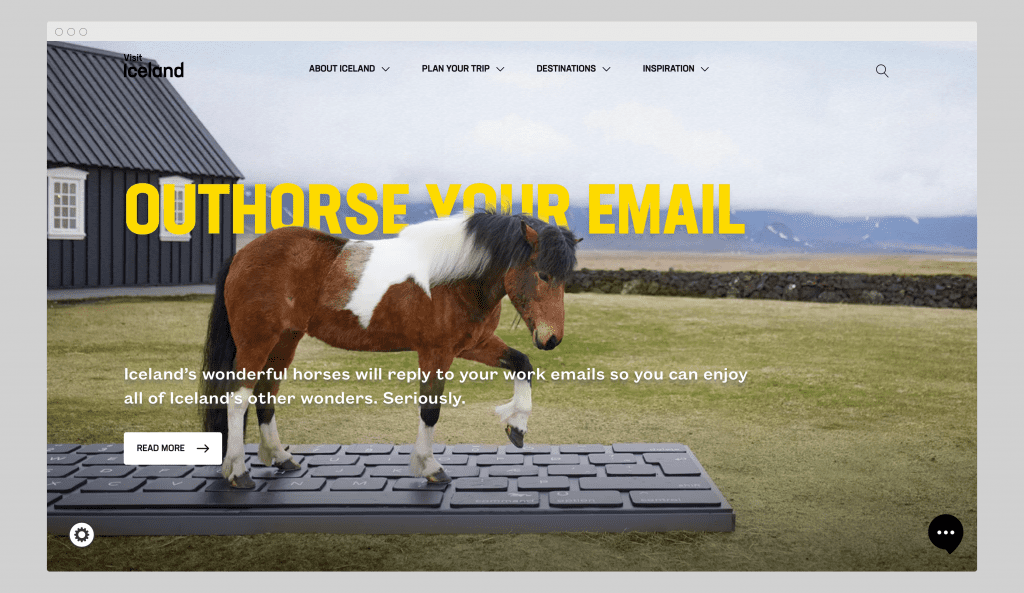
1. Check out Iceland

The cleanse-lower and minimalistic mother nature of Nordic graphic structure works well to talk visible attractiveness, deliver concise messages with clarity (or humor), and entice even further curiosity with nominal work, particularly in the web site earth. Visit Iceland sales opportunities our list with a transitional homepage display screen, embellished with track record illustrations or photos that hover together the web page as they overlap and interact with the text on the display, earning the website truly feel inviting and alive.

As end users scroll even more down, the internet site shows exceptional illustrations of using the organized nature of drop-down menus and vertically shifting lists. With a clear white qualifications and bold capitalized black font, readers are capable to speedily capture sight of what they want to browse, devoid of experience overcome by alternatives. Site article content of likely itineraries and Iceland vacation recommendations are also organized in a structure reminiscent of Youtube, built-in with carousel components that are uncomplicated to check out by using cellular telephone. 

Accessibility to greener journey solutions in the internet site is generally a plus — Check out Iceland has an full webpage dedicated to helping travelers be a part of in on Iceland’s motivation to preserving their character, together with a checklist of environmentally licensed firms, a carbon footprint calculator, and an straightforward-to-comply with record of suggestions for sustainable travel in Iceland.

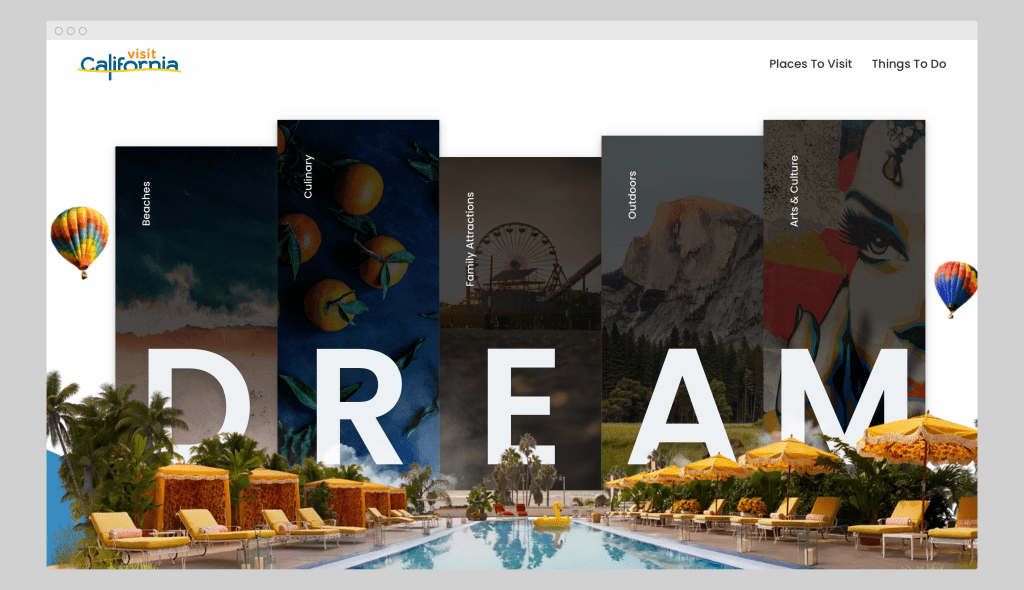
2. Take a look at California

Though the homepage could look common at to start with look, Stop by California’s “Experience California” layout is a person of the very best patterns we have observed in the tourism web page sport. Swipe still left as shortly as you get onto the landing web site (a surprising, but not much too complex way to navigate the internet site, which keeps website visitors engaged), and end users are immediately whisked into a a few-dimensional house to take a look at what the state of California has to present to their travellers.

To the new millennial and Gen Z traveler, style and aesthetic can be just as or extra critical as desired destination information and journey assistance. Interactive visuals and daring colours discuss to the character of California as a getaway location, loaded with globally cultural encounters and superior firms in design and technologies — introducing to the visitor’s impression of what a excursion to California could be like. 

As the household of Los Angeles and the land of influencers, Take a look at California also absolutely embraces the use of Person-Created Content material as a promotional software, and shows this in an easy-to-digest format.

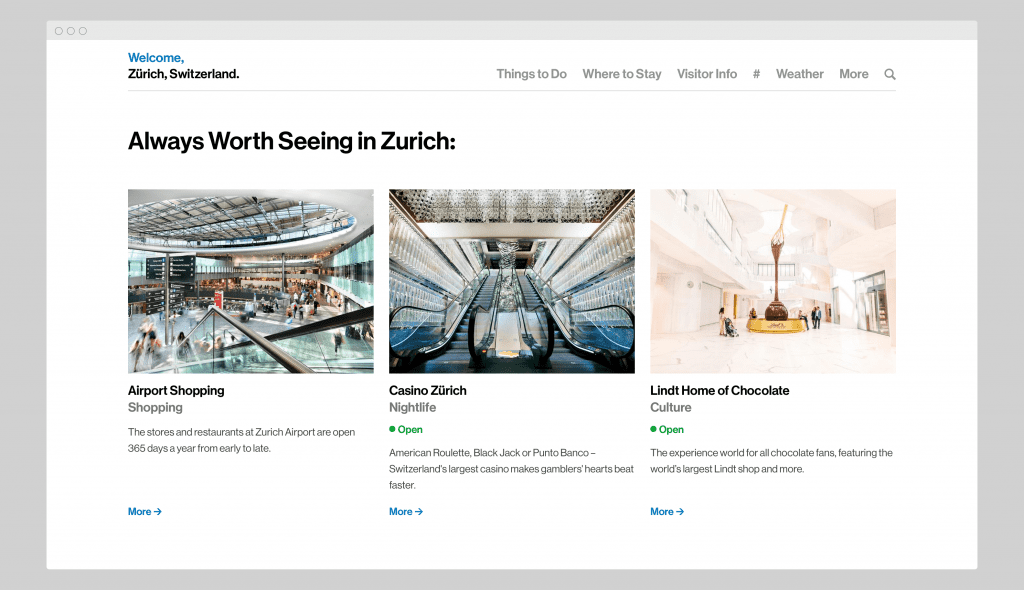
3. Zürich Tourism

Talking of Nordic graphic style and design and consumer-generated content, the formal web site for the town of Zurich is yet another instance of the superb use of white house. Perseverance to sans serif typography, a two-to-3 cool tone colour palette, and an exceptionally simplistic, clean up format keeps visitors from feeling confused and will allow for a respiratory space to go by all the activities supplied on the web site. 

Beneath many of the proposed things to do, dining places, and bars, the Zurich internet site also labels no matter if the company is open up or the company is getting available in actual time, a distinctive element that can be exceptionally beneficial for tourists who are wanting for final minute sites to appreciate or spontaneously strategy a day trip.

Their user-generated written content page is a delightfully neat design, with the page tab connected as a one hashtag in the top menu. The full webpage acts as a unified social media feed, creating all their social media coverage on Fb, Twitter, and Instagram visually obtainable in just one perspective.

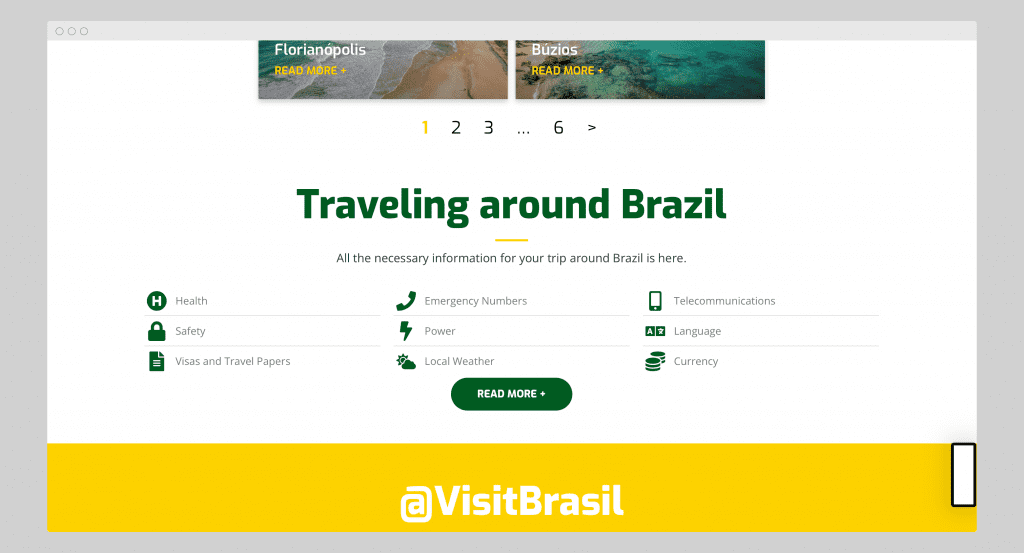
3. Go to Brazil

Pay a visit to Brazil has all data and backlinks available on their homepage, break up into four sections: Encounters, Locations, Locations, and Journey Facts. 

Aesthetically, a framework of yellow is filled with a line-up of motion-packed visuals, image and movie, and a part dedicated to Instagram written content. They know their guests, and they recognize that in-your-facial area online video content material appeals to those people who are seeking for some type of experience. The movie that usually takes up the entire homepage display keeps people engaged at preliminary glance, and although the web site prioritizes promoting their adventurous functions, they balance “fun” with “necessity” and make guaranteed to give easy accessibility to the security details vacationers will will need to know when coming to Brazil.

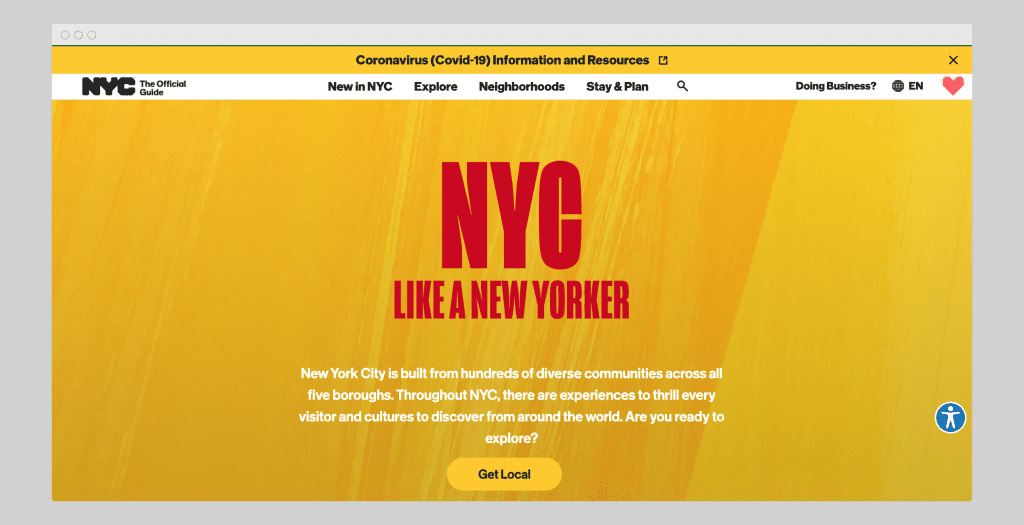
5. NYCgo

We all know New York Metropolis could be its own state, with knowledge choices that are equal to all those of a region.

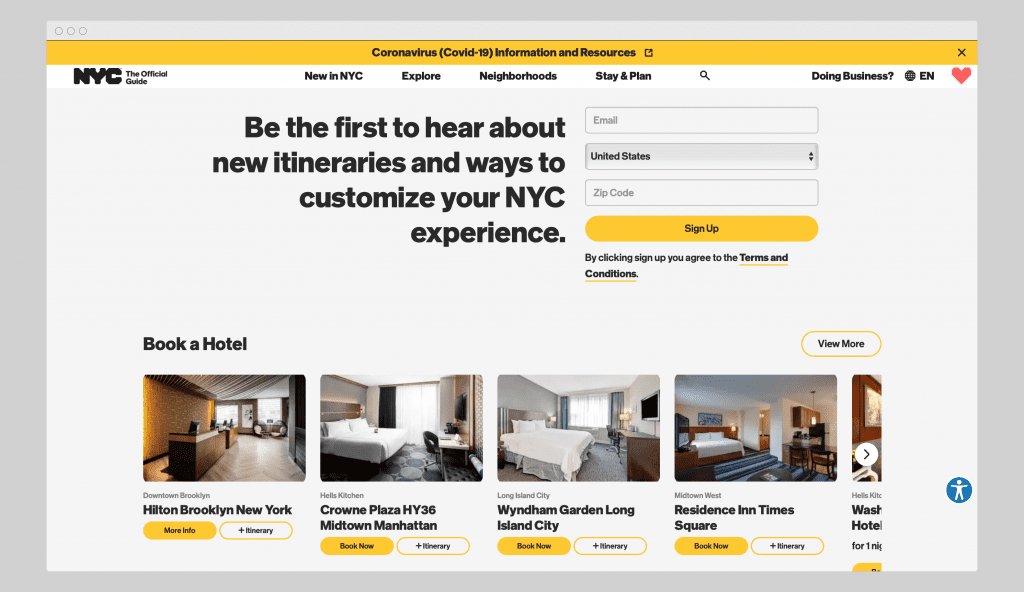
Established up like a reserving web page, the NYCgo’s most amazing features contain the UX framework that is deeply common to the modern day traveler — searching for motels or lodging by way of a look for motor reminiscent to limited-phrase rental or airline web pages, getting able to “like” and help save posts or articles or blog posts for later on referral, and of program, a purpose that features filtered choices to locate functions and destinations catered to the visitor’s particular preference.

The bold, graffiti-like font that handles the homepage and is utilized all over the web-site is basic, which is a important move looking at how considerably text is on the entrance web site. It’s also a terrific aesthetic decision, a subtle way of talking to the headlines that deal with billboards in NYC. While the internet site delivers slews of info on the homepage, the way it is formatted and introduced to the consumer keeps the aesthetic uncluttered and down-to-earth.

6. Stop by Finland

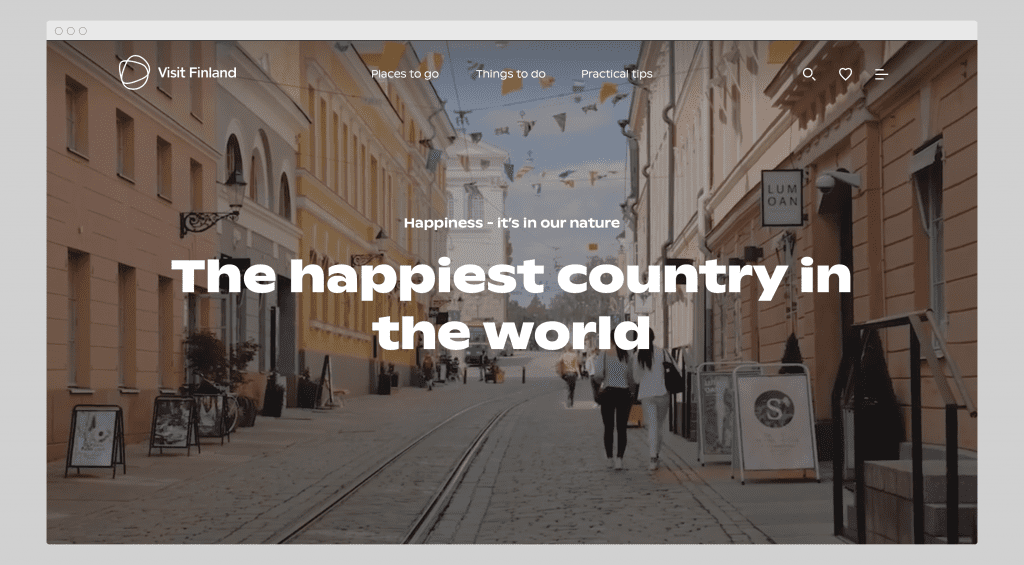
From the logo, to in general style and design, to decision of font, Go to Finland’s internet site shows similarities to a further exceptionally well-liked rental scheduling site, but when it arrives to approachability and visible attractiveness, borrowing people style things performs in their favor.

The website is a clean, clear, and, of system, acquainted expertise — a person that is both modular and linear, exhibiting determination to navigational simplicity. The design does not shy away from white place and minimalism much like its Nordic counterparts also on this list. Full use of comprehensive-display shots and breathtaking imagery is a spotlight, as well as the level of scroll-responsive interactivity site visitors experience as they discover the web page. 

This website also shows numerous Finnish routines and locations by way of the help you save/heart attribute, referencing a person practical experience generally noticed in online buying or Pinterest mood boards. The layout feels especially responsive to the character of the Gen Zers who invest all their time on social media “saving” posts and strategies.

7. Take a look at Australia

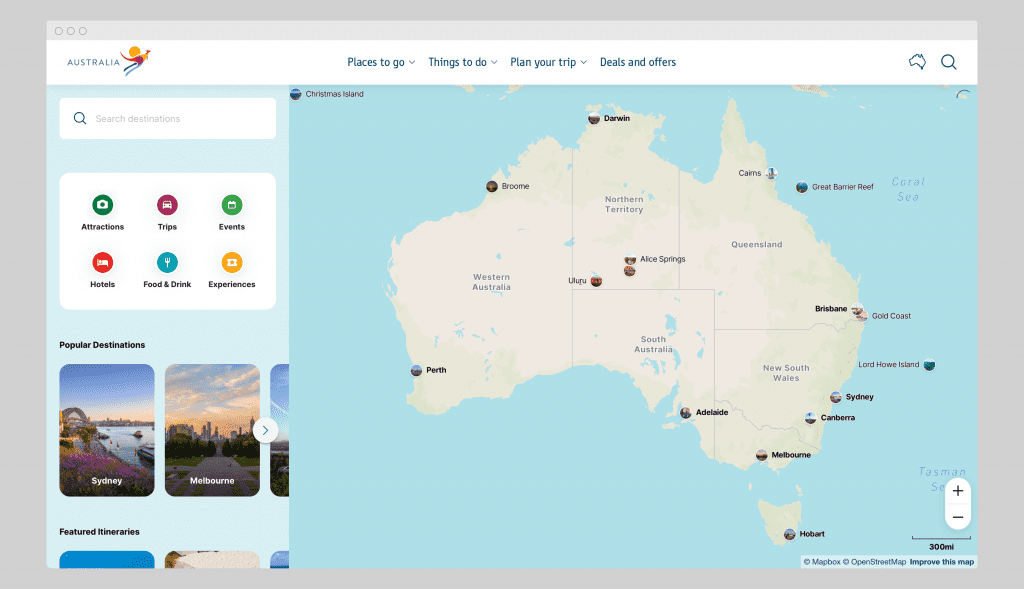
The website’s Check out Australia in 8D web page

Like we’ve observed on other web sites on the record, the Visit Australia web page is vastly loyal to the tile format, which could really feel foolish if overused, but because the tiles are lined up and sectioned in a cohesive method, visitors will discover it incredibly uncomplicated to uncover alternatives for just about every and each aspect of place scheduling. The homepage is lined with left-correct carousels of vertical images, appealing to youthful generations and optimized for mobile formats.

Drop down menus are also a spotlight for this site design. As an alternative of cluttering the body with an overpowering total of text, the tile structure keeps the menu options visually participating for the consumer. Integration of wonderful imagery in every stage of the consumer experience displays excellent perseverance to advertising and marketing the location, which is, ultimately the main objective of a tourism group. 

The Pay a visit to Australia site delivers every little thing, from itineraries and cultural or geographical exercise guides to budgeting and lodging promotions. Recognizing that spending budget is an crucial component for lots of vacationers is also a big as well as for any tourism web site, as it retains website people inside of the website as a substitute of browsing other platforms for “best or most cost-effective deals”. 

Potentially the emphasize of the internet site is Take a look at Australia in 8D, an interactive exploratory encounter that allows visitors to shift through a map of the whole mainland of Australia, such as a few islands bordering the space, and see what each and every location has to provide, from attractions to lodging and foodstuff.

8. Peru

The website’s Peru 360 website page

As a lot as Peru is getting rising fascination as a vacation spot in current a long time, the country also would seem to be particularly aware about speaking COVID security steps and limits to opportunity holidaymakers. The instant landing web site of the tourism web-site gives readers quick accessibility to strategies to get ready and program for a excursion to Peru from property, beginning with multiple avenues to test and double check out current Covid protocols. Showing this amount of diligence to Covid steps not only communicates the actuality that Peru requires security protocols very seriously, but also makes it possible for for worldwide travelers to cross ‘testing or vaccination requirements’, even now a key problem at this time, off their listing of probable concerns.

The crew at Peru Vacation also usually takes benefit of the quite a few recognitions, media coverage, and awards that Peru receives as a tourism desired destination, and pushes that at the forefront of their web site structure. 

The most enjoyable portion of the website is potentially the VR web page, identified as Peru 360, where a single can “visit” various web sites throughout Peru in a digital actuality. Even though this is a system that has developed in level of popularity amongst a whole lot of brand names during the pandemic, quite few official tourism web sites have been effective in offering a well-proven practical experience that feels interactive outside of usual images or videos. 

9. Stop by Italy

Italy has prolonged-been a vacationer-major destination, and the staff at Go to Italy is aware of it. At the forefront of their site are effortless methods to search, finances, and guide the major vacationer sights through the greatest offers. Viewers barely want to scroll down the homepage in advance of receiving quick accessibility to the Ticket Carousel, with exact price ranges stated by attraction or site.

Stop by Italy’s web site isn’t the most bold platform layout-wise, but it prioritizes digestible formats, this sort of as buttons for every move in scheduling or tiled carousels, and feels uncomplicated-to-navigate total, particularly thinking of all the facts on their homepage.

It is very clear that the web-site appreciates what their readers require — to beat traces, to get the greatest rates, and to make the most of their time in a single of the most renowned cities in the world that Italy has to offer you. The internet site is excellent for the vacationer who desires to prioritize setting up and reserving more than aesthetic image inspirations. The web page also acts as a lookup motor of kinds, and does not shy absent from redirecting their readers to other reserving sites or alternatives in purchase to make the very best conclusions.

10. Pay a visit to Greenland

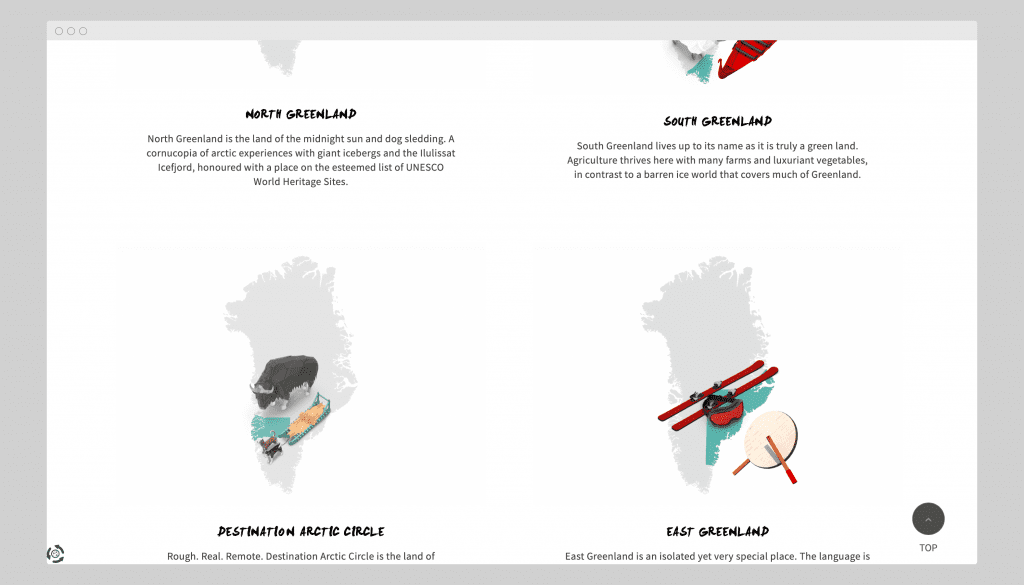
Check out Greenland’s web site also sets up like a common look for engine site (a pattern we are observing across most of the layouts on this checklist) but serves largely for vacation inspiration and regional informational applications. The layout of the web site is easy and faithful to the use of white house, which lets for their one of a kind graphic style factors to glow as a result of in this certain style and design. 

Not only are the 3-dimensional illustrations wonderful, but they are also interactive, performing as links to the respective relative pages. 

Apart from participating geographic and cultural graphics, the web site also traces up choices of different offer tours that guide to exterior service provider links, who are a lot more perfectly-versed in serving to possible people transfer ahead in their scheduling and exploration procedure. Simply because Greenland is a nature-large vacation location, the web site focuses on exhibiting a wide variety of outside actions — primarily based on private interests or geographical locale — in purchase to protect against tourists from emotion deprived of varied actions. 

_________________________________________________________________________________________

Impressive procedures in the electronic earth are receiving raising bold day by day and site styles are seeking to be as responsive as possible, as to make sure they maintain their existence in the vacation arranging place.

In addition to the web-sites on our checklist, various other tourism organizations are diving into special actions to achieve interest from the ever-so-hungry vacationer of the post-pandemic journey globe. Interactive game titles, like Cape Town’s Digital Game Tourism Campaign, are a single of the few approaches these companies hope to bring in younger audiences and give a virtual style of their vacation spot to prospective tourists. The Machu Pichu 360 site invitations visitors to enter the planet of VR and includes auditory stimulants, a move up from the Peru 360 site in our checklist, that engages equally eyes and ears to fill the void tourists have all been going through in the course of Covid.

With the aggressive space for tourism internet websites growing at an increasing speed and mobile applications using the highlight from web page platforms, tourism corporations and designers will most probable carry on to borrow aspects of the freshly digital environment to continue to keep their platforms operating.