

17 Free SEO Tools For Site Audits

It takes the assistance of technology to analyze data, conduct research, validate code, and conduct other SEO site audit checks at scale.

The good news is that these tools don’t have to put your SEO budget into the red.

There are plenty of perfectly adequate, free SEO tools available to publishers and SEOs on a smaller scale. And many of these free tools give you access to the same functionality and data sources as the paid versions.

That means that once your needs have outgrown the free version, it’s an easy transition to the paid versions in order to continue on your journey of success.

In the meantime, check out this list of free tools you can use in site audits to get you started.

Free Content-Related SEO Tools

1. SEO Ngram Tool

While we don’t know which came first, the chicken or the egg, we do know that good content starts with understanding the keywords people use and why they’re using them.

The following free keyword tools will help put publishers on the path to top rankings.

A useful free SEO tool that was recently updated for 2022 is the SEO Ngram Tool that was developed by Ryan Jones, Vice President, SEO at Razorfish.

His SEO Ngram Tool helps you to better understand the keyword combinations that are most commonly used for searching.
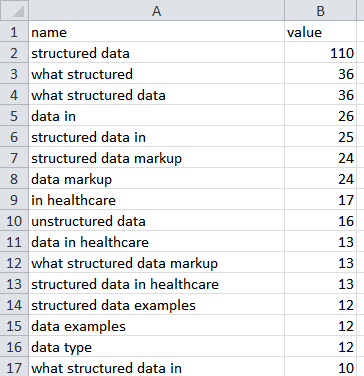
Screenshot of Ngrams SpreadsheetScreenshot of SEO Ngram Tool Spreadsheet taken by author, January 2022

The tool also generates a search term relationship map, grouping the different search terms into a visual map that shows the base keyword terms (primary connections) and the search terms that are related to it.

Below is an animation showing the main keyword in the center.

Around the main keywords are the primary connections which are variations of the main keywords.

Connected to the primary connections are the keyword phrases that are related to the second-level keyword phrases.

So it's:
Main Level > Second Level Primary Connections > Third level keyword phrases

Animation of Search Term Relationship Map

The data can be downloaded to a CSV spreadsheet that shows word combinations that are frequently grouped together.
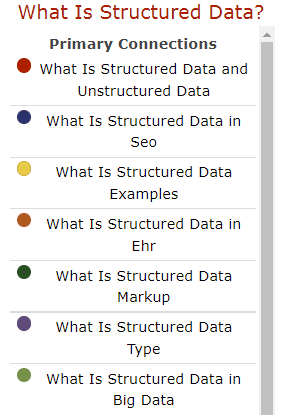
Ngram Primary ConnectionsScreenshot of Primary Connections taken by author, January 2022

2. Answer The Public

This is a highly popular tool, and it seems like everybody knows about it.

Nevertheless, it needs to be listed for those who haven’t yet heard about it because it’s a great tool.

The way Answer the Public works is you enter first your keyword phrase, and it will return a visualization map of popular keyword phrases that are divided by the kinds of questions, like who, what, where, when, and how.
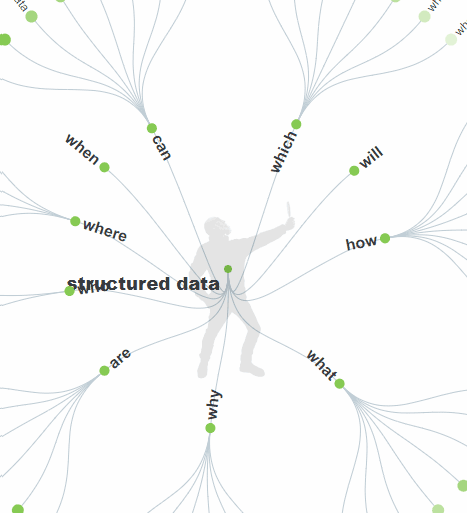
Keyword Data Visualization by Answer the PublicScreenshot of Keyword Data Visualization taken by author, January 2022

A closeup of the ‘how’ section in the keyword data visualization:
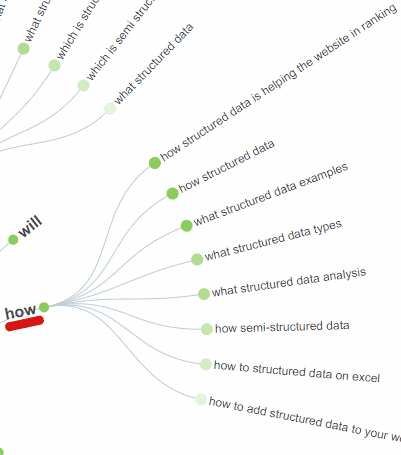
Answer the Public Keyword VisualizationScreenshot taken by author, January 2022

Answer the Public also provides the keyword data in a spreadsheet format, conveniently organized by question type.
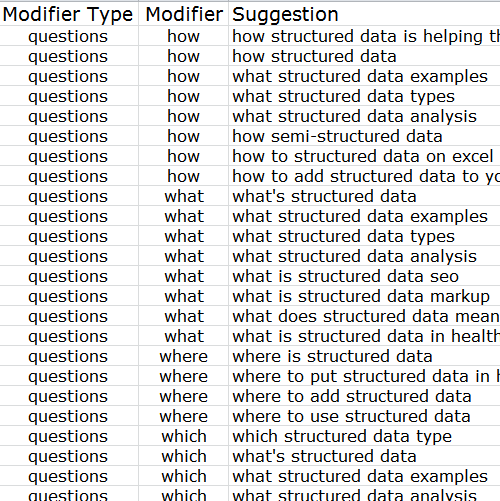
Screenshot of an Answer the Public SpreadsheetScreenshot of an Answer the Public Spreadsheet taken by author, January 2022

3. Ahrefs Free Keyword Tools

Ahrefs offers a multitude of free SEO tools that are worth exploring on their own. One of the tools that stands out is its Free Keyword Research Tool.

It also offers multiple keyword tools that provide 100 top keywords with associated keyword volume and what is represented as Amazon, YouTube, Bing, and Google for search.

Ahrefs commented on the sources of the information:

“Our free tools connect to the same database as our main tools.  The sources are as usual: Google Keyword Planner, clickstream, and data partnerships.”

Regardless of where the data comes from, the tool is a useful resource for generating article writing topics.

4. Siteliner

The free Siteliner duplicate content tool is a scanner provided by CopyScape (an anti-plagiarism service).

Siteliner’s top feature is its ability to identify pages within the site that have similar content. This makes it easy to spot opportunities for improving content.

It’s best for articles to feature content that is unique to each article.

Depending on how much content is similar, articles that share content can create a situation where Google may have to choose which page is more relevant and make one canonical.

Eliminating duplicate paragraphs across articles will help web pages differentiate themselves.

The scanner is limited to 250 pages. Nevertheless, it is useful to alert you to a possible problem with thin pages.

5. W3C Validator

The Worldwide Web Consortium publishes an HTML checker that also checks what the heading outline (H1, H2, etc.) looks like on a web page.

This is a really great tool for checking out how Google sees your web page or a competitor’s web page.

Tick the “Show Outline” option in order to see how your heading elements look to a search engine.

The results can be eye opening and reveal issues with your website template.

Select the Show Outline Box to see headings on a web page. Then, tick the box to show outline. The free HTML validator will show you what your heading tags look like to Google.
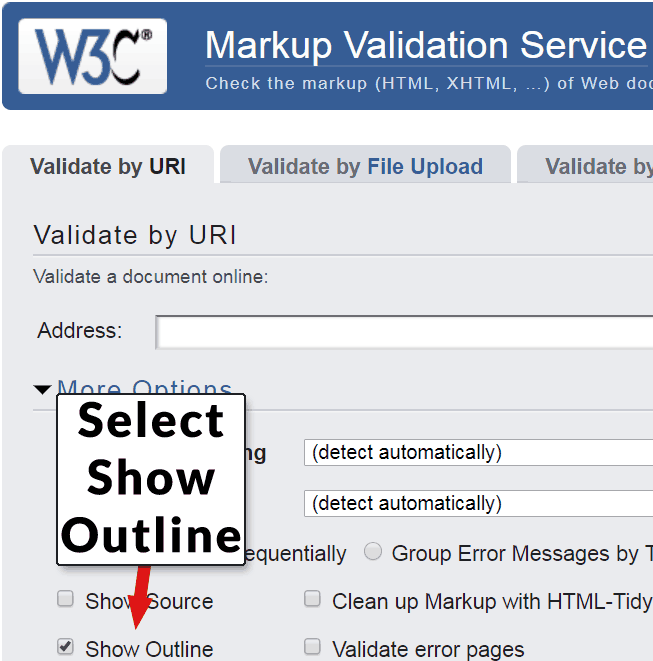
Screenshot of the W3C HTML Validator showing various options

The validator can sometimes choke on really bad HTML, but there’s a way to get around the coding errors.

Restart the process, but this time, check the More Options section and choose a document type. The heading checker will work, guaranteed.
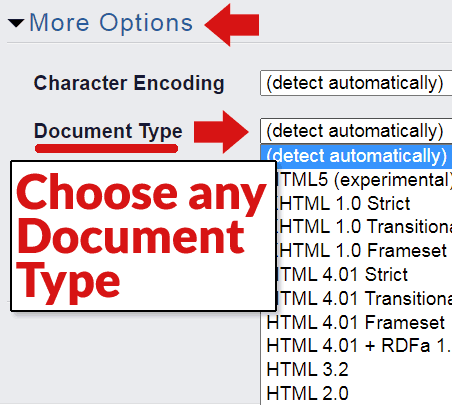
W3C heading checker tool

Free SEO Website Crawler

6. Screaming Frog – Free For 500 URLs Or Less

Industry-leading site auditing software Screaming Frog offers a free version that’s perfect for auditing smaller sites that are under 500 URLs.

It’s a powerful way to crawl a site and learn if there are any problems.

Screaming Frog automatically provides information about your outbound links, internal links, your images, response codes that various pages give, and information about title tags, meta description tags, headings, images, and pretty much everything about a site that a publisher would want to check for site health and mistakes.

Screaming Frog allows you to set the user agent to emulate Googlebot, Bing, Chrome, and anything else you want in order to see how your site responds, providing a true insight into how the search engines and users are encountering your website.

7. Netpeak Spider

Netpeak Spider is another crawling tool that has a generous free version that can crawl up to 100,000 URLs.

The tool provides data on over 80 SEO-related issues and checks on over 100 technical website issues.

It also has other functionalities related to competitor research.

Overall, the free version of the Netpeak Spider makes a useful complement to the free version of Screaming Frog, as they both have different features and present data in different ways.

8. Xenu Link Sleuth

Xenu Link Sleuth is the old-school SEO tool of choice when it comes to a free site crawler.

It’s described as a broken link checker and it does a great job of that. It generates a report for both internal and external broken links.

But, Xenu does so much more than check for broken links.

Xenu can output a report that provides a quick overview of page titles, orphaned pages, redirects, and pages that are not found (404 response codes).
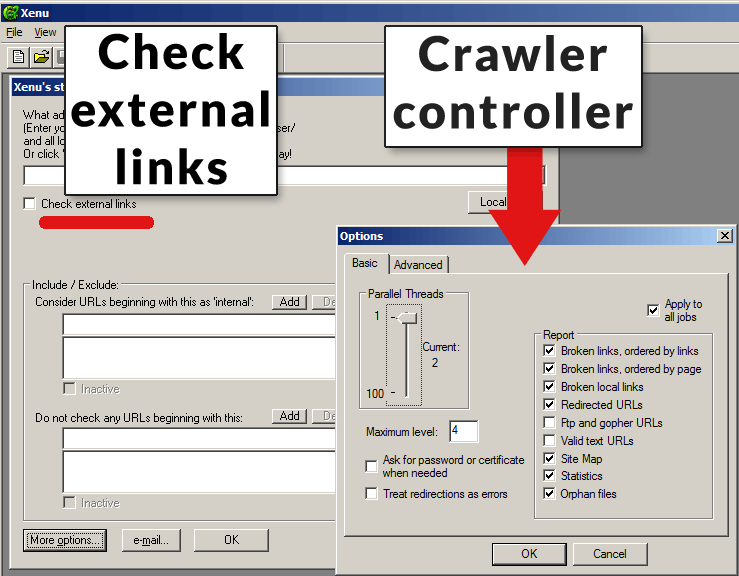
screenshot of Xenu link sleuth control panelXenu Link Sleuth free website crawler and broken link checker.

Free Mobile SEO Tools

Mobile SEO is incredibly important. That’s why it’s essential to be able to test what a search engine results page (SERP) looks like in virtually any city in the world.

It’s also useful to be able to check what your web page looks like in the most popular mobile phones. Pages that look great tend to convert better.

9. MobileMoxie

MobileMoxie provides a fully functional Mobile SEO Tools.

The MobileMoxie SERP checker shows you what the rankings looks like in a huge selection of mobile phone screens.

What makes this tool especially helpful is that it can localize to any city in the world.

Thus, you can test what the mobile rankings are for someone located in any city in the world. This is great for local SEO or for client work where you’re not located in the client’s area.

There is also a MobileMoxie Web Page Checker that can show you what your web page looks like in virtually any mobile phone. This will help you optimize your web page so that it converts the best across a wide range of mobile phones.

The tool is fully functional and can be used for free three times.

Below is the MobileMoxie SERP tester showing a side-by-side comparison of what your SERPs looks like in virtually any mobile phone.

You can also scroll through the local SERPs for any city in the world in virtually any language of your choosing.
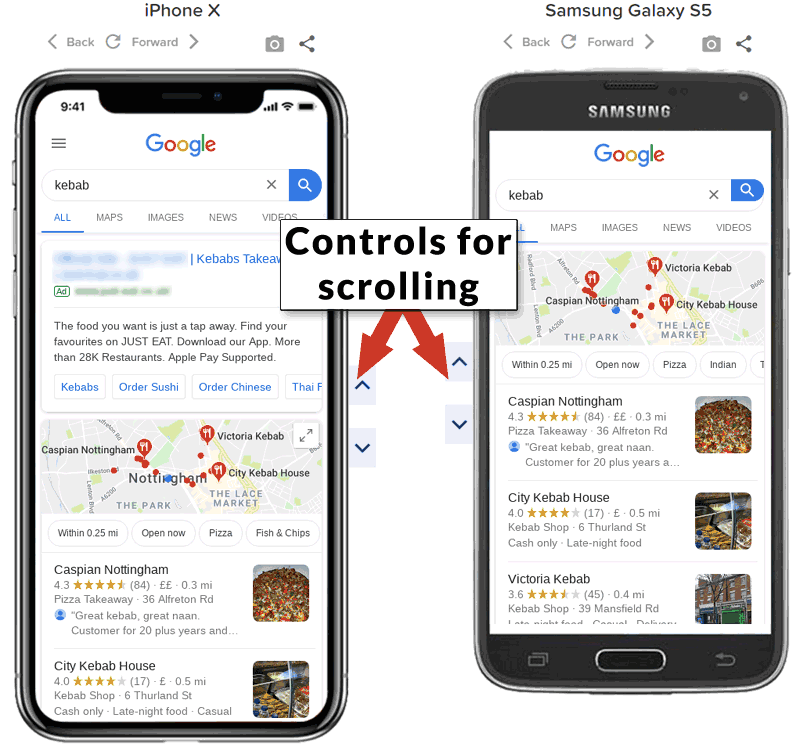
Screenshot of mobile moxie SERPs testing tool

Free Website Technical Audit Tools

10. DNS Propagation Checker Tool

The DNS Checker tool will check how well your site is resolving around the world.

This tool can help surface issues with the server settings that can affect the ability of Google and other site visitors from reaching a website.

I have successfully used this tool to identify why Google’s crawler could not reach a website, causing massive indexing issues. The cause was a bad server setting.

So, if search engines or users are having difficulty reaching the website, give the DNS Checker tool a try.

11. MX Toolbox Blacklist Check

This online tool will check if your domain or IP address is on one of several popular blacklists. Being on a blacklist can affect email deliverability.

Free Website Security Audit Tools

Many SEOs don’t consider security as part of an SEO audit.

Security only becomes an issue after a site’s been hacked and the rankings dropped.

In my opinion, website security should be a component of an SEO audit.

A secure website is a major part of how well it ranks and encourages sales. That’s why I include a thorough security audit with every site audit I perform.

12. Free WordPress Vulnerability Scanner: WPScans

This free vulnerability scanner offers a quick but comprehensive scan of potential issues.

Create the report, then research whether or not your site has issues that need fixing. WPScans.com is a useful tool for beginning a security audit.

13. Free HTTPS Validator Tool: SSL Labs Security Checker

The SSL Labs Security tool will spot misconfigurations and security holes in your HTTPS certificate implementation.

Adding a server security certificate is touted as being easy, but that’s not always the case. This useful tool will help you diagnose hidden issues.

14. Free Drupal Security Scanner: Hacker Target Drupal Security Scanner

This comprehensive security scanner will highlight common issues with a Drupal-based website.

Free Website Performance Tools

15. GZip Compression Checker

The GZip Compression tool checks if your site is using GZip compression. Using compression allows your server to download your web pages quickly.

16. YSlow Performance Audit

The free YSlow Performance Audit tool is a comprehensive performance audit scanner. It creates a report of 23 performance rules.

17. GTmetrix

GTmetrix Speed and Performance Audit is another tool that will generate various benchmark scores. Use these scores to understand where your site can be improved.

Bonus: Free Google Site Audit Tools

Google offers many SEO-related tools.

Aside from the Google Search Console, which is very important and is worth mentioning, here are other useful tools provided by Google for auditing and inspecting web pages and websites:

Page Speed Insights offers web page speed feedback.

Rich Results and Structured Data Testing Tool has been consolidated with the Rich Results tool. This helps diagnose issues with your structured data and confirms whether the structured data qualifies for rich results.

The structured data validator does not verify if your structured data conforms with Google’s guidelines.

Make sure you are following Google’s Structured Data Guidelines. Making a mistake with structured data could result in a manual penalty.

Google Lighthouse is a tool that’s built into Chrome. It is also available as a Chrome Lighthouse Extension.

Google’s Lighthouse is an incredible suite of web performance analytical tools.

Learn More About Google Lighthouse: A Technical SEO Guide To Lighthouse Performance Metrics

The Lighthouse SEO report focuses on how well the site can be indexed, which is an especially useful feature these days.

Lighthouse can be used to diagnose on-page issues related to the code and to help find out what’s making a site slower plus it offers tips on how to improve those shortcomings.

Lighthouse is a must-learn tool for everyone who wishes to improve their site performance metrics.

Be Prepared For SEO Success

The quality of free SEO audit tools has continued to grow in usefulness and sophistication.

Publishers and SEOs have the ability to automate hundreds of SEO tasks without paying a thing.

Take the time to learn how to use these tools and you’ll be pleasantly surprised how powerful these tools are.

Success in SEO is never guaranteed or a sure thing.

But the opportunities for achieving your goals have never been better than they are now, with the help of these free SEO tools.

More resources:


Featured Image: Alexander Supertramp/Shutterstock
In-post images #7 to #9 created by author, January 2022

Telemedicine Company SwiftMD Announces New Site and Telehealth App

Foremost telehealth corporation SwiftMD unveils web site rebrand and telemedicine application to increase its commitment to giving uncomplicated entry to top quality healthcare.

Telehealth enterprise SwiftMD

Telehealth company SwiftMD

Telehealth organization SwiftMD

Telehealth business SwiftMD

EXTON, Pa., Jan. 26, 2022 (World NEWSWIRE) — SwiftMD, a telehealth enterprise with the highest utilization amount in the field, introduced these days the launch of its freshly made website, SwiftMD.com, and telehealth app as aspect of a manufacturer refresh.

The revamped web page functions a present day, streamlined style and new messaging that targets the marketplaces they are catering to (K-12, schools and universities, federal government agencies, unions, TPAs, self-insured corporations and payors) and highlights the telemedicine company’s pioneering adoption of the capitation product and money-back again warranty.

“The web page rebrand carries on to create on our good results in giving entry to good quality care with an relieve of use technique,” said John Lawlor, President and CEO of SwiftMD. “And our new tagline – Talk to a Physician. Whenever. Any place – reinforces how clients can acquire benefit of our 24/7 telehealth assistance in any setting, be it at home, or in the workplace.”

The new site messaging also spotlights how the telehealth company has eradicated prolonged affected individual registration sorts and sped up the medical doctor callback time. “Unlike other telehealth platforms out there, SwiftMD does not make its sufferers fill out a one registration kind,” reported Lawlor. “In addition, the ordinary callback time to hook up to a medical professional is just 7 minutes. We are dwelling up to the assure of our identify, SwiftMD.”

In addition to the new web-site structure, SwiftMD is also formally asserting the release of their telehealth app. Accessible in each the Application Keep and Google Perform, the telehealth application connects SwiftMD members with U.S. board-licensed medical professionals 24/7 via an audio or video phone.

“Though SwiftMD now supplies the best utilization in the business, we required to enhance our telehealth application to assist associates obtain limitless and effortless access to our exclusive large-quality physician group for the most popular ailments,” explained Lawlor. “We pride ourselves on presenting the optimum healthcare price cost savings: from no check with-fees for clients to our ROI warranty for any shopper whose utilization charge would not fulfill their aims.”

SwiftMD.com will be continually current with information of partnerships, new solutions and gains, enterprise milestones, and press releases.

For additional facts about SwiftMD or to indication up as an employer, team, broker or healthcare supplier, go to SwiftMD.com.

For all inquiries, make sure you get hold of jmccrary@swiftmd.com.

About SwiftMD

Headquartered in Exton, PA, SwiftMD is a telehealth business that offers the best utilization amount in the business thanks to its revolutionary capitation product and funds-back assure. With a mission of providing a speedy and simple way for people and caregivers to link with doctors almost for non-unexpected emergency professional medical care, SwiftMD lowers the burden on crowded ERs and the shortage of primary physicians. Their telemedicine system functions U.S. board-licensed medical doctors that give 24/7 treatment solely for SwiftMD clients, which would make scheduling telehealth sessions faster and much more effective, strengthening the excellent of care.

Similar Visuals

Picture 1: Telehealth enterprise SwiftMD

New web site rebrand for telehealth organization SwiftMD

This material was issued by way of the push release distribution services at Newswire.com.

Attachment

The Only Shopify SEO Checklist You Need To Rank Your Site

When it comes to driving motivated traffic to your Shopify store, no other digital marketing strategy is as affordable or impactful as SEO.

For e-commerce retailers, taking the time to ensure your web pages are properly optimized can help increase your organic traffic, meaning more potential customers browsing your products.

Unlike Google Ads or social media advertising, SEO strategies can drive site traffic to your Shopify website long after your ad budget runs out.

For this reason, leveraging SEO is one of the best digital investments a Shopify site owner can make.

What Is Shopify SEO?

Shopify SEO is the process of optimizing a Shopify website to perform better in search engine results.

Although SEO can be applied to any website, Shopify SEO is focused on helping e-commerce retailers who utilize the Shopify CMS to earn more keyword rankings and organic traffic.

Common SEO Challenges For E-Commerce Websites

In general, e-commerce websites are more likely to face certain challenges that can negatively impact search engine performance.

  • Thin Content: Google loves in-depth, long-form content. Because product pages tend toward thin content, it can be difficult to boost their rankings in search.
  • Duplicate Content: With multiple product pages that are so similar or auto-generated, many e-commerce websites face duplicate content issues.
  • Poor Site Architecture: Google likes to see an optimized site structure that users can easily navigate. With so many pages on their website, e-commerce retailers can easily suffer from poor site architecture signals.
  • Not Utilizing Schema: Products schema helps Google crawlers understand your products and promote them accordingly. Not utilizing schema is a huge mistake for Shopify retailers.

To make sure that your website doesn’t suffer from these common setbacks faced by e-commerce sites, the Shopify SEO checklist below is a great place to start.

Automated SEO Features In Shopify

The Shopify platform does have some SEO features built-in that ease some of the SEO workload on-site owners.

These features include:

  • Auto-generated “rel-canonical” tags: this feature helps avoid duplicate content penalties!
  • Auto-generated robots.txt and sitemap.xml files.
  • Automatic SSL certificates: Google prefers to rank secure pages with HTTPS protocols.
  • Auto-generated page titles that include the store’s name.

However, SEO is a vast and multidisciplinary field.

Counting on the Shopify platform alone to do the work of SEO for you is not going to produce the best results.

19 Must-Do Tasks On Your Shopify SEO Checklist

Remember that SEO is not a one-and-done process and will require work both when you initially set up your store and throughout the lifetime of your website.

The checklist below is organized by the type of optimization, but it can be easily completed “in order.”

Some of these steps are a one-time optimization, but the majority will need to be repeated whenever you add new products or pages to your online store.

General SEO

1. Invest In A Custom Domain

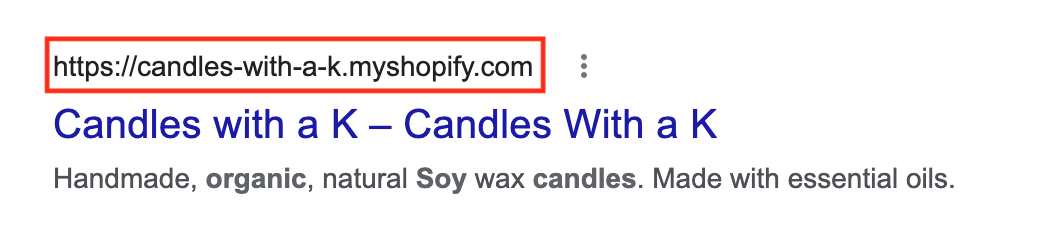
It’s generally better to invest in a custom domain and drop the “myshopify” from your URLs.

Why? Because the URL path is visible to users at the top of the SERP result. Custom domains look more professional and more enticing to users, and higher CTRs lead to better SEO performance.

Example of shopify website in search resultsScreenshot from Google Search, January 2022

You can buy custom domains from Shopify or any third-party domain provider.

Then, add your custom domain in the Settings > Domains menu of your Shopify account.

2. Choose A Fast And Responsive Theme

With last year’s page experience update, fast page speed and load times are non-negotiable if you want to rank well in Google.

Although flashier themes might be tempting, it is better to choose a theme that is optimized for speed and performance.

Your theme also needs to perform well on mobile devices, as Google will index the mobile versions of your web pages.

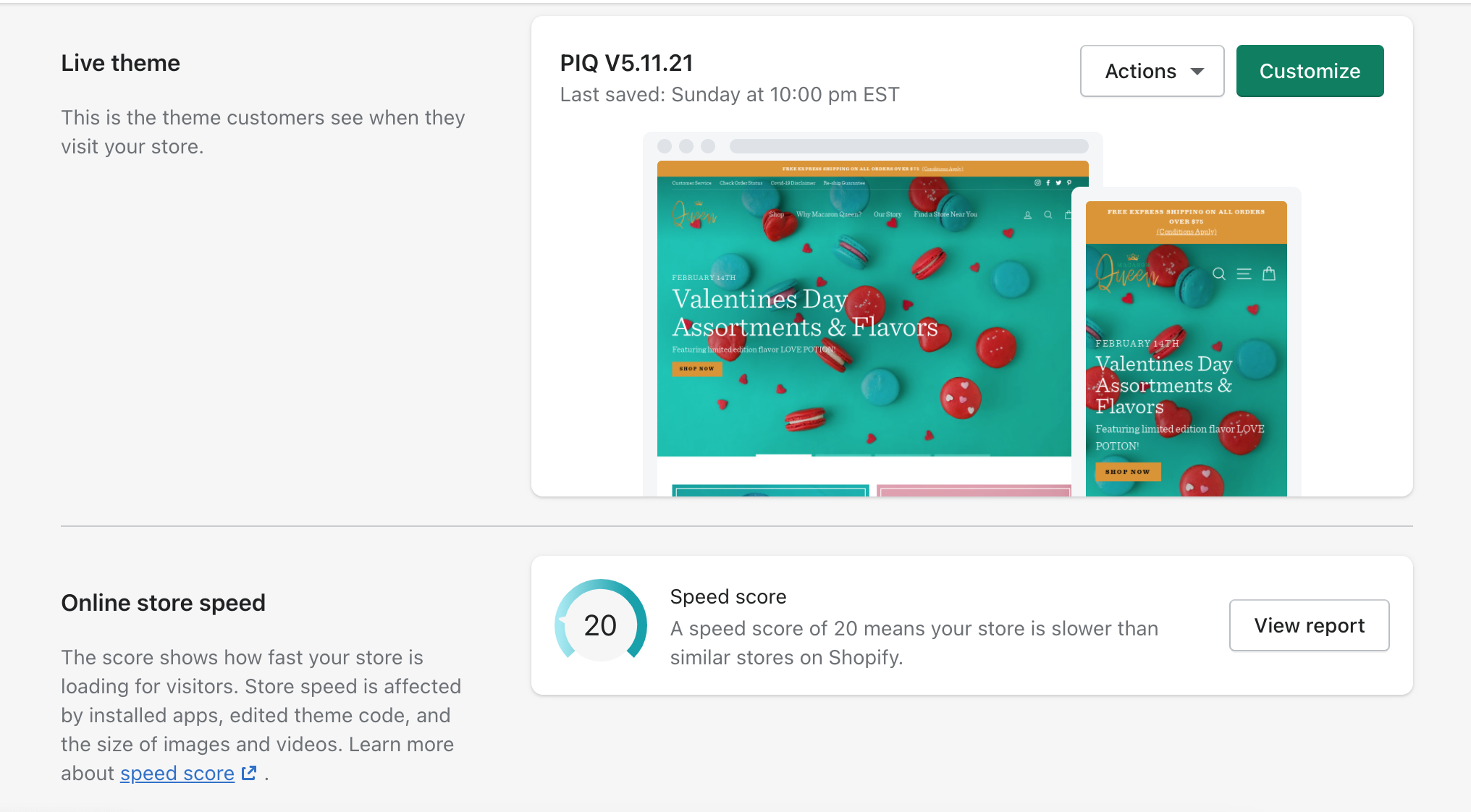
Screenshot of a shopify theme and speed reportScreenshot from Shopify, January 2022

You can get a sense of how fast your current Shopify store is in comparison to others in your dashboard or via your PageSpeed Insights report. If your scores are low, it’s likely impacting your ability to rank in top positions.

Consider another, more SEO-friendly theme.

Here is a list of some of the fastest themes on Shopify.

3. Setup Your Analytics Tools

Your Shopify Analytics dashboard will give you an overview of your e-commerce metrics.

However, you need to set up additional tools to better understand where your website traffic comes from and how users behave once arriving at your website from search.

Google Analytics and Google Search Console are must-haves for any site owner, and they are completely free to users.

After you create your accounts, here are some other key steps you’ll want to take:

4. Get Helpful Shopify SEO Apps

There are all sorts of Shopify SEO apps that can help ensure you are meeting SEO best practices across your web pages. Some of my favorites include:

  • Plug In SEO: Similar to Yoast SEO for WordPress and ensures best practices.
  • SEO Pro: Great for schema and more advanced optimizations.
  • Smart SEO: Very affordable option for lots of SEO value.

On-Page SEO

5. Do Your Keyword Research

Before you start optimizing your content, you need to identify which keywords have strong relevance to your products and will bring qualified traffic to your website.

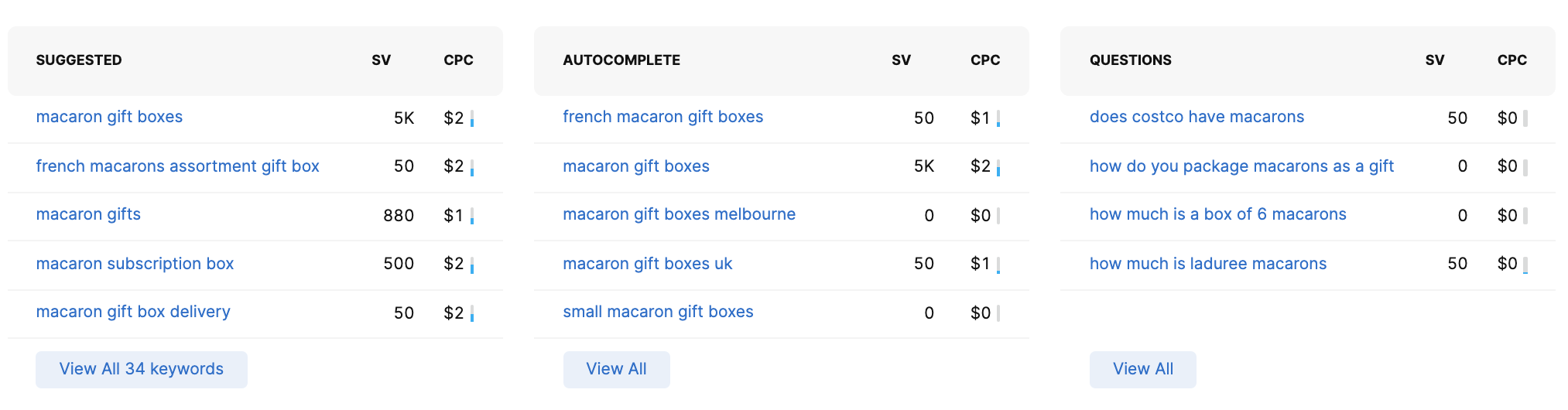
There are hundreds to thousands of ways users might be searching for products like yours. A keyword tool allows you to discover what users are searching for.

Example of Keyword research for a shopify website using a keyword toolScreenshot from SearchAtlas, January 2022

Some of those keywords will be easier to rank for than others, and a part of your SEO work is identifying which keywords present the best opportunities for your store.

The most important keyword metrics to pay attention to are:

  • Search Volume: You want your keyword targets to get a reasonable number of searches per month, otherwise you’re optimizing for no one.
  • CPC: Higher CPCs represent stronger conversion potential. Higher CPCs are more common with commercial and transactional keywords.
  • Keyword Difficulty: Higher scores will mean the keywords are more difficult to rank for. Make sure you choose keyword targets where you can realistically rank on page 1.

Ideally, each web page in your Shopify store will be targeting a different keyword or keyword cluster.

For your product and category pages, optimize for keywords that show more transactional intent, as those users are more inclined to make a purchase.

For your blog posts, optimize for informational queries to capture searchers near the top of the funnel.

6. Optimize Your URLs

There are some URL best practices that are essential to improving your rankings in Google.

  • Keep it short and sweet.
  • Include your target keyword.
  • Avoid unnecessary words like and/or/the/etc..

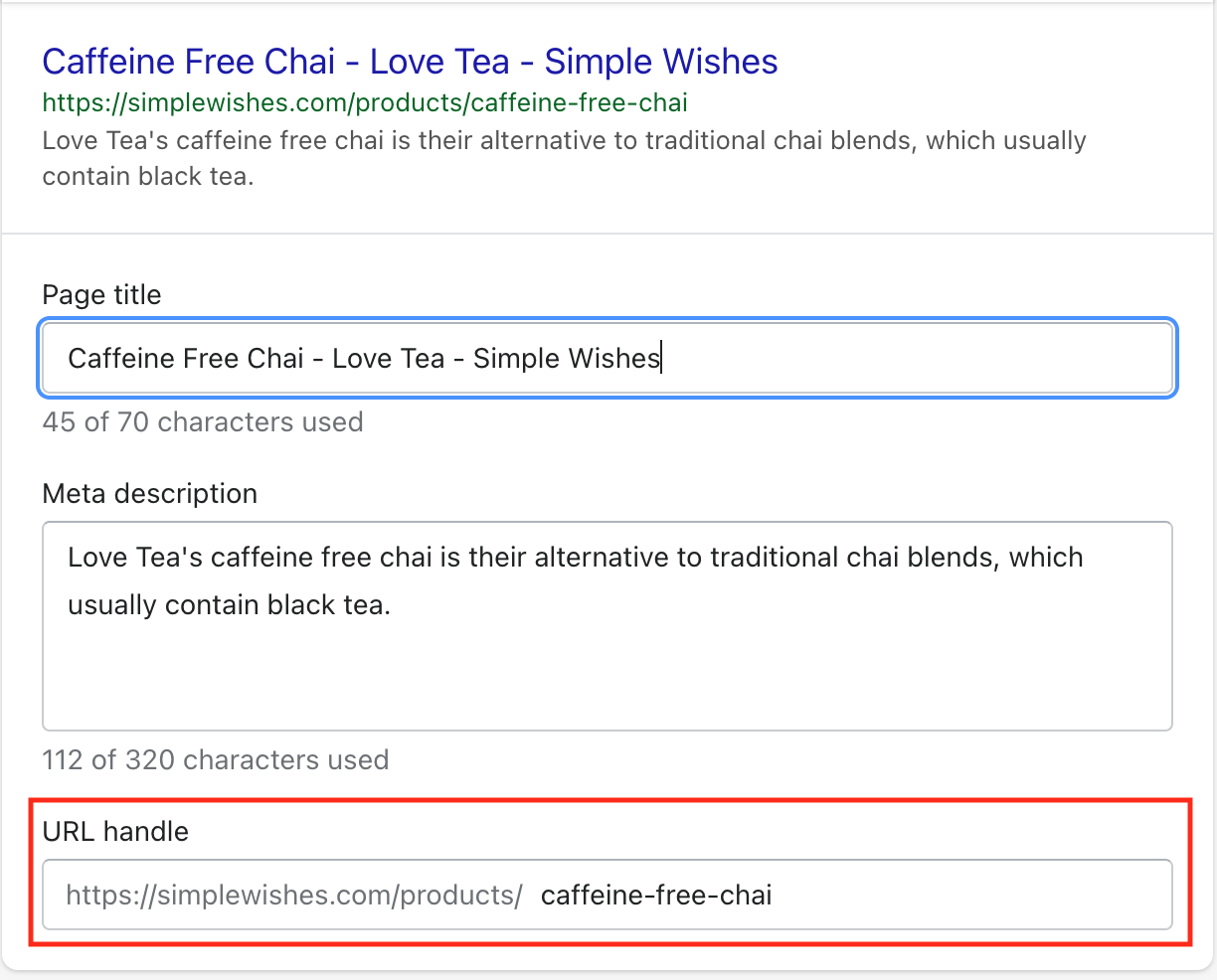
You can easily edit the URL paths in the Search Engine Listing Preview at the bottom of any page in the Shopify CMS.

Screenshot of Search engine preview in Shopify Screenshot from Shopify, January 2022

7. Optimize Your Page Titles And Meta Descriptions

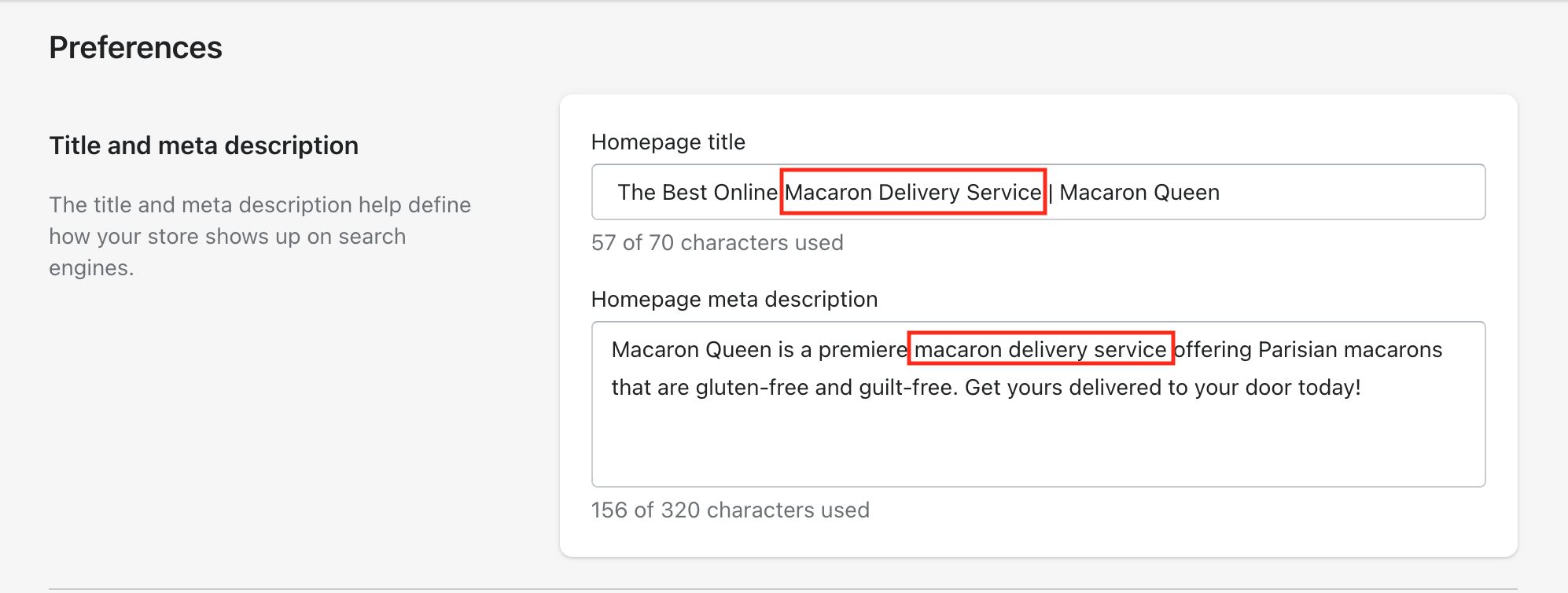
While you’re editing your Search Engine Listing, make sure you also optimize the other meta tags visible in your SERP result: the title tag and meta description.

You’ll want to follow best practices here as well by including your keywords and meeting SEO best practices, especially length – no more than 60 characters for your title tag and no more than 160 for your meta description.

Example of adding keyword into the page title in a shopify websiteScreenshot from Shopify, January 2022

Google looks to these pieces of metadata to understand what your content is about and when to promote it.

And because the meta description may also be visible as a search snippet (although not always), it can influence whether searchers click on your result.

Google is smart enough to understand the terms and phrases that have a semantic relationship to your primary keyword, so there is no need to stuff these on-page elements with the same keyword over and over again.

Your meta tags should read naturally and adequately describe the content on the page.

8. Use A Content Optimization Tool For Your Product Descriptions

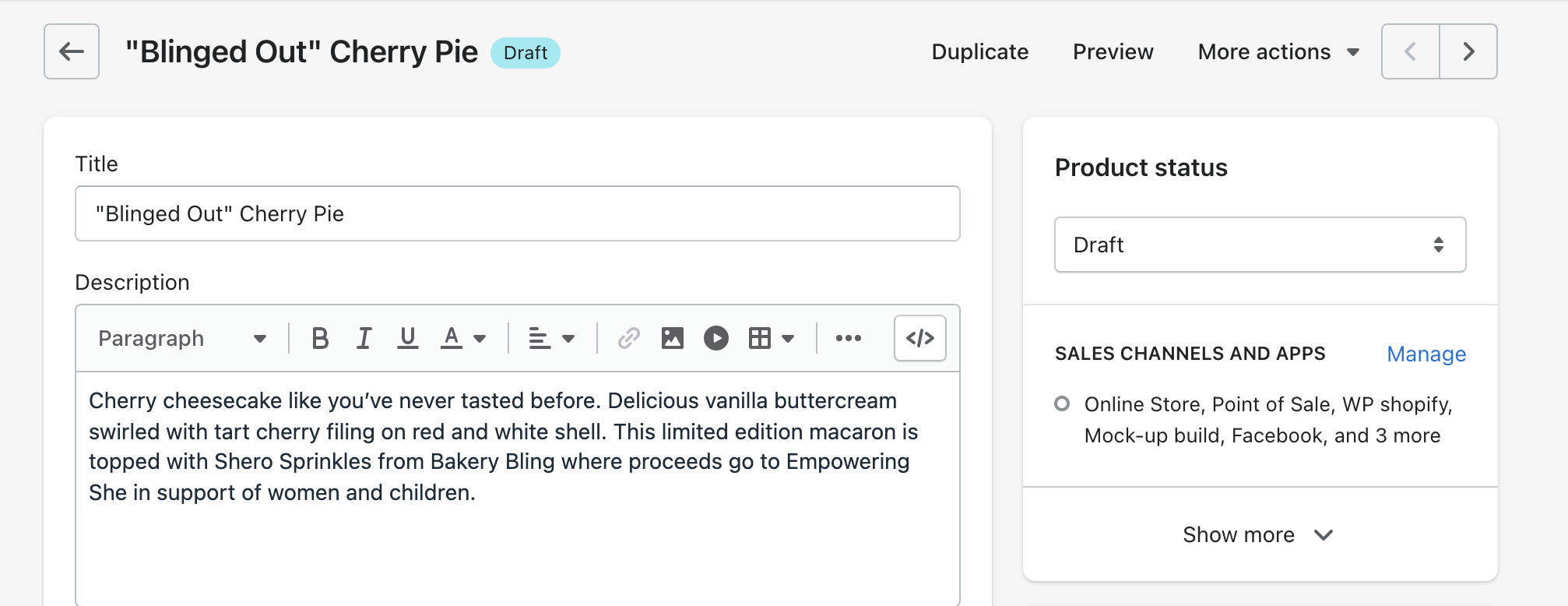
Thin content on product pages can be a serious hindrance for e-commerce websites.

Make sure you take the time to craft original, descriptive product descriptions that include relevant keywords, synonyms, and related terms.

Optimized product description in ShopifyScreenshot from Shopify, January 2022
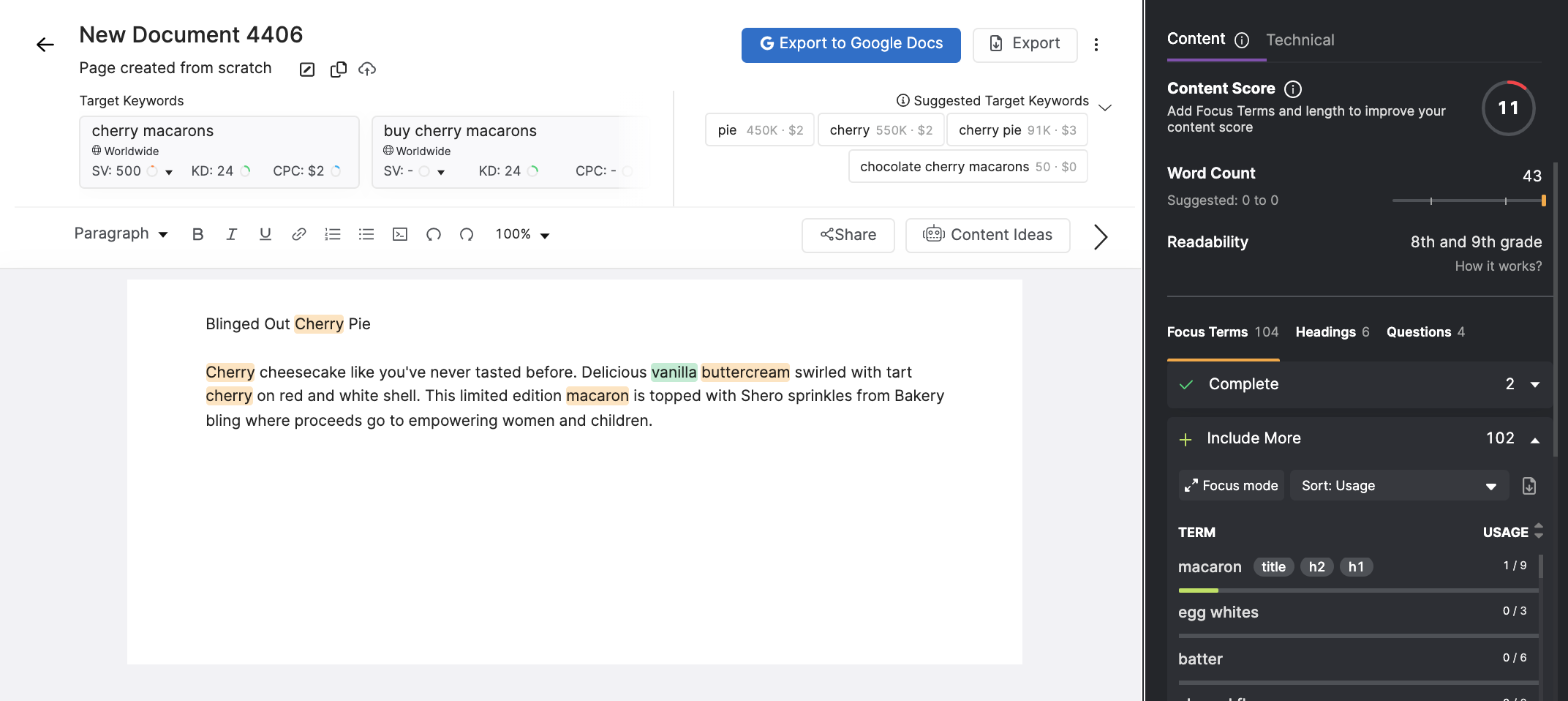
Screenshot of an content optimizer toolScreenshot from the SEO Content Assistant, January 2022

A content optimizer tool can help you identify which related keywords have the most SEO power and show strong relevance signals to your products.

Do your best to include them in a natural way to elevate the ranking potential of your product pages.

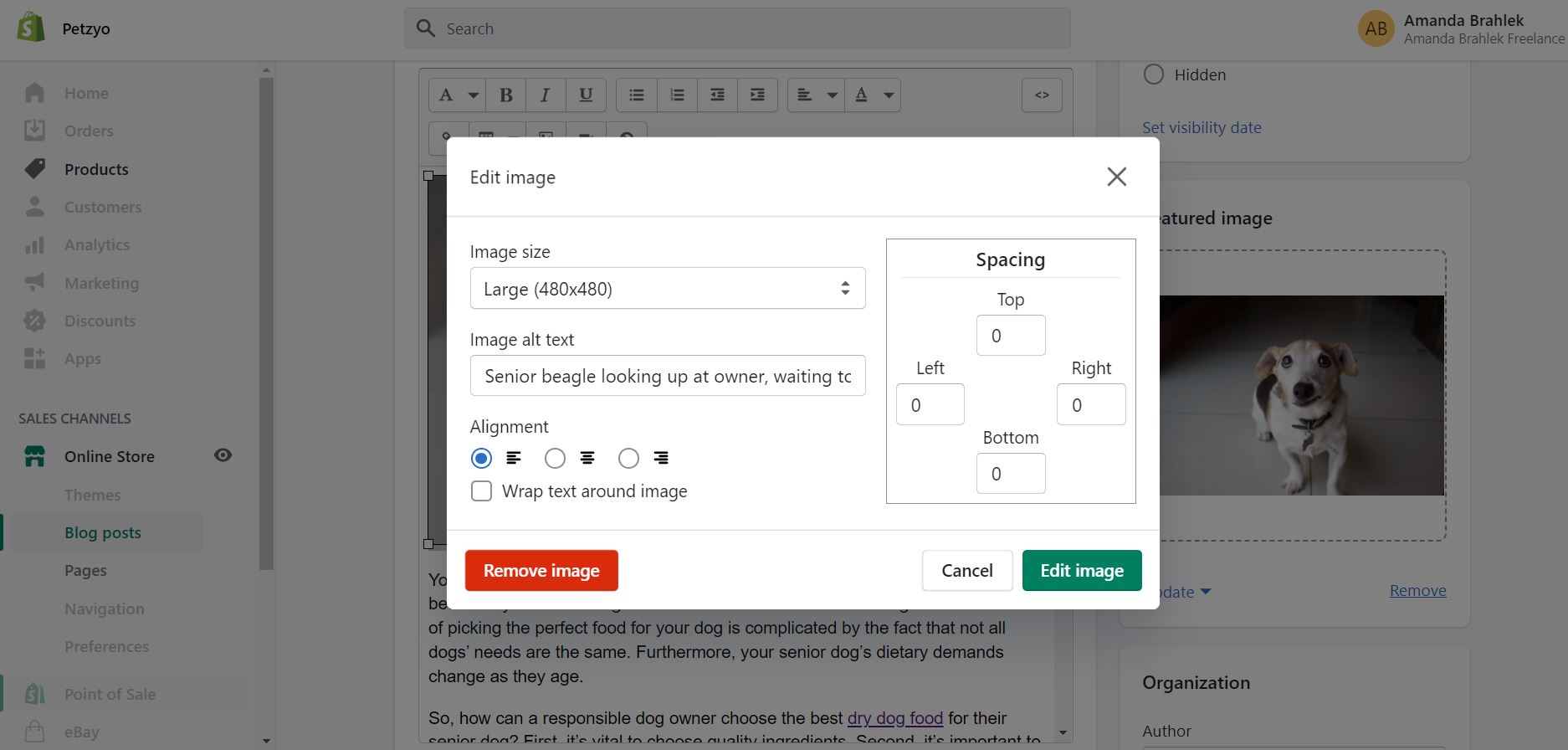
9. Optimize Your Alt Text

Your Shopify website likely has lots of images that showcase your products.

But remember, Google cannot see your images. It’s important you communicate to Google what those images are through descriptive file names and keyword-rich alt text.

Example of how to optimize alt text in ShopifyScreenshot from Shopify, January 2022

This also makes your Shopify website more accessible to users with visual impairments.

10. Create Blog Content To Target Long-Tail Queries

To capture users who are near the top of the sales funnel, create high-quality blog content that is optimized for relevant long-tail queries.

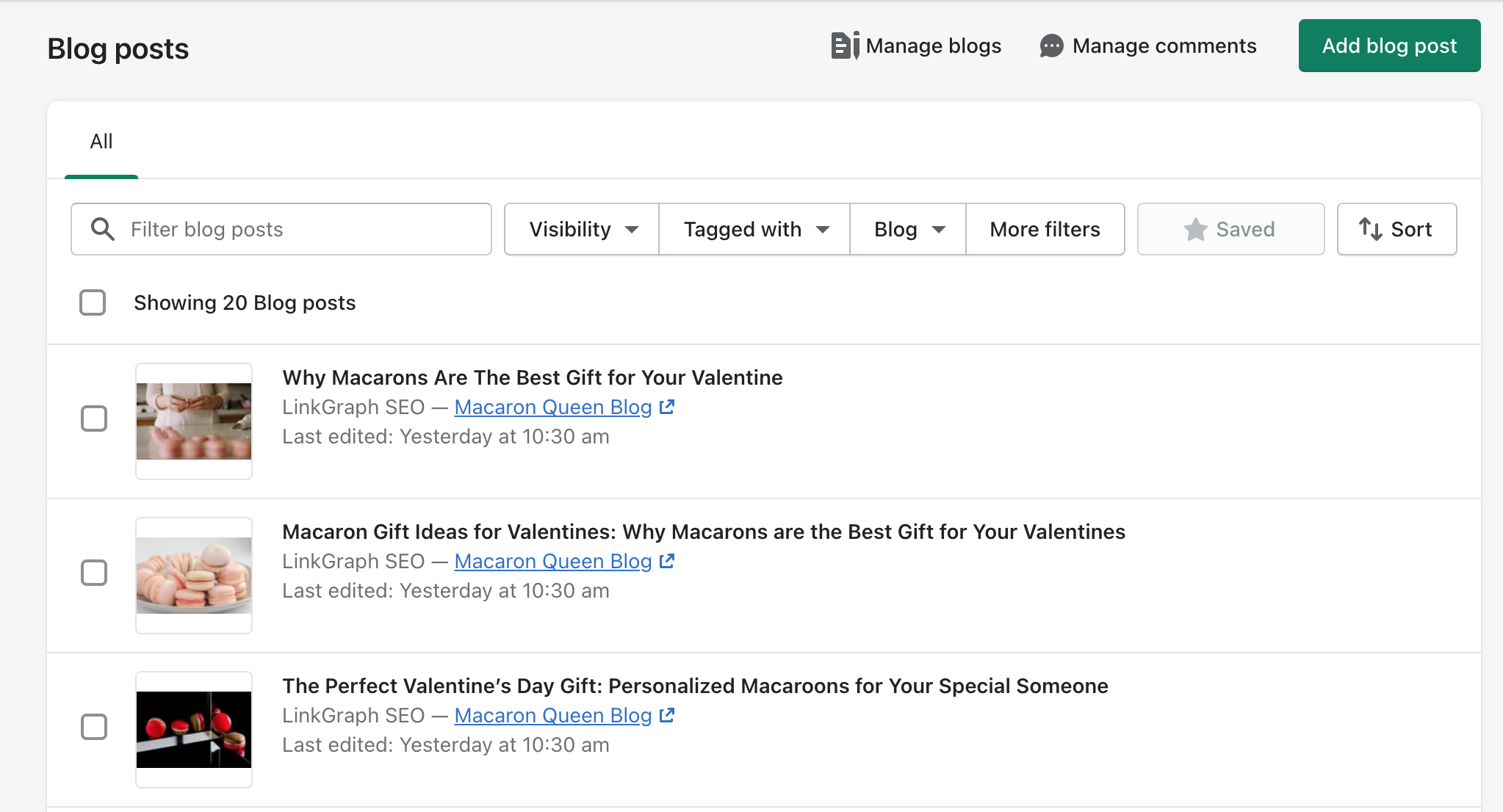
list of Blogs in shopify websiteScreenshot from Shopify, January 2022

By answering the questions users are asking about products like yours, you can build brand awareness and expertise.

It’s also a great way to increase the total number of keywords that your Shopify store ranks for.

Technical SEO

11. Create An SEO-Friendly Navigation Menu

Navigation menus help your users easily move throughout your online store. Not only will a SEO-friendly navigation menu look better to Google crawlers, but it will also create a better user experience.

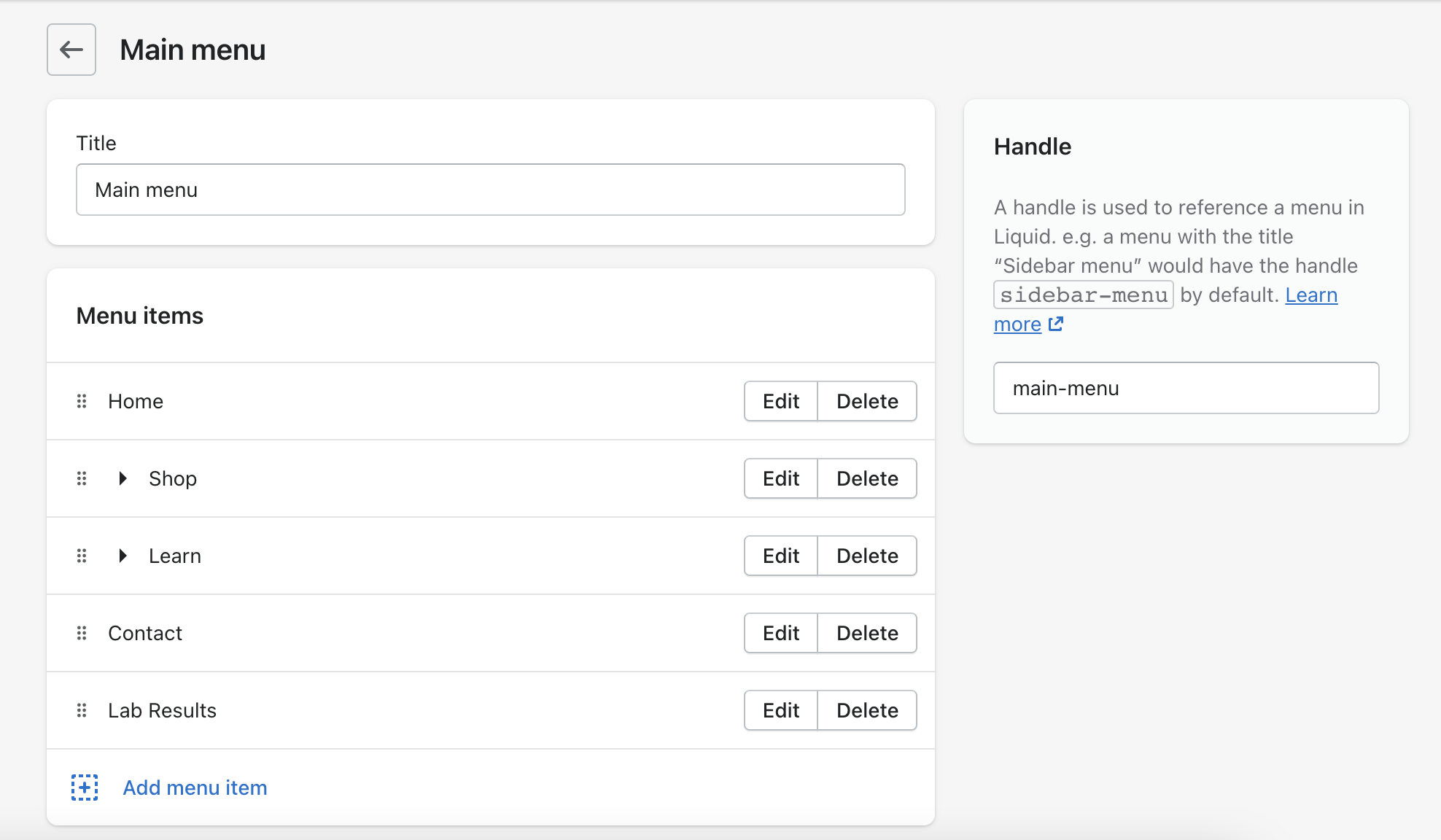
Navigation Menu in ShopifyScreenshot from Shopify, January 2022

A few SEO tips for navigation:

  • Prioritize clear and easy navigation.
  • Take the time to make sure that your products are well organized into collections.
  • Keep your navigation consistent across the page.
  • Use the nav to help users easily contact you or your support team.

12. Leverage Internal Links

Your internal links accomplish a few things.

They keep users moving throughout your website, they help search engine crawlers understand your site architecture, and they distribute your PageRank across more of your site.

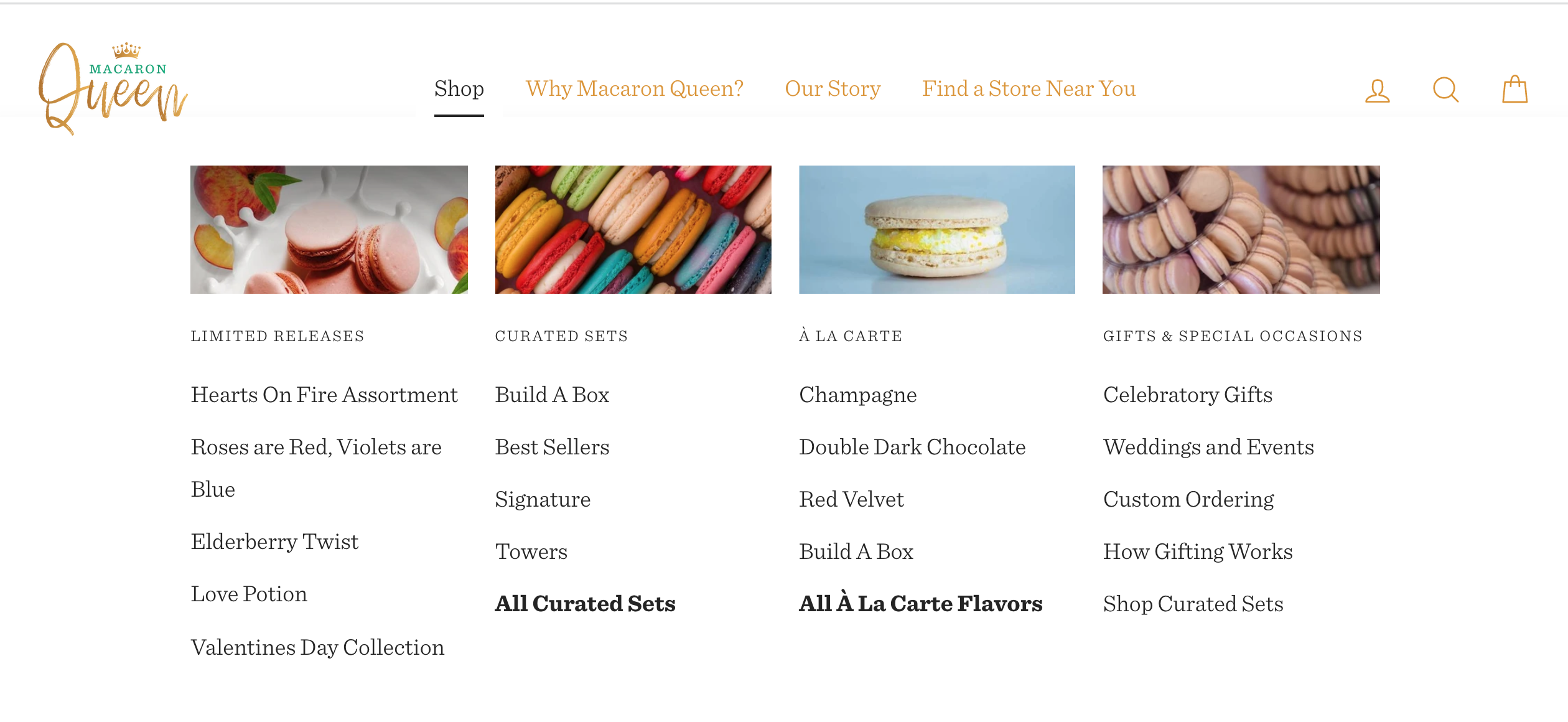
The majority of your Shopify website’s PageRank will be on your homepage, which is why the links you include in your nav menu should be strategic.

Navigation Menu of Shopify WebsiteScreenshot from macaronqueen.com, January 2022

Avoid sending link equity to items that are out-of-stock, seasonal, or are unlikely to rank well in search results due to thin or unoptimized content.

Instead, push PageRank toward pages that you want to elevate in search, like your primary category and collection pages.

13. Add The Products Schema

There are a few different ways to add structured data to your Shopify website, and which is best for you will be determined by how comfortable you are editing your website’s code. To add schema manually, go to Themes > Action > Edit Code.

You can use a schema generator tool to generate your markup and input all of the required properties.

Shopify users should consider using the following Product Schemas when applicable:

  • Aggregate rating.
  • Brand.
  • Category.
  • Color.
  • Dimensions.
  • Model.
  • Material.
  • Special offers.
  • Image.

If working in your HTML editor isn’t your jam, plenty of Shopify plugins have Products schema features and make the process simple.

14. Add Product Reviews

Positive reviews on your products can push users toward a click or purchase.

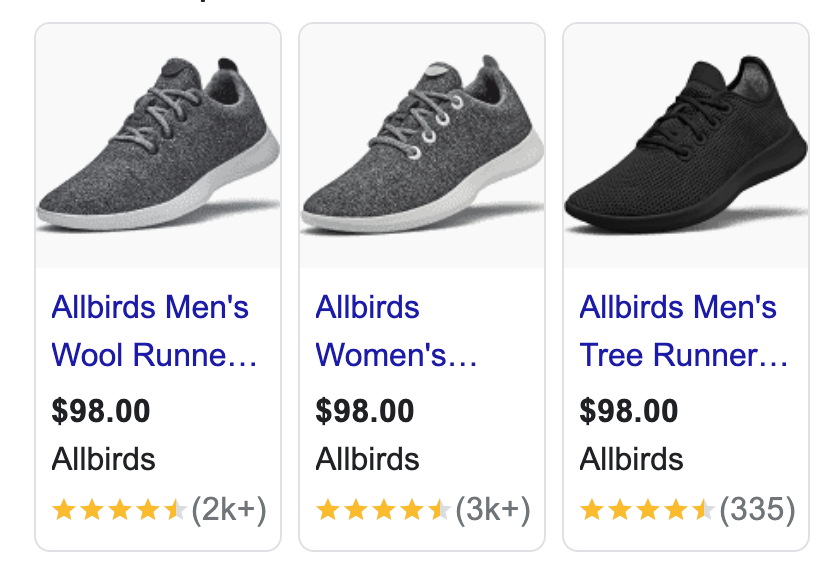
Download the Product Reviews app in the Shopify store to start leveraging product reviews. This app sends structured data information to Google so those yellow stars appear with your SERP result.

example of shoe's from Allbirds shopify store with product reviewsScreenshot from Google, January 2022

They can be game-changing in improving CTRs and generating more clicks to your store.

Off-Page SEO

15. Build Links To Your Shopify Site

You will also need to build off-site signals in order for Google to trust your online store and rank it in search results.

This is arguably the most difficult part of SEO because you don’t have control over whether a website chooses to link to yours.

However, there are some easy ways to start earning links:

  • Create high-quality content like blog posts and ask other site owners to link to it.
  • Get featured in gift guides or product roundups.
  • Guest blog on relevant sites.

16. Invest In Public Relations

Public relations and organic outreach are at the heart of link building and one of the best ways to earn high-quality links from authoritative websites.

If you don’t yet have the time or resources to do PR outreach, sign up for Help-A-Reporter Out (HARO). You’ll get daily emails from journalists and publishers looking to hear from experts or feature certain products.

Shopify Website Maintenance

17. Regularly Audit Your Website

Over time, your website will change. This occurs as you add or delete pages on your website, as your pages accrue backlinks, or as the landscape of search changes.

A regular website audit can help you determine which of your pages are performing the best in search and which are underperforming.

The insights provided from a website audit can help you identify key content, page experience, or authority issues that you need to prioritize and resolve.

18. Repair Broken Links

As you change up your product offering or items go out of stock, you will likely unpublish or delete pages of your Shopify Website.

If that page was linked to anywhere else on your website, you will create a “broken link.”

Google does not like to rank websites with excessive broken links, as it looks as if the website is not active and being properly taken care of.

Once a quarter, it’s a good idea to run a site crawler across the entirety of your website to identify broken links and repair them.

19. Study The Data And Iterate

As more users visit your online store, your analytics tools will provide you with loads of data about how they are behaving on your website, how they got there in the first place, and more.

Make sure to draw insights from that data to iterate on your keyword targeting, page content, internal linking, meta tags, and more.

Conclusion

Remember, SEO has a wonderful way of lowering customer-acquisition costs in the long term.

Learning the basics of Shopify SEO and taking the necessary steps can be all the difference in outranking and outperforming your competitors.

Follow the checklist above, and you’ll most likely see Google reward you with more keyword rankings and more site traffic.

More resources:


Featured Image: Kaspars Grinvalds/Shutterstock

SEO Experts Give Advice on Increasing Your Cannabis Site Visibility on Google


Despite the rapid growth of their market, cannabis providers have a limited arsenal when it comes to online promotion. Google does not allow advertising of cannabis or any related services, so PPC is out of the question. Fortunately, there are plenty of SEO strategies to boost visibility even in this highly censored industry. Discover the best tips for driving organic traffic in 2022.

SEO in the cannabis field requires a special type of expertise. Professional dispensary SEO services are helping sites rank on the first page on Google on a number of keywords. Experts navigate the complicated legal landscape and help their clients succeed through high-quality content and white-hat strategies.

How SEO Works

So, what is search engine optimization all about? Websites cannot promote themselves. Cannabis providers may not use paid ads, but they can forge ahead through wise optimization. This concerns technical aspects of their sites, content, and link-building strategies. SEO is always a complex endeavor.

When users search for cannabis, CBD, marijuana, or any other related products or services, they enter keywords into a search engine. If your website ranks well for these words, you may end up on the first page of the Google results. The higher you rise — the more users will click on your link, visit your catalog, and potentially buy from you.

The premise is quite simple, but the factors contributing to ranking are diverse. A professional agency knows all the ins and outs of search optimization. Make use of the following tips and tricks to make the most of your web presence:

1.   Boosting Your Website

Websites can be optimized for SEO during and after development. In addition to eye-catching and aesthetically-pleasing design, you need smooth navigation, fast loading, and engagement through images, videos, infographics, and other elements. Put yourself in your customer’s shoes and think about the first impression your site makes.

Slow loading is a major deterrent. The majority of users abandon websites that load for more than 3 seconds. When choosing any graphic elements, make sure they do not overload the interface. Find the perfect balance between quality and size.

2.   Mobile Optimization

Google prioritizes websites optimized for smaller screens. Today, the majority of customers use their smartphones or tablets for the online search. Hence, they are most likely to Google cannabis on the go. Make sure your content looks great on mobile screens and visitors can find what they need quickly and easily.

3.   Adding a Blog

A blog will not only let you educate visitors and customers. It is also important for SEO! Optimize your articles for organic search by including relevant keywords. Gradually, you can establish yourself as a trusted source of insights about the industry and its products. Provide only well-researched content and keep it updated. Allow customers to comment to boost engagement.

Marijuana is still a controversial subject surrounded by a lot of myths and misconceptions. For example, the overwhelming majority of American consumers have an incorrect perception of safety oversight for CBD, and few understand the intricacies of this emerging market. This is hardly surprising, as there is a patchwork of contradictory and inconsistent regulations across the country.

Help your visitors make sense of what cannabis is all about, how to use the products correctly, and what benefits they bring. Contribute to changing consumer perceptions and attitudes for the better. Create a strategy, post regularly, and pay attention to the following requirements:

●     Avoid salesy language and explicit promotion of your own products or services. Focus on education instead.

●     Make sure the articles are well-structured, have proper meta tags, keywords, and subheadings, etc.

●     Include lists, images, and subheadings to make the articles more readable.

●     Write at least 500 words.

4.   Google My Business

GMB is a powerful tool showing the physical location of your business, its contact information, hours, and a brief overview of products and services. It can help you reach new customers online and offline. Create your local profile and keep it updated.

Google will ask you to verify your business, which may be done in different ways — for example, by mail. Normally, it takes around five business days to complete verification. Then, customers will be able to find you online. Provide users with as much information as possible, and double-check every detail. Even small mistakes make businesses lose credibility.

5.   Google Reviews

Encourage customers to leave reviews on Google Maps and any other websites where your company is featured. Response to positive and negative feedback alike, and solve the problems if the complaints are objective. Do not ignore criticism, even if it is unfair. Remember that the majority of your potential customers check reviews before placing an order.

6.   Social Media

Although social media ads are prohibited, your company can still create a profile and fill it with impressive content. On the one hand, this is a great way to promote your website and include links to it. Secondly, it is also good for SEO, as social media profiles are also ranked for organic search.

7.   Google Analytics

Finally, successful SEO campaigns are unimaginable without reliable metrics. How will you measure the performance of your site and make sure your investment is paying off? Google Analytics is a treasure trove of information. You will see how many unique users come from organic search, which pages are the most popular, what keywords are used to find your content, etc. If you have not implemented Google analytics code on your site, do this ASAP and start tracking your data!

Google Will Deindex Pages If Site Is Down For Several Days

Google will begin to deindex your pages from search results if your website experiences more than a couple of days of downtime.

This is stated by Google’s Search Advocate John Mueller during the Google Search Central SEO office-hours hangout recorded on December 10.

An SEO named Aakash Singh called in to the livestream to ask Mueller how he can minimize the impact on search rankings while his client’s website is down for over a week.

Unfortunately for Singh and his client, it’s not possible to take a website down for a week without any negative impact to its SEO and search rankings.

Advertisement

Continue Reading Below

If a website’s pages become inaccessible then it will only take a matter of days before they start to get de-indexed, Mueller says.

Mueller goes on to suggest an alternative method for handling planned downtime, but it still doesn’t guarantee no harm will be done in the short term.

Read his full response in the section below.

Google’s John Mueller On The SEO Impact Of Website Downtime

If a website is down for longer than a few days, whether it’s planned or unplanned, it won’t be possible to prevent negative effects on search rankings.

Mueller states:

Advertisement

Continue Reading Below

“I don’t think you’ll be able to do it for that time, regardless of whatever you set up. For an outage of maybe a day or so, using a 503 result code is a great way to tell us that we should check back. But after a couple of days we think this is a permanent result code, and we think your pages are just gone, and we will drop them from the index.

And when the pages come back we will crawl them again and we will try to index them again. But it’s essentially during that time we will probably drop a lot of the pages from the website from our index, and there’s a pretty good chance that it’ll come back in a similar way but it’s not always guaranteed.”

A key takeaway here is that the impact of extended downtime will last longer that the duration of the outage.

Your pages won’t come back immediately, and when they do there will be strong fluctuations in search rankings before things settle down.

“So any time you have a longer outage, where I’m thinking more than a couple of days, I would assume that at least temporarily you will have really strong fluctuations and it’s going to take a little bit of time to get back in.

It’s not impossible because these things happen sometimes. But if there’s anything you can do to avoid this kind of outage, I would try to do that.”

Advertisement

Continue Reading Below

What should a website do during an extended outage?

One way to handle it, Mueller says, is to set up a static version of the site that users can be directed to while the main site is down.

If possible, however, the best thing to do is make sure the outage lasts for less than a day.

“… that could be something like setting up a static version of the website somewhere and just showing that to users for the time being. But especially if you’re doing this in a planned way I would try to find ways to reduce the outage to less than a day if at all possible.”

Advertisement

Continue Reading Below

Hear Mueller’s full response in the video below:


Featured Image: Screenshot from YouTube.com/GoogleSearchCentral, December 2021.

Enterprise SEO Site Structure: 14 Essential Optimizations

Site structure is crucial for any enterprise SEO service to implement, but the essential optimizations go well beyond the scope of what’s seen in traditional corporate SEO.

An enterprise site must adopt a digital marketing strategy that looks at all of the fine points of a site, usability, and elements in your organization’s control.

Here are tips you can use for any enterprise site to create a structure that will work today and in the future.

1. Put SEO Governance In Place

An enterprise SEO strategy can be massive.

Marketing teams are handling hundreds of campaigns, content marketing adds countless pages to a site, and even social media may be handled by an enterprise SEO agency, internal team, or mixture of both.

So, what can you do to keep everything in order and running smoothly?

Implement SEO Governance

Governance helps in a variety of ways, both in the B2B and B2C worlds, and will provide processes that help:

Advertisement

Continue Reading Below

  • Enterprises launch in multiple countries without conflicting issues.
  • Provide controls over certain URLs so that not everyone can create or change vital pages.
  • Reduce the risk of multiple teams working against each other to rank for the same keywords or services.
  • Provide consistency across multiple sites.

Every enterprise SEO strategy should start with a governance plan so that there are rules and processes in place that all teams can access and follow.

Policies, standards, and processes ensure that digital marketing strategies don’t conflict, reduce errors and help enterprises maintain consistency.

2. Create A Foundation For WCAG 502 And ADA Compliance

An enterprise site must take website accessibility into account as part of its overall SEO strategy. Large companies, such as hotel chains, are being sued for not being compliant.

Even outside of that risk, being compliant should be part of your overall site structure strategy.

Why?

It’s good practice. Anyone doing SEO work today should put a major focus on making their website WCAG and ADA compliant.

Since this is a massive topic, see this guide for more: How to Avoid Costly WCAG, ADA & 508 Accessibility Penalties.

Advertisement

Continue Reading Below

3. Add Site Search

Internal search is so important, even in traditional SEO, because users have a very low attention span. Unfortunately, people don’t want to click three or four links to find the page or product that they’re interested in on your site.

One simple addition to your site structure is adding an internal search.

The search should:

  • Search all internal files.
  • Include search suggestions.

As part of your internal linking and content strategy, you should add search suggestions to guide your website’s users in the right direction.

4. Create URL Guidelines

Creating URL guidelines is essential and while it’s part of governance, it must be explained a little further to fully understand.

One of the SEO fixes no one wants to make is to go back and have to redirect hundreds of pages because cross teams created the same content and used similar URLs. For example, teams can create:

All of these pages may work and have different content. Unfortunately, this is one of the ways that you’ll frustrate and confuse anyone who visits your site. Create URL guidelines that include:

  • Capitalization.
  • Hyphen or dash for spaces.
  • Special character usage.

However, when your enterprise SEO strategy spans multiple countries and languages, you may need to allow the use of certain special characters for European sites and disallow them for US websites.

Consider where the business is expanding now and, in the future, to create better URL guidelines to follow.

Advertisement

Continue Reading Below

These guidelines are essential when working with multiple teams or an outside SEO agency. Even if all of your operations are in-house, creating guidelines will ensure future team members remain consistent with their URL creation.

5. Plan Out Your Main Site Navigation

You probably didn’t expect a guide meant for companies using an enterprise SEO solution to include information on the main navigation of a site. Still, it remains one of the most critical elements of site structure.

Designing the main navigation menu is one of the most important aspects of site structure, and it will also make your site easier for search engines to crawl.

A few recommendations here are:

  • Create a top menu with important links to mini-sites, business units, checkout and registration.
  • Ensure all menus are mobile-friendly.
  • Use a shallow site structure.

Shallow site structure is vital, and what this means is that a user will click three or fewer times to reach every page on your site. Enterprise brands must spend time planning for a shallow site structure.

Advertisement

Continue Reading Below

An enterprise business will lose considerable users and revenue if they force users to click more than three times to reach the page they want to visit.

Site taxonomy is also important. What this means is creating a logical URL structure, such as /business-unit/service-name. Users should never have to leave the subfolder to find other services from the same business unit.

Navigation may seem trivial, but it’s a part of SEO strategy that receives far too little attention.

Once your navigation is in place, you can move to your internal link strategy that can span cross-business units.

6. Internal Linking For Success

Internal linking should be a part of every SEO strategy – it’s fundamental – but it’s even more critical for an enterprise SEO strategy to use interlinking extensively.

When you have strong internal linking, it’s easier for a search engine to crawl your site, and it’s even more important for visitors.

This is an SEO tactic you can use across multiple domains across multiple languages, with a few nuances to consider.

Advertisement

Continue Reading Below

For example, if the enterprise operates in various countries, you must make sure cross-linking between sites and hreflangs are properly assigned.

A few tips for creating your internal linking strategy are:

  • Create a database of pages that can be interlinked.
  • Add interlinking as a critical part of your content strategy.
  • Encourage interlinking X number of times a post.

Ideally, you’ll use an SEO tool that can help you automate this part of your site structure to some extent. An SEO team should develop these guidelines and assist with the strategy.

So, when creating your content marketing strategy, add in internal linking as part of the SEO tasks that cross teams discuss. Following the same guidelines and procedures across teams can be difficult, but it’s a vital part of enterprise level SEO

7. Don’t Forget About Your Breadcrumbs

Another SEO tactic that should be in use across every enterprise site is breadcrumbs. As part of your digital marketing strategy, you should spend time helping visitors navigate your site as easily as possible.

Advertisement

Continue Reading Below

For example, if you land on Walmart from a search engine and are on their “comforters” page, you’ll see breadcrumbs for:

While simple, this helps Walmart direct its site users to pages of interest. Enterprise brands must use breadcrumbs, especially as their content marketing efforts increase.

8. Be Mindful Of Keywords And Cross-Business Unit Competition

When contributing and building an enterprise website, you can work with one SEO team or many. Often, you’ll work with an enterprise SEO company for a handful of websites under the enterprise organization.

As an SEO expert, it’s vital to be mindful of keyword usage, optimization, and cross-unit competition.

What often occurs is that every team is running its own enterprise SEO campaign. For example, let’s assume that the company has sites in:

Advertisement

Continue Reading Below

  • U.S.
  • U.K.
  • Ireland
  • Spain
  • Italy

SEO work on the Spain and Italian enterprise websites won’t conflict with each other due to the language difference.

However, there can be a lot of SEO effort lost when working on the U.S., U.K. and Irish sites if cross-business units are competing with each other.

Teams across business units and sites need to try and collaborate as much as possible.

Enterprise marketing can easily cause conflicts among multiple teams and units. Therefore, enterprise brands should conduct SEO audits frequently to lower the risk of teams working against each other rather than together.

9. Create Proper Categories And Subcategories

As an SEO specialist, you know the importance of creating proper categories and subcategories. When developing enterprise SEO governance, it’s crucial to spend time creating categories and subcategories.

Advertisement

Continue Reading Below

The goal is to help search engine bots and humans have a logical way to traverse your site.

Ideally, the categories and subcategories would be simple enough to follow that people could change your URL with a high likelihood of reaching a valid page. Additionally, these sections make it easier to create logical navigation that’s easy to follow.

So, while this tip isn’t revolutionary by any means, it’s an area every enterprise SEO service should focus on when first optimizing an enterprise website.

10. SEO-friendly Pagination

Pagination is vital, especially for larger ecommerce sites where a category of products may have 100+ pages. A few things to consider here are:

  • Reduce your use of JavaScript.
  • Remain consistent with your pagination approach.
  • Show all products on a page when it doesn’t impact load time too much.
  • Canonicalize any duplicate pages, such as /product/ and /product/1 showing the same content.
  • Deoptimize pages after page 1 if you don’t want these pages in the search results.

It’s crucial that you spend time on the site’s pagination and remain consistent across all related sites under the enterprise’s control.

Advertisement

Continue Reading Below

11. Sitemaps

Even sitemaps have their limits, and while some enterprise sites will never reach these limits, others will blow past them. So, you can split up sitemaps logically to avoid hitting the following limits set by Google:

  • No single sitemap should be 50MB or more uncompressed.
  • No sitemap can contain 50,000 or more URLs.

For example, large ecommerce sites can easily reach these limits. So, you could break the sitemap into smaller chunks, such as by product type or category.

12. Shared Modules And Requirements

Inside the enterprise’s CMS, you can do some preliminary work to keep issues with site structure from occurring. For example, you can create or use modules that will:

  • Conduct duplicate checks on:
  • Protect keywords in URLs.
  • Suggest related pages.
  • Require Image Alt attributes.
  • Require aria-labels for forms and links.
  • Automatically noindex specific types of content (PDF files or newsletter pages with duplicated content).
  • Implement other features to comply with the Enterprise’s SEO governance policies.

Advertisement

Continue Reading Below

13. Redirects

Redirects are a significant challenge, and there are a lot of redirect mistakes that can take a major toll on an enterprise’s SEO. When multiple teams are working on a site together, this can lead to:

  • Moving pages and URLs.
  • Removing pages.

For example, if sites are merged or a business is acquired, hundreds or thousands of redirects can be put in place. So, you should have a system in place to:

Advertisement

Continue Reading Below

  • Cross-check redirects.
  • Remove unnecessary redirects.
  • Run a full redirect audit to ensure pages are working properly.

Otherwise, if the pages are stuck in a redirect loop or produce a 404 error, you’re going to lose a lot of SEO potential in the process. This can also directly impact your website’s crawl budget.

14. Core Web Vitals

Core Web Vitals are talked about a lot lately and they’re critical on the enterprise level, too. You’ll want to pay attention to a few things:

  • PageSpeed optimization across the entire site.
  • Core Web Vitals for different sections of a site that may have its own design.
  • Easy navigation on desktop and mobile devices.

Advertisement

Continue Reading Below

You must pay close attention to Core Web Vitals, especially across multiple domains and servers.

Additional Tips For Enterprise Site Structure

We’ve covered a lot of points, but there are a few additional areas that are vital to touch upon to ensure the enterprise organization stays on track with your SEO solution.

Consistency

You need to remain consistent. While this is easy when working on a basic website, it’s challenging when working for an enterprise company. For example, one enterprise SEO firm may divert from governance and protocols, which can lead to issues across the board.

Protocols and procedures must be implemented to enable the company to run an SEO campaign that drives results consistently.

Otherwise, throughout the life of the business and as its sites and content assets grow, you’ll find yourself doing more SEO fixes than bringing value to the company.

If protocols or procedures change, ensure everyone in the enterprise organization is on board with the changes, from the social media manager to members of another SEO team working on international sites.

Advertisement

Continue Reading Below

SEO Audits

When running a backlink campaign, it’s common to run an audit, eventually, to learn what links are gained and lost. However, you need to also focus on the basics of search engine optimization and conduct routine site audits.

Enterprise-level SEO is all about checks and balances.

However, audits go beyond running fancy enterprise SEO tools to check for broken links or redirect loops. You’ll also want to include internal audits as part of the overall workflow of the business. For example, let’s assume that another team is handling local SEO.

Before the team publishes any of the pages, you may:

  • Audit the page.
  • Keep the page in draft until it’s checked against governance.
  • Publish the page when everything is proper.

Corporate SEO has a lot of checks and balances. It’s up to you to create these checks and balances as part of your search engine optimizations efforts.

Advertisement

Continue Reading Below

Of course, full site audits should be conducted periodically so that you can catch errors that may slip through the cracks.

Quick Note About Crawl Budget

Every enterprise SEO company should have control over the enterprise’s overall architecture and site structure. The key is not to waste the crawl budget and your SEO effort in the process.

Often, teams go overboard with their content strategy, and it takes away from other pages on a site where there’s a lot of value.

As part of the site structure and overall governance, it’s crucial to:

  • Eliminate most thin or low-quality pages.
  • Remove pages with iFrames (common in older sites).
  • Noindex pages that may be duplicated.

For example, enterprise SEO often includes working with numerous teams and service providers.

One team may hire a news generation service to publish new industry news on the site, and these pages may be thin content and even duplicated.

Advertisement

Continue Reading Below

SEO Governance

Governance must handle these pages properly, ideally with noindexing, so that you’re not losing value in the SEO work being done due to crawl budget issues.

If you have strong governance in place, it will help maximize the value of the enterprise’s search engine optimization.

Final Thoughts

Enterprise approaches go beyond traditional, local, and technical SEO because there are so many moving parts. Governance and the fine details matter more than getting a backlink or having content go viral on social media.

Every enterprise SEO company should review the site(s) that they’re working on to ensure that a well-formed site structure is in place.

Once you have a good foundation for your site structure and the proper protocols and procedures in place, you can focus more on traffic and conversions.

More resources:


Featured image: Shutterstock/aliaksei kruhlenia