The World Cup’s New High-Tech Ball Will Change Soccer Forever

When the 2022 World Cup made its debut on Sunday, it kicked off one of the most significant in-game uses of technology in sports history.

All tournament long, match balls will contain a sensor that collects spatial positioning data in real time — the first World Cup to employ such a ball-tracking mechanism. This, combined with existing optical tracking tools, will make VAR (video assistant referees) and programs like offside reviews more accurate and streamlined than they’ve ever been. Combining these two forms of tracking has long been a holy grail of sorts in technology circles, and FIFA’s use of the ball sensor in particular will serve as a highly public test case over the next four weeks.

Like so many other parts of the burgeoning world of sports tech, the setup used at the World Cup is both an endpoint and the foundation of a whole new era. Years of research and testing were needed to get here — this particular ball sensor was in development and testing for six years before receiving full FIFA certification — but events like this could quickly catapult emerging technology into the public eye through applications that stretch well beyond officiating.

What went into the development of today’s tracking technology, and what are its key uses at this World Cup? How has the tech been tested, and how can players, teams and fans alike be confident that it’s accurate and consistent? And maybe most importantly, what does this same technology portend for the future of analysis, fan engagement and team data across the world’s most popular sport?

I spoke to people across the world of sports tech to find answers around one of the field’s boldest experiments to date.

Which technology is being used, and how does it work?

FIFA’s application of this technology at the 2022 World Cup is being termed a “semi-automated offside” program – one that’s largely run by AI features, but retains a vital element of human confirmation.

Within every match ball is a device designed by KINEXON, a major player in the performance-tracking world across several sports. Per the company, this device weighs 14 grams (just under 0.5 ounces), and actually houses two separate sensors operating simultaneously:

  • Ultra-wideband (UWB) sensor: A type of technology that’s superior to GPS or Bluetooth for precise positional data, plus can transmit data in real time to constantly track the ball’s position.
  • Inertial measurement unit (IMU) sensor: A sensor meant to detect nuanced movements of an object in space.

“While the ultra-wideband helps me to have the position of an object, the IMU gives me the granular movement in three dimensions,” said Maximillian Schmidt, co-founder and managing director of KINEXON.

So any time the ball is kicked, headed, thrown or even so much as tapped, the system picks it up at 500 frames per second. Data is sent in real time from sensors to a local positioning system (LPS), which involves a setup of network antennas installed around the playing field that take in and store the data for immediate use. When a ball flies out of bounds during the course of play, and a new ball is thrown or kicked in to replace it, KINEXON’s backend system automatically switches to the new ball’s data input without the need for human intervention.

KINEXON’s in-ball device is supported by suspension technology provided by Adidas, designed to house the sensor at the central interior point of the ball and keep it secure in a consistent location.

Paired with this ball sensor is optical camera tracking from Hawk-Eye, a system well known for its work in tennis. Twelve Hawk-Eye cameras are set up around the stadium, tracking both the ball itself and each player 50 times per second. Twenty-nine separate points of the body are tracked for players, including limbs.

When combined, these two data sources allow for offside decisions that are not just highly accurate, but also available much faster than in the past – a major priority for FIFA in this World Cup cycle.

“We debriefed in 2018 after the World Cup,” Nicolas Evans, head of football research and standards for FIFA Technology Innovation, said. Such a debrief is standard after each World Cup, according to Evans. “The biggest area for improvement we saw was the time it took to make offside decisions.”

With that in mind, data from both KINEXON and Hawk-Eye is run through artificial intelligence software that’s programmed to generate automated offside alerts to officials in the match’s video room. Instead of manually combing through plays, a time-consuming process, AI programs auto-generate alerts that can then be confirmed by video match officials.

The software also generates 3D renderings of the spatial data, which will be overlaid onto TV broadcasts and in-stadium monitors to give fans a direct look at how each reviewed call was decided.

How accurate is this data? How is it tested?

Some readers might have an understandable question at this point: “How do I know this data consistently reflects the true positioning of the players and ball?”

The first concept to understand here is refresh rate, which is measured in Hz and refers to the number of times per second that a given display is able to draw a new image. Standard 50Hz video, a common format used for HD monitors today, is generating a new image 50 times per second (or a “frame rate” of 50 frames per second, for those more familiar with that term). Anyone who has slowed a video down to frame-by-frame mode knows the sensation of slight periods of time passing between each frame – and for 50Hz video, that gap is 20 milliseconds per frame (for 60Hz video, it’s 16.66 milliseconds per frame, and so on).

With KINEXON’s ball-tracking system, that data is coming in at 500Hz, meaning any gaps in true positioning are below two milliseconds long – or 10 times shorter than standard 50Hz lags. Furthermore, the use of a PTP master clock allows synchronization between KINEXON and Hawk-Eye data that’s precise down to one-millionth of a second, per Evans, ensuring the two feeds are never out of whack with one another.

To check each component of the system, FIFA has conducted tests in both controlled and live settings.

For both the KINEXON ball sensors and Hawk-Eye’s optical camera setup, a format known as “ground truth testing” is required by FIFA’s Quality Programme for Electronic Performance Testing Systems (EPTS). The approach utilizes a minimum of 36 high-quality Vicon motion-capture cameras, combined with reflective markers designed for these cameras placed on the ball itself and every player for ultra-accurate detection. As players and the ball move around the testing pitch, both these Vicon cameras and the KINEXON/Hawk-Eye setups run simultaneously – and researchers compare the two outputs to assess the accuracy of the latter systems. This testing is augmented by the use of other tools, such as a laser to detect events like high-speed player sprints.

Another kind of test is also vital here, especially for one of the world’s most-watched sporting events: Ensuring that the addition of a sensor inside the ball is imperceptible to the players kicking it. Since it’s all too easy to envision a scenario in which a prominent player blames the feel of the “different” World Cup ball for a missed penalty or some other on-pitch failure — igniting a worldwide controversy — eliminating such concerns is naturally important.

Adidas is the key entity responsible for this kind of testing, which sources familiar with the program report is done in two ways:

  • Blind player testing: With the help of clubs in places like Spain, Germany and England, extensive blind testing was carried out to see if players could tell the difference between “normal” balls and balls infused with the sensor/suspension setup without knowing which was which ahead of time.
  • Mechanical shooter testing: In a lab setting, robotic shooting devices can be programmed to “kick” the ball at varying speeds, spins and directions. High-speed cameras then evaluate the flight of the ball, ensuring that the presence of the sensor does not create abnormal flight paths.

This testing was performed in several professional and grassroots settings, such as the 2021 FIFA Arab Cup in Qatar and the 2021 FIFA Club World Cup in Abu Dhabi. In addition, Evans said FIFA ran several of its own additional blind tests, including at a team workshop in Qatar earlier in 2022.

“Together with our partner Adidas, large-scale sample blind tests have been carried out where no differences could be observed by players between the connected ball and the regular ball,” Evans said.

These and similar forms of tech also have been getting real-life test runs for years now. An earlier version of KINEXON’s sensor-infused ball was used alongside jersey tracking in 2018 in Germany’s fourth-tier Regionalliga to bring real-time data to a live TV broadcast; a newer setup was used earlier this year during a German academy club match. The Hawk-Eye camera setup, meanwhile, has been utilized in the UEFA Champions League group-stage matches throughout the early part of this season in the lead-up to the World Cup.

Of course, none of this guarantees an incident-free event. Unforeseen circumstances can come up in the world of tech. Equipment can malfunction. Even in the likely scenario that the tech works perfectly from start to finish, good luck convincing crazed sports fans of that if their country’s top player has trashed the tracked ball or suggested the system isn’t accurate.

Such possibilities are all but unavoidable in the end. But the companies involved are confident they’ve met every important threshold to introduce this new level of technology into the world’s most important soccer competition.

“[It’s] probably as good as it’s ever been in this type of technology,” Evans said.

This is the tip of the technological iceberg

The 2022 World Cup is barely scratching the surface of the potential capabilities of this sort of technology – which go well beyond officiating.

Before long, this combination of ball- and optical-tracking could be a familiar tool to everyone involved with the sport — much like Second Spectrum tracking in the NBA or Hawk-Eye in tennis. Teams and players could use the resulting data for next-generation tactical analysis; broadcasts could use it to visualize the game and draw in new viewers. Fans could eventually have access to a vast ocean of new stats that were never possible until now.

In fact, this already has started happening.

Earlier in 2022, KINEXON’s ball sensor was used in a Liga Portugal relegation match, along with sensors in player jerseys to track their movements. More than 300 different metrics were collected in multiple categories, including technical data (shot and pass speed, ball possession time, distinct ball actions), performance data (dribbling speed, accelerations and sprints — both with and without the ball — plus measures of athlete “load”) and tactical data (for both teams and players, tactical concepts such as space control, pressing, ball gains/losses and counters can be tracked).

Possible applications of this data, especially once it’s a more standardized part of the game and the parties involved become familiar with using it, are virtually limitless.

“We can use that information in real time to tell new stories,” Schmidt said. “[We can use] them to create virtual worlds, augmented overlays, insights on performance of players.”

For one thing, expect soccer fans to have new ways of enjoying the game based on this advanced tech. The first layer here will be broadcast improvements: More 3D immersive graphics, similar to the offside renderings 2022 World Cup viewers will see, could be used in several new ways – even those that viewers control. We’ll also see overlaid on-screen data, much like the LA Clippers’ “CourtVision” broadcast option that displays tracking information and a digitized view of the court during play.

And the next wave after that is even more exciting to think about. The world of virtual reality offers tantalizing potential; imagine watching plays (or even an entire game) from the direct vantage point of Kylian Mbappe, Karim Benzema or any other player of your choosing. Evans and others in the space also expect this data to eventually make its way into the world of video games, merging real and digital realms.

That’s just on the fan side. As the 2022 World Cup tracking setup becomes more commonplace around soccer, players and teams will now have a wealth of new data, particularly surrounding the ball – the true heartbeat of the sport. Tactics, analytics and even all-important health and performance improvements are all on the table.

Said Schmidt: “More and more leagues are now thinking about, ‘How can we enhance the already existing dataset with new insights from the ball?’ Because it’s the head of the game.”

So as tech continues to change the way we view sports, the 2022 World Cup stands poised to serve as a watershed moment. When you see that first “semi-automated” offside call, remember what it took to get to this point – and daydream about what the near future holds.

Check out our latest World Cup predictions.

When is it okay to change URLs for SEO reasons?

Personally, I change outdated, harmful or lengthy web addresses (a.k.a., URLs) when updating existing content quite often.

Why? Let me explain.

What did Google’s John Mueller say about changing URLs for SEO?

Before we dive in, let’s see what the official Google position on changing URLs for SEO seems to be. It’s quoted from a tweet by John Mueller, Search Advocate at Google, as the connection between webmasters and the search giant.

As reported by Barry Schwartz on Search Engine Roundtable, Mueller stated that the risk is much higher than the possible reward when changing URLs (for SEO reasons):

“(…) Will it help the site? Very, very rarely (if they have terrible URLs that you can’t even copy & paste, maybe). Will a change negatively affect the site for a while until it’s reprocessed? Probably. Some risk + usually no gain.”

How does a proper URL look in the first place?

Let’s start with the ideal state of your URL. 

In case you are using WordPress or a similar CMS, you will most likely have a well-designed URL structure already by current standards. 

The examples below are all fine:

  • example.com/post-title
  • example.com/topic/post-title
  • example.com/topic/sub-topic/post-title

Does your URL look anything like this? Congratulations! You most likely do not have to change anything! 

It’s just like Mueller said: the risk of changing a URL would outweigh any imagined benefit.

Examples of potentially harmful URL structures

Custom websites and even content management systems of the early days often create harmful website addresses. 

You may even run a legacy WordPress site that has some mistakes of the past still built in. 

Does your website address look like some of the potentially harmful examples below?

  • example.com/p?=123
  • example.com/2022/11/01/post-title
  • example.com/keyword1-keyword2/keyword1/keyword2-keyword1
  • example.com/category/sub-category/topic/sub-topic/very-long-headline-that-does-not-really-have-to-be-added-to-url?id=123456789&utm_source=Twitter&utm_campaign=social

All these were pretty common until a few years back, so you may still have a site with a less optimal URL structure like one of the above.

Also, with website builders and complex enterprise-level CMS software, you may have additional issues.

Sometimes, website builders like Weebly or Squarespace add gibberish to file names when dealing with special characters from foreign languages.

  • Numbers-only post addresses are short and sweet, but there is no reason to click them. They are bland and meaningless.
  • Date-based addresses make sense only for publications that truly publish time-sensitive news, like The New York Times (e.g., https://www.nytimes.com/2022/10/12/business/wall-street-mixed-quarterly-earnings.html). For everybody else, it may discourage people from clicking a link to evergreen content because they assume it’s just “yesterday’s news”.
  • Keyword-stuffed URLs can ostracize visitors as they are viewed as low quality and Google might also demote them in search results.
  • Very long, hard-to-read URLs with lots of redundant elements can simply confuse people. 

URL parameters that often contain other website names or even addresses (like utm_source=Twitter.com) are utterly confusing. They can even mislead scripts on third-party sites where you share content.

When to change URLs for SEO reasons

So when can you change URLs? Ideally, never – not only for SEO reasons. It’s “never change a running system” as an old computer geek motto says.  

However, we are not living in an ideal world (and I understand that Mueller’s tweet is too short to add all the exceptions). So here, we’ll go over instances when it’s OK to change URLs.

Sometimes URLs are completely bonkers as in the example offered by Patrick Cunningham on LinkedIn:

Lengthy ecommerce URL example

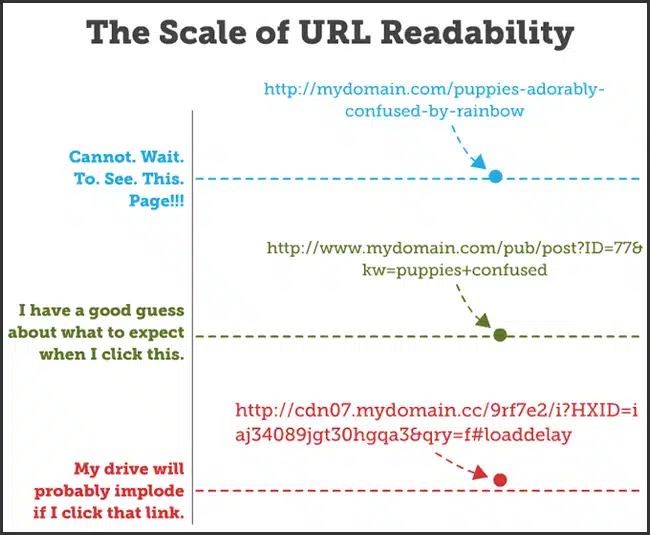
Below is a classic comparison of typical URL structures from Moz.

The Scale of URL Readability

Personally, I do change less dirty URLs as well. Why?

Let me explain.

First of all, I have been shortening lengthy URLs when updating existing content on WordPress regularly. For SEO reasons, a very long URL like this:

  • example.com/shortening-too-long-urls-when-updating-existing-content-on-wordpress 

…can be shortened to:

  • example.com/shortening-urls 

Why exactly?

First off, the URL itself is by now a negligible ranking factor. As you’d expect, experts are divided on that question. 

The most obvious SEO benefit of clean URLs is that they contain (just) keywords in them and no redundant “stop words.”

So whenever someone links your URL (like many automated systems do – think aggregators), you get rich anchor text links that benefit you in Google’s organic results.

Also, people are most likely to click them and thus notice your content, share it and link to it.

The URL:

…is less likely to attract visitors than:

  • example.com/henry-cavill-shirtless

After an update of existing content, you might find that the current URL no longer reflects the original message. It may even be that the updated article states the opposite of what it said earlier.

A legacy article, like example.com/google-plus-launched, could be changed to example.com/google-plus-discontinued to reflect the current reality. 


Get the daily newsletter search marketers rely on.


When to change URLs for other reasons: Findability, usability and shareability

Direct SEO benefit is not the only reason to change, optimize or fix your URLs. There are at least three often more important ones. 

When people talk about SEO, they often limit their SEO definition to something like “technical SEO optimization for Google.”

Thus, when I suggest doing something for actual visitors, many clients will scream “no” and tell me “but that’s not SEO.” Hence, they don’t want to pay for it.

The logic behind this seems to be very old school as in “who cares for actual visitors when Google loves it”? Nowadays, this approach no longer works well. 

Google now considers a plethora of ranking factors, many of which can be subsumed under the umbrella of user experience (UX).

Convincing Google that you have to rank on top of its organic results is only the first step.

You have to enable people to find the actual resource they are looking for, use it without difficulties, and ideally share it.

Findability

Findability goes beyond SEO. It ensures that things are findable on-site as well. 

If you have a complex website with lots of sections, topics and categories, you may want to ensure that they are reflected in the URL so visitors know where they are locally.

A simple URL like example.com/post-title may not suffice, especially when there are lots of similar resources. 

Consider a post title and address this: google-struggles.

Imagine a site that covers Google in many different sections:

  • example.com/technology/google
  • example.com/finance/google 
  • example.com/law/google 

Depending on the context, the content of the article could be covering something completely different:

  • “Google struggles to combat spam”
  • “Google struggles to satisfy shareholders”
  • “Google struggles to convince EU”

Your site may have started years ago and grown substantially over time. You may have added thousands of articles and by now it’s hard to find them on the site just by relying on the post title.

Consider changing your URLs to make content more findable on your site then, particularly if many people use your internal search to navigate the site.

Usability

Some argue that findability is just a subset of usability. To me, you have to be able to find something first to be able to use it second. 

Again, too-long or cryptic URLs that appear in the browser address bar might be unhelpful. Just compare these two examples from Amazon:

  • www.amazon.de/dp/1501197983/?coliid=IZB68GB6MJQMQ&colid=3A7JBQOG6TBE9&psc=1&ref_=lv_ov_lig_dp_it
  • www.amazon.com/Contact-Novel-Carl-Sagan/dp/1501197983

Which one of them is more usable? I think you get the point. 

Both the German one and the .com link to the same product (as the id “1501197983” is the same).

When you see just the URL in the address bar, you have no way of knowing what the cryptic one leads to. 

Most people have more than one tab open in their browsers. Sometimes you want to decide quickly which tabs to close. 

When you scroll down to view the reviews on Amazon (the only original content they have), you will not know which product you are viewing from looking at the page and address bar. 

When I research products on Amazon and open numerous tabs, I tend to close other tabs because of this.

Also, if it wasn’t for the globally recognized brand, it would look like some kind of creepy phishing site.

Does your URL look like the first example above? You have a usability problem to fix.

Shareability

So you found something and were able to use it. Now you are fond of it and want to share it. 

Or maybe, you were researching it for someone else (like your elderly parents) in the first place and now want to share your findings. 

You may see some sharing buttons you could use but, in many cases, you will just want to copy and paste a link (or rather URL) to send by mail or instant messenger, think:

  • Skype.
  • WhatsApp.
  • Telegram.
  • Other instant messaging apps.

Sharing long URLs can look like this:

URL sharing on Skype

On my own site, I also add an easy way to copy and paste a link. Most sites don’t do this. They rather promote third-party sites. So what you do is:

  • Go to the address bar.
  • Select the URL.
  • Copy it.
  • Then paste it manually. 

A lot of things can go wrong while sharing so the link may not arrive at its destination without breaking. 

Often, it is also not attractive enough to entice the recipient to click it.

A numbers-only URL stuffed with all kinds of gibberish like the above example may even prevent someone from clicking it as it looks suspicious.

Does your URL make it very difficult to be copied, pasted and shared? You may have to change it then. 

As you probably notice, all these reasons are also “SEO reasons.”

When visitors can’t find, use or share your links due to bad URL structure, they are less likely to spread the word about your content, products or services.

At the end of the day, you get less exposure and ultimately links.

How to change URLs without hurting your SEO too much

Now that you have found out that indeed your site is one of those few exceptions that make a change of URLs for SEO reasons advisable – what’s next? 

How do you change URLs actually without damaging your SEO?

Follow these tips.

Be descriptive 

Just having cryptic numbers like “1501197983” in your URLs, won’t cut it.

Make your URLs as descriptive as possible. You can keep the number for technical reasons (as explained below), but add the gist of what the page is about to the URL slug. In our case, it’s something like: 

  • example.com/change-url-seo

Forget keyword-stuffing

The “SEO reasons” Mueller meant are probably adding keywords to URLs to “rank better.” In the distant past, many people would do that. Nowadays it’s rather counterproductive. 

A URL slug like /change-url-seo is already keyword-rich. 

I ranked top 10 on Google for the phrase [url seo] for years and the URL was a lot less clean than that back then.

Add a number

WordPress and most other CMSs (internally) require a number to find a resource. So once you don’t have one in the URL it is mapped internally (and even slows down your site a bit). 

Also, when you change URLs too radically, WordPress might not be able to map the URL to the resource correctly.

The solution is simple and a compromise, you add both the number and the self-explanatory URL slug, as in:

  • example.com/123/change-url-seo

The following will all lead to the same article:

  • example.com/123
  • example.com/123/cha
  • example.com/123/change-url-seo

Thus, sharing long URLs by mail or IM is also less likely to break the link.

Use hyphens (no other special characters)

Ideally, hyphens should be the only special characters in URLs (just like example.com/hyphenated-url).

If your system requires other characters for technical reasons, make sure to find out whether they are supported by Google and what they mean.

Use 301 redirect

When you move in real life, you will most likely tell your customers or clients your new address.

On the web, it’s similar albeit even easier. You have to use a redirect to tell both visitors and Google spiders where to find you now. 

Almost the same process applies when just a page from your site moves or when the whole domain gets replaced (e.g., when your business changes its name). 

There are many techniques to redirect a page or whole site, yet just one of them truly works both for visitors and Google at the same time. It’s a 301 redirect. You just have to implement it. 

When your site runs WordPress or other modern CMSs, a 301 will be applied automatically in most cases – unless the new URL is so different that the CMS can’t assign it correctly anymore.

Here is an example of an URL redirected by simply using the URL slug feature of WordPress on my blog.

url-slug-example

After shortening it, I simply looked up whether the post still shows up when reloaded or throws an error.

Then you can use third-party redirect tools. On WordPress, there are many different ones. I use Redirection by John Godley, which is free and has been downloaded over 2 million times.

Some all-in-one tools like Yoast SEO also offer that (as a Premium) feature. On Yoast, it’s called redirect manager.

Otherwise, you may have to:

Manually add your URL in Search Console

This is probably the risk Mueller wanted to warn website owners about in the first place.

Once you change the URL – and assuming the 301 redirects work properly – it can still take a long time for Google to find and index the new address.

Whether Google will crawl it quickly or over time depends on the overall authority and even the size of your site. Changing the URL in your XML sitemap may take care of that, but you can’t be sure.

So when you’re in a hurry or want to minimize the risk of losing valuable organic reach it is advisable to tell Google manually through the Search Console that a resource moved and where it is now.


Opinions expressed in this article are those of the guest author and not necessarily Search Engine Land. Staff authors are listed here.


New on Search Engine Land

About The Author

Tadeusz Szewczyk

Tadeusz Szewczyk, also known as Tad Chef, is a professional blogger and SEO since 2004. Even though based in Berlin, Germany he has covered blogs, social media and search for a global audience starting in 2006. In 2007 he launched his own blog – SEO 2.0 – and also published on numerous other marketing blogs ever since. In recent years he wrote for the social media accounts of many clients as well. You can connect with Tad on LinkedIn and Twitter or visit his website and read his blog about social SEO.

Could new technology solve climate change?

Elizabeth Robinson and Esin Serin take into account how much we must be relying on technological fixes in the mission to arrive at internet zero.

It is now crystal clear that considerable development on mitigating weather alter can be accomplished by way of a shift to zero-carbon vitality, cutting down deforestation and adjusting how we develop foods and what we eat. Renewable electricity is ever more getting to be cheaper to produce than fossil fuels – just one the latest Oxford College analyze indicates that changing fossil fuels with clear electricity could convey world discounts of up to $12 trillion by 2050. And the Intercontinental Strength Agency has found that there is now additional employment in ‘clean energy’ – including renewables, electrical autos, power efficiency and nuclear electric power – than in the fossil fuel market, so the economic argument by yourself should really offer enough incentive for rapid decarbonisation of the electricity system.

We also know that a changeover away from fossil fuels would deliver significant advantages for wellbeing and wellbeing through minimized air pollution and shifts toward far more lively existence and balanced diet plans. And a commitment to web zero can also minimize social inequality, specifically in previously extremely unequal societies, if investments are designed in, for example, very affordable and trusted lower-carbon public transportation, urban eco-friendly areas, and properties with a lot more effective cooling and warming.

However the fact is, global emissions are nonetheless escalating, and nations around the world are seemingly resistant to utilizing the needed pricing and regulatory procedures to pace up the energy changeover that is so central to reaching web zero. In part, this is since of vested interests, in portion due to the fact not adequate focus is becoming compensated to a just transition, for example with regard to personnel whose livelihoods are intently joined to fossil fuels.

At this stage, it will be difficult to avoid the need for even more technological methods if the globe is to have any hope of assembly the Paris Arrangement temperature goals. Indeed, by 2050 almost fifty percent of the emission reductions needed to access world web zero may perhaps have to have to arrive from technologies that are currently at the demonstration or prototype stage, according to the International Strength Company.

What much more can systems attain?

Surely, we require to continue on to establish systems that maximize vitality efficiency and lower demand from customers, to extend very low-carbon techniques of creating electricity to exchange fossil fuels, and to get rid of current carbon from the environment. On the latter front, carbon seize – used possibly to tackle the industrial emissions that are most complicated to cut down, or to clear away carbon specifically from the ambiance – is often found as an vital aspect of pathways to web zero. The world’s recent major facility for capturing carbon instantly from the ambiance, in Iceland, can forever take away only 4,000 tonnes of CO₂ for every yr, but many million-tonne-scale initiatives are because of to occur on the net by 2030. Costs are currently substantial, even though, and there is currently no market for removals for operators to simply recuperate these prices. For case in point, the business circumstance of the Icelandic undertaking may possibly involve a carbon offset purchase price per tonne of CO2 of $200–300 by 2030 and $100–$200 by 2035, which represents a important boost on the latest carbon rates under the European Emissions Trading Plan of close to $70–80 for every tonne.

Hydrogen is another space where by there is big innovation potential for a transfer to clean power. This flexible gas is only small-carbon to the extent that it is created in a very low-carbon way. The most widespread process of developing reduced-carbon hydrogen requires sufficient source of renewable energy and h2o. To address the latter, some researchers are performing to pull this gas “from slender air”. These strategies come at a significant expense, with estimates that environmentally friendly hydrogen may possibly not be aggressive even if carbon charges ended up all around €200 ($237) for each tonne.

Nuclear fusion, which could offer an properly limitless resource of low-carbon energy, has been deemed to be ‘a couple a long time away’ for a lot of many years now. The price tag of ITER – the worldwide megaproject aiming to convey fusion to existence – could now operate to €22 billion, up from an original estimate of €6 billion. But self-confidence that fusion will finally be commercialised is maybe more robust now than at any time, with private sector investment  rising quickly in the latest several years and a historic history on sustained fusion electrical power damaged earlier this 12 months.

At the far more controversial finish of the spectrum are geoengineering procedures these kinds of as photo voltaic geoengineering, which reflects daylight away from the Earth’s floor, or ‘seeding’ clouds and oceans to modify rainfall and raise carbon absorption from the seas. (Some researchers have even prompt a system to refreeze the North and South Poles.) This sort of approaches offer you the probable to minimize world wide temperatures whilst they are currently being used but do not minimize carbon dioxide concentrations in the atmosphere, which suggests they do not deal with the root result in of climate adjust and threat temperatures going back again up straight absent if they are discontinued. Nor do they decrease ocean acidification, whereas decreasing or eradicating carbon dioxide can accomplish this. There is also considerable uncertainty around the impacts these technologies may possibly have throughout space and time: if they altered tropical monsoon rains, for occasion, the unfavorable implications for food items protection could be considerable, especially in reduce-revenue countries.

Whatever the claims, we really should not about-depend on a technological repair

Even if enabling new engineering is the world’s very best (and possibly only) prospect to limit worldwide emissions to net zero, we must not hold off in embedding methods conveniently obtainable right now in the hope that some long term technological resolve will conserve us. If we do, we will be at substantial danger of overshooting the Paris temperature goals and threatening intergenerational fairness as we imperil the futures of younger generations and all those not but born. By the time new technologies are out there in a form that will work, at an reasonably priced cost, it could be far too late. Knowledge with some of the carbon seize and storage tasks to day illustrates that technologies may perhaps not do the job correctly at initial go and discovering-by-undertaking (which normally takes time) is an crucial aspect of the innovation method.

The fast drop in the value of photo voltaic photovoltaics (PV) and wind electrical power could possibly counsel the exact could materialize for more recent systems. On the other hand, the more than-allocation of community methods to new improvements (with the chance of socially regressive repercussions, relying on how expenses are recovered) could undermine the general public legitimacy of the transition as a whole. This threat could be better with regard to expense into the much more controversial technologies, which at present have small ranges of general public help, these as solar geoengineering.

Numerous of today’s early-phase systems might progressively grow to be part of a extra complete (or determined?) approach to handle weather adjust, in particular with the earth set to miss out on numerous of its Paris Settlement and Glasgow Climate Pact targets and aspirations, if present traits go on. But we now have a pretty very good thought of the immediate actions that can produce urgently necessary emissions reductions, net zero-compatible advancement, and health and fitness and perfectly-becoming co-rewards. This leaves no motive to hold off practical weather mitigation motion that can and must take place now.

Please go through our feedback policy before commenting 

Notice: The post gives the views of its authors, not the position USAPP– American Politics and Plan, nor of the London University of Economics nor the IMF, its government board, or its management

Shortened URL for this submit: https://little bit.ly/3R6L4Oa


About the authors

Elizabeth Robinson – LSE Grantham Exploration Institute on Climate Adjust and the Natural environment
Elizabeth Robinson is Director of LSE’s Grantham Exploration Institute on Local climate Transform and the Ecosystem.


Esin Serin – LSE Grantham Investigation Institute on Weather Modify and the Ecosystem
Esin Serin is Plan Analyst with LSE’s Grantham Study Institute on Weather Adjust and the Natural environment.

The robot named Baxter that wanted to change the world of work

In this weekly series, CNBC will take a appear at providers that manufactured the inaugural Disruptor 50 list, 10 yrs later on.

One of the enduring classes of the Iphone era is that Steve Employment led with what the shopper didn’t know they wished till he confirmed it to them. Robotics pioneer Rodney Brooks has operated from a related plan — with varying degrees of accomplishment.

His robot vacuum cleaner Roomba, and its parent firm iRobot, which additional or much less built the group of robotic vacuums an inexpensive, need to-have for a lot of shoppers, was not long ago marketed to Amazon for $1.7 billion.

“iRobot identified a product-market healthy. It had a aspect set and a price that lots and heaps of men and women ended up willing to shell out for, that puck-formed point that cleans the ground rather very well,” mentioned Matt Beane, an assistant professor in the engineering management program at the University of California, Santa Barbara, and a robotics qualified.

But yet another of Brooks’ significant, early strategies, hasn’t worked out the way he or the entire world imagined.

Rethink Robotics was launched in 2008 with the notion that a cobot — a robot doing work alongside humans in methods that regular automation couldn’t (i.e. with a lot significantly less threat to the human), and devoid of the fencing that most industrial robots remained within — was a sector waiting around to be manufactured among the industrial customers. But for all the novel ideas that Brooks and his Rethink colleagues introduced to the desk, its very first cobot hardly ever caught on.

It caught on in the push, for confident, and if you were subsequent tech news at the commencing of the very last ten years you probably observed Baxter and “his eyes” staring out from the monitor between his arms at some point in a picture or movie footage. At CNBC, we uncovered firsthand the constraints of performing with novel industrial robots when we invited Baxter on-air for a dwell section as aspect of Rethink getting named to the inaugural Disruptor 50 listing in 2013. For specialized causes, it would have been a lot additional difficult than we imagined to get Baxter on to the tv studio established.

Even though he could not be a component of the robotic foreseeable future any longer, there is no background of the cobot that can be created devoid of Baxter.

“There is no these matter as the cobot devoid of Rod Brooks,” Beane mentioned. “Rethink commenced the market.”

After a large amount of early fanfare, reality established in for Rethink. By 2018, it was having difficulties to scale its operations and come across ample potential buyers for Baxter, with its two-armed style and design proving to be a novel idea, but a oversight. “No 1 desires a two-armed robot,” Beane reported, describing that structure determination as “people projecting on to a robotic their have bodily kind.”

Rethink pivoted, in what turned out to be a go designed much too late, to a one particular-armed robotic named Sawyer. But the technologies had other issues.

Rethink wager on an solution that used elastic actuators — a technological innovation a person of Brooks co-founders was an pro on — which permitted the robotic to complete “force sensing,” an approach the enterprise backed simply because it would make the robots safer all around human coworkers. Rethink’s design and style would also make the robots lower cost, finding rid of conventional business reliance on motors and connected components.

Paul Maeder, a mechanical engineer who invested early in Rethink through his VC company, informed the American Society of Mechanical Engineers in a submit-mortem on Rethink that goes deep into the technical shortcomings, that much less expensive parts in addition power sensing appeared like the way to deliver down pricing in the robotics marketplace and enchantment to clients.

And it did bring down pricing.

“The actuality is that they experienced a very minimal price position, shockingly low,” Beane said. “They had done an incredibly excellent work at materials sourcing and layout, and they had been headed to one-third or a person-quarter of the price for other robots.”

But Rethink in no way reached the sector penetration or scale it required to preserve its functions. As the financials worsened, Rethink turned the acquisition focus on of a Chinese business, a deal Beane claims would have had a great shot at acquiring the agency to scale. But that deal was scuttled “at the last moment,” according to the corporation, and a 2018 personal bankruptcy adopted. Rethink was purchased out of bankruptcy by German automation company Hahn Group, which is even now attempting to make the engineering a good results these days.

In a statement supplied to TechCrunch at the time of its demise, Rethink reported, “We had been early to market place with a extremely innovative item that was forward of its time, and however, we did not achieve the professional results we had expected.”

It can be accurate Rethink had no scarcity of intriguing, revolutionary ideas, even if they weren’t the proper ones for the market.

According to Beane, 1 of the most intriguing was the ability for the cobot to be programmed by the employee. “Individuals really don’t make a lot of this feature any longer, but that was a graphic person interface process which failed to need code and you could train it, teach it to do a task as the worker,” Beane explained. “But no supervisor would transform these functions on,” he included.

That’s an strategy that Brooks is nevertheless performing on right now, via his newest robotics startup Robust.ai, co-launched with cognitive scientist Gary Marcus, which is producing a warehouse cobot, Carter, that is like a cellular purchasing cart giving transportation in just fulfillment facilities. “It can generate in any path and is employee programmable and can bodily collaborate,” Beane reported. “A good deal of the exact DNA is there.”

When Sawyer grew to become the direct cobot, Rethink invested in a know-how that built-in the cobot with preexisting industrial automation, an appealing strategy, but in the end, one more bottleneck that was highly-priced in engineering time to connect and to get to converse with equipment like conveyors. “Just to change the velocity of a conveyor is extremely high priced,” Beane said.

The DNA that has grow to be conventional in the cobot current market that Baxter, and later Sawyer, hoped to dominate, is from Rethink rival and Denmark-dependent Universal Robots. While its cobots may perhaps be “extremely monotonous searching” in Beane’s perspective, they were what the market in the end desired.

“In the stop, the sequence elastic actuators were being likely not the ideal notion in the globe,” Maeder explained to ASME. “What shoppers actually want is a reduced-cost, simple, quickly, repeatable robotic. They want to put something in this precise place yet again, and once again and once more. In the close, that was a ton additional complicated for us to obtain than for some of our opponents since they weren’t making an attempt to do power sensing.”

Even the two arms that Baxter had could generally be procured by a customer if they seriously needed that solution, by paying for two solitary-arm robots, and that is what Common Robots — which was obtained by industrial automation firm Teradyne in 2015 — excels at, with its UR3, UR5 and UR7 cobots top to improved income, and successive generations of its cobot line continuing to hit the industry.

The possibility for robotics technologies continues to be considerable, while it is even now trailing other automation techniques in market penetration. Robot profits in the North American current market have been growing, and the Teradyne unit led by Common Robots is observing regular, if not explosive, product sales growth, as well. Earnings was $300 million in 2019, and then enhanced to $376 million past 12 months soon after a Covid dip. In accordance to Wall Avenue estimates, sales could access $440 million this year, or about 18{4224f0a76978c4d6828175c7edfc499fc862aa95a2f708cd5006c57745b2aaca} growth. That progress fee is greater than the percentage of total income it signifies, which is even now underneath 15{4224f0a76978c4d6828175c7edfc499fc862aa95a2f708cd5006c57745b2aaca}.

“A good deal a lot more will take place,” Beane mentioned. “Progress frequently appears to be gradual up close … but the utility of a robotic system that can achieve normal responsibilities at a realistic cost is incredible, billions, possibly trillions well worth of price,” he added.

And expenditures continue to keep going down, from batteries to sensors and software, which means the price tag overall performance for robots keeps going up steadily. But exactly where the cobot finds its finest utility continues to be an open question. Though the industrial earth use has been in the first many years often as a lot a promoting ploy or, at best, an experiment somewhat than proof of prevalent adoption, there is rationale to forecast a number of roles for cobots based on an aging demographic.

“Anyone who says not in my life span, you better hope it is in your life span, for the reason that you will need to have assist,” Beane reported. 

He anticipates that jobs outside of the producing sector with which cobots have been linked — from warehousing to retail, health care (feel cobots bringing materials to nurses) and retirement communities — are parts poised for developing use. “Producing is about substantial throughput and significant consistency and you can automate the heck out of it with out a cobot,” Beane explained. “We’re only just finding began on this capacity remaining useful and utilized at scale.”

Rodney Brooks is amid the robotics industry experts who has spoken about a world that is having more mature and a doing work population that is not as powerful. He wrote in a web site submit masking his yearly predictions that “soon the houses of the aged will be cluttered with also lots of robots.”

Wall Road analysts are targeted on the chance presented by a continual labor shortage, and connected changes getting location in a world wide outsourcing paradigm which economies which includes the U.S. have been relying on for many years. With “around shoring” and onshoring of extra producing exercise, there is raising demand from customers for labor in a limited labor sector. One response is automation, and technological innovation like Common Robots is fairly uncomplicated to program and put into action.

But 1 significant difficulty the cobots have not however solved is the similar a single that started out Brooks down the Rethink route: figuring out what everybody wishes from this technological innovation, the “killer app,” so to speak, for the cobot. Common Robots has lots of distinctive apps for its know-how, but not a single one particular that drives powerful need within just 1 very large quantity market. That is a solvable difficulty, but even now a do the job in progress. Robots managing popcorn stations in a movie theatre or robotic cafe baristas aren’t the career prospect that takes the cobots to centre phase in the economic system. But there is a scarcity of folks and automation has to be a single of the solutions, even if it won’t materialize by tomorrow.

We have not achieved a planet of real actual physical collaboration among human worker and cobot, Beane suggests, “the form of stuff where humans reach about to get the following thing and the robotic sees I am reaching and palms it to me and we could even brush up in opposition to every other,” but, “We are having there,” he additional.

The automatic devices that are most broadly deployed stay the types that are far more hazardous and held at a length.

But Beane thinks that Rethink came closer to fixing the difficulty than it is supplied credit rating for, and has nonetheless to confirm in its new existence under Hahn. Hahn did not respond to a request for remark by press time.

“One more eight months and it’s possible they could possibly have gotten product-sector fit. It was affordable and dependable. I actually do consider we could have observed an Apple iphone moment,” Beane explained.

In his particular website, Brooks summed up the Rethink story this way: “Baxter and Sawyer were the initial harmless robots that did not need a cage to preserve humans away from them for the humans’ defense. And Sawyer was the 1st modern day industrial robotic which ultimately received away from possessing a laptop-like language to manage it, as all robots experienced due to the fact the plan was first created at the Stanford AI Lab back in the very early seventies. There is continue to a large amount remaining to be finished.”

Pandas’ furry faces make it hard for scientists to tell them apart. AI facial recognition might help change that.

They’re extensively cherished for their plumpness and clumsy antics, but big pandas absence distinguishable facial attributes, producing it complicated for experts and keepers to inform them apart and as a result preserve keep track of of them.

Now researchers at the Chengdu Exploration Base of Huge Panda Breeding in China have pioneered new engineering that utilizes synthetic intelligence to identify the creatures, letting them to keep an eye on the animals equally within the sanctuary and in the wild.

Facial recognition engineering employed on humans and other animals these types of as chimpanzees is not nuanced enough to discover the large pandas, which are regarded as a countrywide symbol of China.

“They deficiency a distinguishable biological characteristic,” Chen Peng, a researcher at the Chengdu base, advised NBC Information in early July. This is thanks in portion mainly because of their furry faces and lack of facial expressions.

Panda identification is starting to be simpler thanks to a developing database of visuals and films that have been analyzed in current many years to detect slight variances in between the animals. Much better recognizing person pandas — and as a result improved knowing panda populations — can support with conservation, researchers say.

The use of AI engineering can also reduce the human time and labor demanded to research the pandas, who typically reside by itself and are scattered during broad bamboo forests.

Facial recognition samples from the Chengdu Research Base of Giant Panda Breeding in China.
Facial recognition samples from the Chengdu Study Foundation of Huge Panda Breeding in China.Chen Peng / Chengdu Investigation Foundation of Giant Panda Breeding

More than 200,000 visuals and 10 terabytes of movie info have been collected from around 600 pandas, both of those living and deceased, at the Chengdu research base so far.

Presented that large pandas primarily try to eat and slumber, holding tabs on them is much from thrilling.

However, that could very well be the charm for the tens of millions of people today throughout the entire world who tune into the exploration base’s on line system to notice the animals.

The livestream had extra than 68.5 million followers as of early July, with the substantial the greater part observing from the U.S., adopted by Japan and Britain.

Numerous pandas have their own focused lover groups, made less complicated with a facial recognition application for pandas developed with info from the AI database.

Zhan Zilin, 5, frequented the Chengdu enclosure in early July to see her favorite panda, Dudu. “I love pandas for the reason that they are so cute,” she claimed.

Chen reported his team was operating to extend the tracking know-how to keep an eye on other endangered species in the wild.

“We would like to use relevant AI technological innovation to the smart checking of animals,” he stated.

China has created considerable progress in large panda conservation, with officers reclassifying the previously endangered species as “vulnerable” past year.

Additional than 600 reside in captivity about the globe, while all over 1,800 live in the wild.

“We are all silently guarding them,” Chen stated.

Tech startups look to blockchains to change the future of real estate

Nate Gipson bought a discover back in February that one particular of his rental residences in Memphis, Tennessee, necessary a new ceiling fan. As a landlord, he believed the ask for was fair enough. 

But before the function could go forward, he experienced to hash it out with a team of other folks who, like him, had bought a stake in the assets via a cryptocurrency site known as Lofty AI. And some of them essential convincing. 

“There was a big discussion of, ‘Is the house manager scamming us?’” Gipson reported. “They explained, ‘I can go on Amazon and get one particular for $35.’” 

Like lots of selections on Lofty AI, it arrived down to a vote of the homeowners, and the bylaws required a 60 {4224f0a76978c4d6828175c7edfc499fc862aa95a2f708cd5006c57745b2aaca} supermajority for acceptance. 

Welcome to the following stage of the crypto financial system, in which possession of faraway rental attributes is divvied up into digital tokens that are sold close to the planet, and exactly where the token-holders completely transform the small business of currently being a landlord into a collection of on the net polls — a method that the tenant may well not even know about. 

Lofty AI is just one of various tech startups aiming to use blockchain engineering to develop a new variety of expenditure in true estate. They add to a increasing motion created all over shared ownership and cooperation, typically known as distributed autonomous companies, or DAOs. 

DAOs are often fashioned about precise tasks, these kinds of as crowdsourcing funds to obtain a initial-version copy of the U.S. Structure, and associates get a say if they’ve bought a token on the net. 

The concept of genuine estate investing for the common human being is not new. Internet websites this kind of as Fundrise and RoofStock have for a long time supplied the opportunity to invest in shares of homes and business developments in distant spots, but they normally require a bare minimum expense of $1,000 or more and limit how rapidly an investor might money out. 

Lofty AI is going further, building a mainly unregulated on line market in which pretty much any adult in the environment can commit as minor as $50 to invest in a electronic token equivalent to a stake in a single-assets rental small business. Each token represents a share of ownership in the Delaware-based limited legal responsibility enterprise. 

“Real estate has traditionally been witnessed as a stodgy market which is resistant to adjust, and now we’re seeing all forms of tech and actual-estate ventures,” claimed Desiree Fields, an assistant professor of geography and international metropolitan reports at the University of California, Berkeley. 

She reported the emergence of new genuine estate marketplaces demonstrates how very hot the housing market has come to be, attracting at any time a lot more buyers when pricing out quite a few would-be householders. 

“You just cannot pay for to obtain a home your self, but perhaps you can develop into 1/50th of a landlord,” Fields said. 

Lofty AI is nonetheless compact. Its online market started final 12 months and so far lists about 90 rental qualities, typically in Rust Belt states these as Illinois, Michigan, Missouri and Ohio. Property administration businesses tackle the day-to-working day rental operations. 

“We just believed, ‘Is there any way we can make genuine estate investing extra obtainable, so that any individual with an internet connection would be able to start out building an financial commitment portfolio of rental attributes?’” reported Jerry Chu, Lofty AI’s CEO. The startup obtained funding from Y Combinator, a effectively-recognised Silicon Valley investment organization. 

“What we want is to bring the advantage of obtaining these person attributes you without owning to offer with the issues,” he mentioned. 

Gipson, 24, isn’t a typical Memphis landlord. A university student in the San Francisco Bay Place, he also owns tokenized shares of rental houses in Chicago, and he consistently votes on subjects that appear up for his qualities — this kind of as the new ceiling admirer, which owners did approve.

“I sense like a landlord earning individuals decisions,” he claimed. He options to provide his tokens finally for a down payment on a property of his very own. 

The buying and selling of tokens are recorded on a blockchain, a technique in which several computers add to a shared databases or ledger that no one entity controls. Chu mentioned the blockchain ledgers are fit to consider the location of aged-fashioned document-holding in true estate for the reason that the transactions are clear. 

“The consumer and vendor just can’t have faith in every single other sometimes, and which is why you have this total escrow and settlement approach,” he stated. “For us, settlement requires 4 seconds.” 

But it’s not apparent if the strategy of democratizing expenditure in rental houses will sit well in a limited housing current market that’s previously observing large alter thanks to other tech startups. 

Gipson mentioned the startup began telling investors not to achieve out to their tenants right just after an practical experience early on when a tenant acquired about Lofty AI and assumed it was so unusual that it will have to have been a fraud. 

“It would be negative etiquette if a tenant was achieved out to by 30, 40 different folks stating, ‘Oh, I very own the property,’” he stated. 

One-household house rentals have historically been informal preparations, as specific landlords rented out their 2nd homes or properties they inherited. But that altered in the course of the Fantastic Recession that commenced in 2007, when substantial financial investment corporations started to buy up foreclosed houses. 

That has paved the way for tiny traders to crowdsource their way in, reported George Ratiu, a senior economist at Real estate agent.com. 

“The single-loved ones rental is getting to be anything of a standardized trader course,” he stated. “We’re just beginning to sense and see the impression that technologies is producing.” 

Ratiu stated traders have been captivated to the rentals in aspect by lower levels of new design constricting the national supply of housing and pushing up prices and rents. Climbing interest rates this yr will also hold some prospective homebuyers in the rental current market extended, boosting demand in the short expression, he said. 

“The chance is: What takes place in a down sector? Are their positions going to be hedged effectively more than enough that they can endure that shock?” he said. 

The qualities on Lofty AI have maintenance reserve resources, and token owners have experienced lively discussions in on line message boards about how to handle evictions and stay away from getting absentee landlords or even worse. 

“The brief-expression traders will often choose the cheapest repairs since they never want their CoC afflicted,” 1 trader wrote this month on Lofty AI’s Discord concept board, referring to “cash on dollars return,” a evaluate of expenditure efficiency. 

Very last calendar year, a new investor joked darkly on Discord: “I’ve joined the club and possess tokens. I’m uncertain if my business card ought to be titled ‘uncle moneybags’ or ‘slumlord’. Remember to suggest.” 

Fields, the Berkeley professor, mentioned that complex and nameless ownership preparations could make it hard to hold landlords accountable. 

“The landlord can be any where. There is this geographically stretched romance,” she stated. 

“Absentee landlords are not a new detail, but they really do not always have a stake in Cleveland, Ohio, and the people who reside there.” 

The conversion of owner-occupied houses into rentals is getting pushback in some neighborhoods where neither renters nor outside buyers are especially welcome. The Wall Street Journal described this thirty day period that leasing limits are on the rise among homeowners associations. 

But the principle of tokenized true estate is nevertheless staying tried out in other places, which includes at competing startups these as Arrived Households, which presents rental home shares starting up at $100, and Vesta Equity, which enables homeowners to convert fairness into non-fungible tokens, a variety of special digital asset. (Lofty AI’s tokens are fungible tokens, that means they are interchangeable with tokens in the exact property.) 

In the mountain city of Aspen, Colorado, the St. Regis resort is marketing possession shares by means of a electronic currency referred to as Aspen Coin. As of last month, 826 traders held the coin, according to tZero, an on the web market where the coin is traded. 

For traders, the emergence of these marketplaces may possibly tackle what is lengthy been a draw back of serious estate: People ordinarily can’t sell rapidly if they will need income for another objective. 

“We consider blockchain engineering and its gradual introduction supplies an significant path for facilitating liquidity,” explained Alan Konevsky, tZero’s executive vice president. “It’s an open ebook that traders see.” 

But govt regulation continues to be a issue mark for cryptocurrency marketplaces. Lofty AI has taken the placement that its tokens do not satisfy the federal authorized definition of a “security” and that its market does not meet up with the definition of an “exchange,” enabling the startup so considerably to stay away from most regulations from the Securities and Exchange Fee. 

SEC Chair Gary Gensler has reported that most crypto tokens bear the hallmarks of regulated securities, but the commission has so considerably held off issuing guidelines when the Biden administration research several questions all-around cryptocurrency. 

The SEC did not answer to a ask for for comment on Lofty AI. 

But Lofty AI previously strike a regulatory wall in California, in which point out regulation defines a protection additional broadly than federal regulation. In February, Lofty AI stopped making it possible for California-primarily based investors to purchase new tokens. 

The California Division of Economic Security and Innovation declined to remark. 

In the absence of authorities restrictions, Lofty AI has been coming up with procedures of its have, this sort of as barring any one from possessing far more than 15 per cent of a house. The enterprise makes 8 percent of the sale value of a residence if traders acquire all the tokens. 

“Our hope is that it receives as huge as feasible,” Chu reported.